
Advanced Home Theater Audio Calibration: Beyond Auto-EQ (Manual Tuning Explained)

Audio calibration is required beyond auto-EQ because automated systems correct measurements, not listening realism. Auto-EQ aligns speakers to mathematical targets, but it cannot fully account for room acoustics, timing interactions, bass behavior, or how human hearing interprets sound in a real space.
Modern home theaters rely on auto room correction to establish a baseline, handling speaker levels, distances, and basic frequency response efficiently. That baseline, however, is only the starting point. Real rooms introduce reflections, boundary gain, phase interactions, and seating variations that automated algorithms simplify or average out.
This article will explore what manual calibration addresses that automation cannot and how it provides audio that feels cohesive, immersive, and emotionally engaging.
Understanding What Auto-EQ Actually Does (And What It Doesn’t)
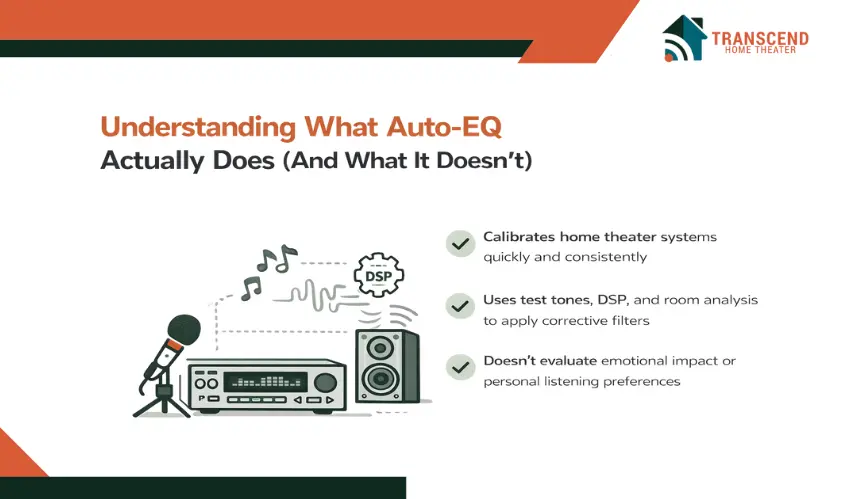
Auto-EQ systems are designed to solve a very specific problem: bringing a home theater system into a measurable state of balance as quickly and consistently as possible.
They use a calibration microphone, test tones, and built-in DSP logic to analyze how sound behaves in a room, then apply corrective filters to compensate for obvious issues. This process is efficient, repeatable, and helpful, but it operates within clearly defined technical boundaries.
How Auto-EQ Systems Analyze Your Room and Speakers
Auto calibration platforms such as Audyssey, Dirac Live, and Yamaha YPAO focus primarily on frequency response and basic time alignment.
The microphone captures test signals at one or multiple seating positions, and the system averages those measurements to determine speaker levels, distances, and EQ filters.
This approach assumes that smoothing response across several positions produces a balanced listening experience for most users.
From a technical standpoint, Auto-EQ excels at correcting large peaks, taming obvious resonances, and establishing consistent channel output. It ensures that no speaker is drastically louder than another and that major tonal imbalances are reduced.
What Auto-EQ Is Not Designed to Optimize
Auto-EQ does not evaluate sound the way human hearing does. It does not interpret emotional impact, spatial realism, or how bass energy feels during dynamic scenes. The algorithms also rely on averaged data, which can mask localized problems such as seat-specific bass nulls or subtle timing conflicts between subwoofers and main speakers.
Additionally, Auto-EQ applies generalized target curves intended to work for a wide audience. These curves may not align with personal listening preferences, room geometry, or content type.
Music-focused listeners, for example, may prefer a different tonal balance than what works best for cinematic playback. Because Auto-EQ prioritizes mathematical neutrality, it often overlooks these contextual and perceptual factors.
Manual Home Theater Audio Calibration Philosophy: Accuracy vs Preference
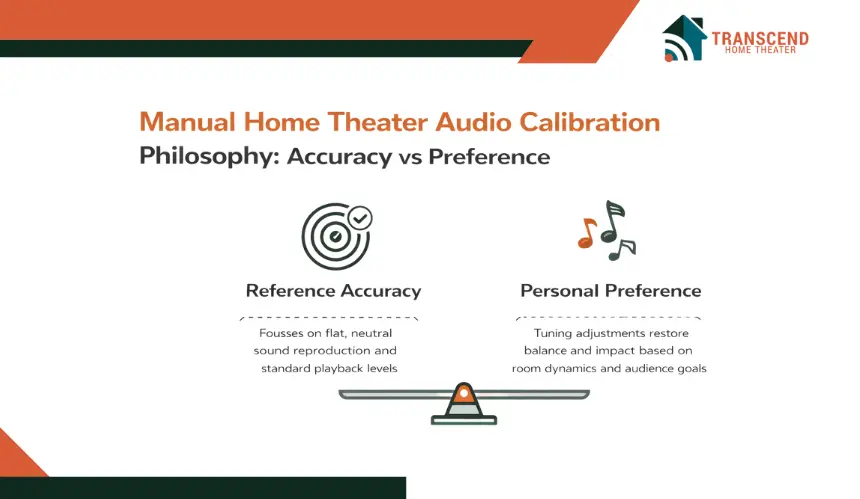
Manual calibration begins where automation ends in a home theater environment. Once Auto-EQ establishes a technical baseline, the next step is deciding what the system should sound like, not just what it can measure.
This transition shifts calibration from algorithm-driven correction to intentional sound shaping, where accuracy and personal listening expectations are balanced with purpose.
Why Reference Accuracy Alone Does Not Guarantee Better Home Theater Sound
Reference accuracy is built around neutral frequency response and standardized playback levels intended to preserve the original mix. In theory, this ensures faithful reproduction. In a real home theater system, however, room dimensions, seating distance, speaker layout, and surface reflections reshape how that reference is perceived.
Even systems aligned with established standards such as THX can sound restrained or emotionally distant when the room alters tonal balance or dynamic impact.
Human hearing prioritizes intelligibility, bass weight, and spatial continuity over mathematical flatness. When calibration focuses only on reference targets, dialogue may feel thin, surround effects may lack scale, and low-frequency energy may fail to deliver cinematic impact.
Preference-Based Tuning as a Controlled Refinement
Preference-based tuning does not reject accuracy. It refines it. The goal is to shape sound in a controlled way that respects the original mix while adapting it to the listening environment and usage patterns. Small tonal adjustments can restore body to dialogue, enhance low-frequency presence, or improve immersion without compromising clarity or balance.
In a home theater setting, these refinements directly affect how movies, streaming content, and live broadcasts are experienced. Systems focused on cinematic playback often benefit from added bass authority and midrange fullness, while mixed-use setups require careful balance to maintain consistency across different content types.
Balancing Measurement Data With Human Perception
Effective manual calibration treats measurement data as guidance rather than a final judgment. Frequency charts, SPL readings, and timing data identify structural issues, but listening determines whether changes enhance realism. This approach prevents overcorrection and preserves the natural character of speakers while respecting the acoustic limits of the room.
By establishing a clear calibration philosophy early, every manual adjustment that follows remains intentional. Instead of chasing perfect graphs, calibration decisions serve a defined listening goal, creating a home theater experience that feels cohesive, engaging, and emotionally convincing.
Step-by-Step Manual Home Theater Audio Calibration Workflow
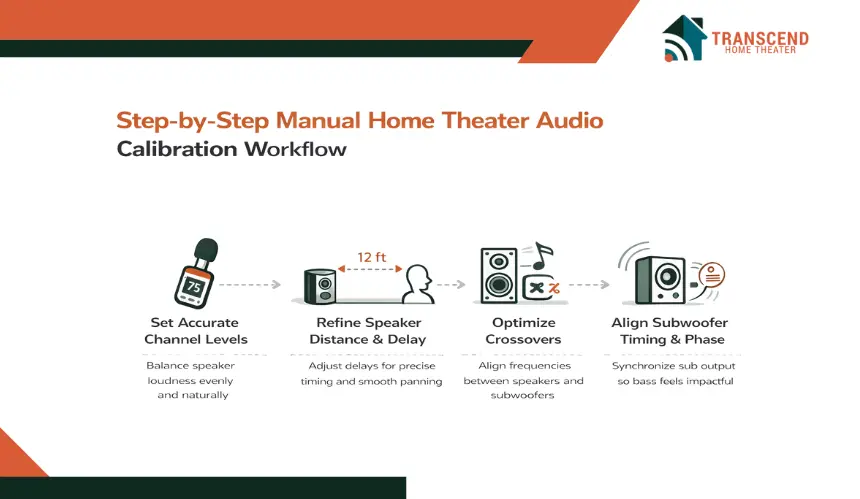
With a clear manual calibration philosophy in place, the next step is execution. Manual tuning works best when approached as a structured workflow rather than a series of isolated tweaks.
Each adjustment builds on the previous one, ensuring that changes improve system cohesion instead of creating new imbalances. In a home theater environment, this order matters because timing, level balance, and bass integration are tightly interconnected.
1. Setting Accurate Channel Levels for Balanced Playback
Channel level matching establishes a stable loudness foundation across all speakers. Manual level calibration ensures that dialogue, effects, and ambient sounds maintain consistent presence regardless of direction.
Even small level mismatches can cause center-channel dialogue to dominate or surround effects to feel disconnected from the front soundstage.
Using calibrated test tones and controlled listening levels, channel trims are adjusted so each speaker contributes evenly. This step focuses on perceived balance rather than raw output, allowing the soundstage to feel unified during both quiet scenes and dynamic sequences.
2. Refining Speaker Distance and Delay for Precise Timing
Speaker distance settings control when sound from each channel reaches the listening position. Auto-calculated distances often approximate physical placement, but manual verification improves timing accuracy. Small delay adjustments help align wavefront arrival, sharpening imaging and improving spatial coherence.
In a home theater system, accurate timing directly affects how smoothly sound pans across the room. Proper alignment ensures that movement feels continuous rather than fragmented, especially during fast-paced action scenes.
3. Optimizing Crossovers for Seamless Speaker Integration
Crossover configuration determines how low frequencies are shared between speakers and subwoofers. Auto-EQ frequently assigns crossover points based on measured extension rather than real-world performance. Manual crossover optimization accounts for speaker behavior at usable listening levels, not just test signals.
Adjusting crossover points helps prevent midbass congestion and reduces strain on smaller speakers. When configured correctly, transitions between speakers and subwoofers become inaudible, creating a more cohesive and natural presentation.
4. Aligning Subwoofer Timing and Phase With Main Speakers
Subwoofer integration is one of the most critical steps in manual calibration. Timing and phase alignment ensure that low-frequency energy reinforces rather than cancels output from the main speakers. Misalignment often results in weak impact or uneven bass response across seats.
Manual phase adjustment focuses on maximizing bass clarity and punch at the primary listening position. When properly aligned, bass feels tighter, more controlled, and better integrated into the overall soundstage rather than detached or overwhelming.
5. Confirming Changes Through Controlled Listening
After each adjustment, controlled listening verifies that changes improve realism rather than alter sound arbitrarily. Short listening sessions with familiar content help confirm balance, timing, and bass integration without introducing fatigue.
This step-by-step workflow prevents overcorrection and maintains logical progression. Each calibration stage prepares the system for the next, ensuring that manual tuning enhances the home theater experience in a measurable and audible way.
Manual EQ Adjustments: When and How to Use Them
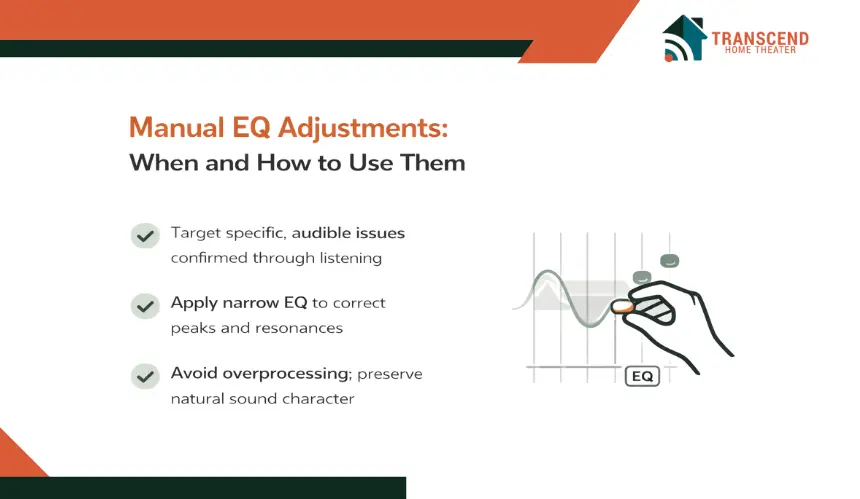
Once levels, timing, and integration are dialed in, equalization becomes a precision tool rather than a blunt fix. Manual EQ is not about reshaping the entire sound signature.
It is about addressing specific, audible issues that remain after structural calibration is complete. Used correctly, EQ refines clarity and balance in a home theater without stripping away dynamics or character.
Identifying Problems That EQ Can Actually Solve
Manual EQ is most effective when applied to narrow, repeatable issues that listening confirms. These often include localized resonances, mild tonal imbalances, or frequency buildups caused by room boundaries.
EQ works best on peaks rather than dips, since cancellations are usually caused by room geometry and cannot be corrected electronically.
Listening cues guide this step. Harshness in the upper midrange, bloated bass notes, or nasal dialogue often point to frequencies that benefit from controlled attenuation.
Measurement data helps locate those frequencies, but audible confirmation determines whether adjustment is warranted.
Applying Targeted Corrections Without Overprocessing
Effective EQ adjustments are small and deliberate. Narrow bandwidth filters with modest gain reduction preserve overall tonal integrity while resolving specific problems. Broad, aggressive EQ moves often flatten dynamics and reduce impact, especially in cinematic playback where contrast is essential.
In a home theater system, restraint is critical. EQ should support dialogue intelligibility, maintain surround consistency, and preserve low-frequency punch.
When adjustments begin to alter the character of voices or instruments, it is a sign that EQ is compensating for an issue better addressed through placement or timing.
Knowing When to Leave Frequencies Untouched
Not every irregularity requires correction. Slight response variations often contribute to a sense of space and realism. Chasing visual perfection on graphs can lead to lifeless sound that feels controlled but uninvolving.
Manual calibration prioritizes audible improvement over visual symmetry. If a frequency irregularity is not clearly audible during normal playback, it is usually best left alone. This approach protects the natural dynamics and emotional impact that make a home theater engaging.
Confirming EQ Changes Through Real Content
Final EQ validation happens through familiar material, not test tones alone. Dialogue-heavy scenes, dynamic action sequences, and music passages reveal whether adjustments improve coherence or introduce unintended coloration.
When manual EQ is used selectively and validated through listening, it becomes a powerful refinement tool. Instead of correcting everything, it corrects only what matters, completing the calibration process with precision rather than excess.
Measurement Tools That Enable Accurate Manual Calibration
Once levels, timing, crossovers, and integration are set, measurement tools help validate what cannot be fully judged by ear alone. Frequency response irregularities, bass decay issues, and timing anomalies often become clearer when visualized. This data-driven perspective helps distinguish between audible problems and harmless variations that do not require correction.
In a professional home theater design and installation, measurement tools are often used to fine-tune systems after physical layout decisions are complete. This ensures the system performs as intended within the constraints of the room.
1. Measurement Microphones and Analysis Software
Calibrated measurement microphones capture accurate room data across the audible spectrum. When paired with analysis software such as REW, they provide detailed views of frequency response, decay times, and impulse behavior. These insights help identify narrow resonances, bass buildup, and alignment inconsistencies that may not be obvious during casual listening.
The value of these tools lies in interpretation. The goal is not to achieve perfectly flat graphs, but to understand how the room and speakers interact so adjustments remain targeted and restrained.
2. SPL Meters and Level Verification Tools
Sound pressure level meters help confirm channel balance at reference listening volumes. Even small level discrepancies can alter dialogue focus or surround immersion.
SPL verification ensures that manual level adjustments translate accurately to real playback conditions rather than relying on relative loudness perception alone.
This step reinforces consistency, especially in multi-speaker environments where small imbalances can accumulate across channels.
3. Using Data to Support Listening Decisions
Measurement data should always be evaluated alongside listening tests. Graphs identify potential issues, but familiar content determines whether those issues affect realism or enjoyment. When data and listening agree, confidence in calibration decisions increases. When they conflict, listening takes priority.
By using measurement tools as confirmation rather than control, manual calibration remains grounded in real-world performance. This balanced approach ensures that refinements improve clarity, impact, and cohesion without drifting into overcorrection or unnecessary complexity.
If your system sounds good but still not right, it may be time to move beyond automation. Transcend Home Theater specializes in precision tuning that brings clarity, impact, and realism together in a way presets never can.
Frequently Asked Questions
Can manual calibration improve streaming audio quality, or does it mainly benefit Blu-ray and physical media?
Manual calibration improves streaming audio as well because it optimizes how compressed soundtracks interact with the room and speaker layout. Clearer dialogue, smoother bass transitions, and more stable surround placement help offset the limitations of streaming bitrates and dynamic range.
Does manual calibration change how loudly a home theater needs to be played to sound immersive?
Proper manual calibration often improves perceived impact at lower volumes. When timing, balance, and integration are correct, detail and spatial cues remain intact without needing excessive volume, making late-night or moderate listening more satisfying.
Is manual calibration useful in smaller living rooms, or only in dedicated theater spaces?
Manual calibration is often more noticeable in smaller rooms because space limitations exaggerate timing issues and bass buildup. Fine adjustments help compact environments sound controlled and immersive rather than congested or boomy.
Will manual calibration need to be redone after furniture changes or room updates?
Significant changes such as moving seating, adding large furniture, or altering wall coverings can affect acoustics. While a full recalibration is not always necessary, targeted rechecking ensures the system remains balanced after environmental changes.
Can manual calibration extend the usable lifespan of existing speakers and equipment?
Yes. Proper calibration reduces strain on speakers by improving integration and balance. This allows existing equipment to perform closer to its potential, often delaying the need for upgrades while improving overall listening satisfaction.