
Zigbee, Z-Wave, Thread & Wi-Fi 6: Choosing the Best Communication Protocol for Your Smart Devices
A Quick Overview: Zigbee is an open-source, low-power mesh protocol that connects a wide range of sensors, bulbs, and switches across short to medium distances. |
Choosing the right protocol determines how well your smart ecosystem performs, from automation speed and energy consumption to overall network stability. This guide explores how each of these standards operates, compares their strengths and limitations, and helps readers decide which one best fits their home automation goals.
What Is a Smart Home Communication Protocol?
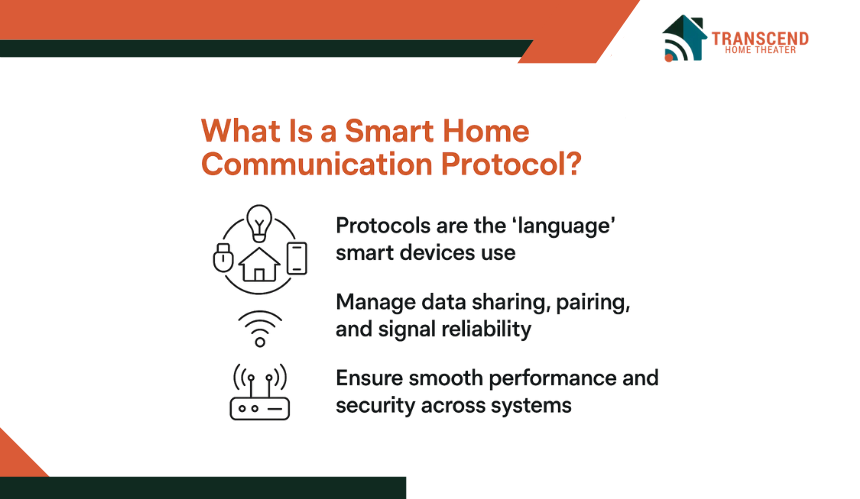
A smart home communication protocol defines the language that connected devices use to share data with one another or through a hub. It sets the rules for how signals are transmitted, received, and acknowledged across the network.
In simple terms, these protocols are the backbone of IoT communication, deciding whether your motion sensor can instantly trigger your lights or your smart lock can respond without delay.
They handle signal routing, data encryption, device pairing, and interference management, ensuring consistent performance even when dozens of gadgets are connected.
When designed or configured by a smart home automation company, these communication standards can be optimized for better responsiveness, security, and long-term reliability across complex device networks.
Why Protocol Choice Matters for Performance and Compatibility in Smart Homes
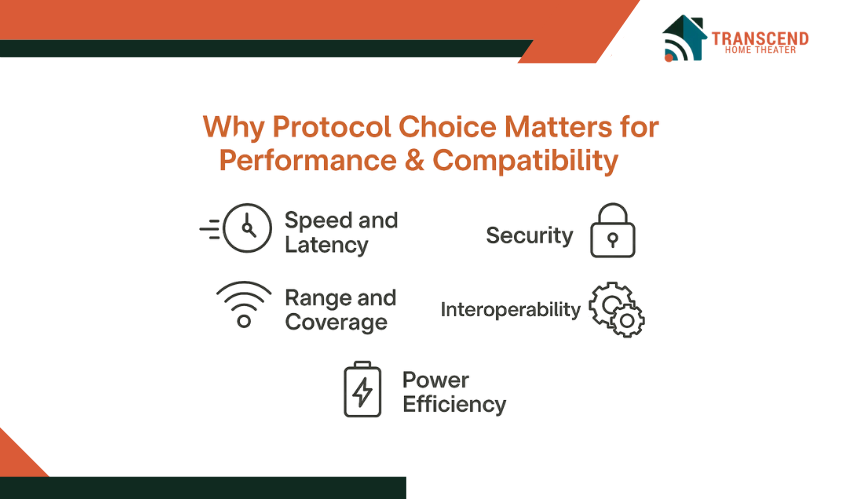
Not all smart devices communicate the same way, and that’s where protocol selection becomes critical. The protocol you choose affects several key performance metrics:
- Speed and Latency: Determines how quickly commands are processed across devices.
- Range and Coverage: Impacts signal reach, especially in multi-room or multi-floor homes.
- Power Efficiency: Influences how long sensors or battery-powered devices can operate without recharging.
- Security: Governs the encryption and authentication methods used for safe communication.
- Interoperability: Decides whether devices from different brands can coexist under one smart ecosystem.
For instance, Zigbee and Z-Wave excel in low-power mesh communication, while Wi-Fi 6 focuses on high-bandwidth transmission for streaming and real-time monitoring.
Deep Dive into Each Smart Home Protocol
Each communication protocol follows its own logic for transmitting data, optimizing performance, and maintaining stability. Understanding how they differ helps identify which one aligns best with your home’s layout, device count, and automation goals.
Zigbee: The Open and Energy-Efficient Mesh Standard
Zigbee operates on the 2.4 GHz frequency band and connects multiple devices through a mesh network that reroutes data automatically if a single node fails. It’s commonly used in smart bulbs, plugs, and environmental sensors due to its low-power consumption and strong support from major brands like Philips Hue, IKEA, and Amazon Echo.
Zigbee’s strength lies in scalability and energy efficiency. It allows hundreds of devices to communicate simultaneously without requiring a powerful hub. However, because it shares the 2.4 GHz spectrum with Wi-Fi and Bluetooth, signal interference can occasionally occur in crowded wireless environments.
Z-Wave: Secure Connectivity for Reliable Home Automation
Z-Wave runs on a sub-GHz frequency, avoiding congestion from Wi-Fi networks. It’s favored for smart locks, security systems, and structured automation setups because of its robust signal penetration through walls and its consistent communication range.
Unlike open-source protocols, Z-Wave is proprietary, meaning devices must be certified for compatibility. This ensures predictable performance and encrypted connections across different brands.
Newer versions such as Z-Wave Plus offer extended range and lower latency, making it ideal for users who value stability and security in their automation routines.
Thread: The IP-Based Framework for Modern Smart Homes
Thread introduces a new generation of smart home networking built on IPv6. It uses a self-healing mesh that allows devices to communicate directly without relying on a central hub. Each node acts as both a transmitter and receiver, improving reliability while keeping energy demands low.
Thread’s main advantage is its native compatibility with the Matter protocol, which promotes cross-brand interoperability. It enables faster response times for sensors and lighting controls, particularly in systems where multiple vendors’ products coexist. This makes Thread one of the most future-ready communication standards for connected living spaces.
Wi-Fi 6: The High-Bandwidth Standard for Data-Intensive Devices
Wi-Fi 6, also known as 802.11ax, brings higher data throughput and greater efficiency to smart homes that rely on streaming and real-time monitoring. It supports numerous connections simultaneously using technologies like OFDMA and MU-MIMO, reducing lag even when many devices share the same network.
While Wi-Fi 6 consumes more power than Zigbee, Z-Wave, or Thread, it’s the preferred option for smart cameras, voice assistants, and media hubs that transmit large volumes of data. Its improved spectral efficiency and enhanced security protocols (WPA3) make it suitable for bandwidth-heavy environments where speed and reliability take priority.
Comparative Overview: How Smart Home Protocols Compare
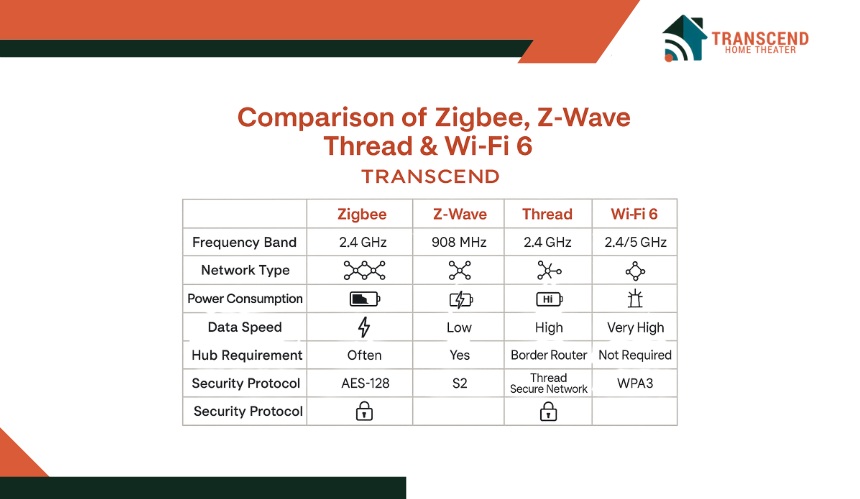
The following table offers a clear side-by-side comparison of Zigbee, Z-Wave, Thread, and Wi-Fi 6, outlining their operational frequency, network type, power needs, and ideal applications. It helps visualize which protocol aligns best with different smart home priorities.
Feature / Protocol | Zigbee | Z-Wave | Thread | Wi-Fi 6 |
Frequency Band | 2.4 GHz | 908 GHz | 2.4 GHz | 2.4 / 5 GHz |
Network Type | Mesh | Mesh | Mesh (IPv6-based) | Star |
Power Consumption | Low | Low | Low | High |
Data Speed | Moderate | Moderate | High | Very High |
Range | Up to 100 ft | Up to 300 ft | Up to 100 ft | Varies by router |
Hub Requirement | Often | Yes | Border Router | Not Required |
Security Protocol | AES-128 Encryption | S2 Encryption | Thread Secure Network | WPA3 |
Scalability | High | Moderate | High | Limited by bandwidth |
Interface Level | Moderate | Very Low | Low | Variable |
Ecosystem Type | Open | Proprietary | Open | Open |
Real-World Applications of Zigbee, Z-Wave, Thread, and Wi-Fi 6
Each protocol plays a distinct role in shaping how smart devices operate in daily environments. The effectiveness of a communication standard often depends on its use case, rather than just its technical specifications. Below are examples that show how each protocol performs in real-life applications.
1. Zigbee in Everyday Automation
Zigbee is most effective in dense device networks such as lighting systems, motion sensors, and smart switches. For example, homeowners using Philips Hue bulbs or Echo smart hubs benefit from seamless coordination between multiple lights and switches through Zigbee’s self-managing mesh. The protocol’s minimal power draw makes it suitable for continuous background automation.
2. Z-Wave in Home Security and Access Control
Z-Wave’s long-range, interference-free signal makes it ideal for security-focused automation. Many smart locks, alarms, and garage sensors use Z-Wave because its sub-GHz operation ensures reliable communication even through walls or concrete. Systems like Ring Alarm and SmartThings hubs utilize Z-Wave to maintain stable, encrypted connections without data loss.
3. Thread in Modern Matter-Compatible Homes
Thread stands out in newer Matter-enabled smart homes where interoperability is crucial. It supports multi-brand ecosystems where devices from Apple, Google, and Samsung work together through Matter’s unified framework.
This makes Thread especially useful for users upgrading to next-generation smart ecosystems that require quick response times and local control without relying on the cloud.
4. Wi-Fi 6 in High-Bandwidth Smart Environments
Wi-Fi 6 dominates setups involving real-time video, audio streaming, and remote monitoring. Smart cameras, voice assistants, and smart TVs rely on its high throughput to transmit large data volumes without lag. It’s also widely used for connecting hubs and routers that manage multiple devices through cloud platforms or voice assistants.
Choosing the Right Protocol for Your Smart Home Setup
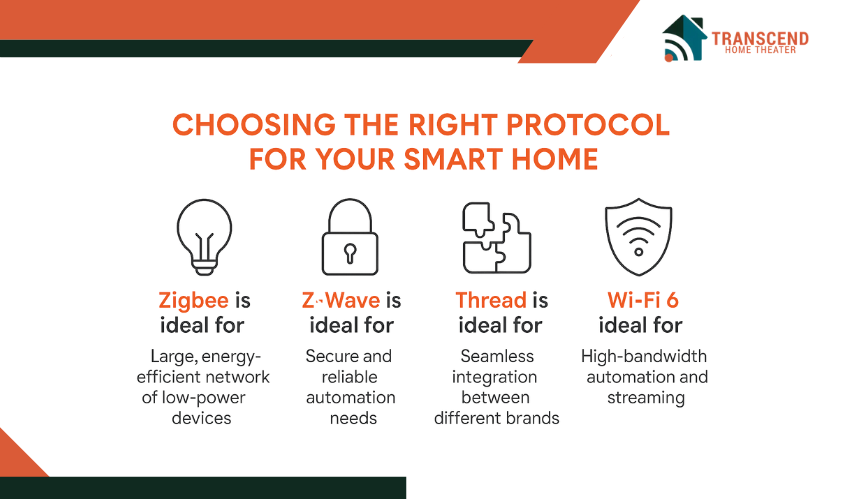
Selecting the best protocol comes down to identifying the main purpose of your connected ecosystem. Each standard serves a specific function, and the right choice depends on what you prioritize, efficiency, security, or performance.
- Choose Zigbee if you want to build a large, energy-efficient network of low-power devices such as lights, sensors, and switches that can run for months without maintenance.
- Choose Z-Wave if your focus is on security and reliability, especially for smart locks, alarms, or any system that must remain responsive in every condition.
- Choose Thread if you are creating a Matter-compatible home and want seamless integration between products from different brands without depending on cloud servers.
- Choose Wi-Fi 6 if you rely on high-bandwidth automation, such as smart cameras, displays, or voice assistants that demand fast and stable connections.
When used strategically, these protocols can also complement each other. For instance, combining Thread or Zigbee for low-power devices with Wi-Fi 6 for bandwidth-heavy ones creates a balanced, high-performing ecosystem.
Whether you’re upgrading to Matter-compatible devices or refining your existing network, the right communication protocol makes all the difference. For expert setup, seamless integration, and customized automation design, connect with Transcend Home Theater, your trusted partner in building intelligent, future-ready smart home environments.
Frequently Asked Questions
Can I use multiple smart home protocols in the same system?
Yes. Many modern smart hubs and bridges support multi-protocol integration, allowing Zigbee, Z-Wave, Thread, and Wi-Fi 6 devices to operate together. This hybrid setup ensures broader compatibility and improved network resilience without needing separate control apps.
Do Matter-certified devices replace older Zigbee or Z-Wave products?
No. Matter doesn’t replace earlier standards; instead, it provides a unified framework that allows them to coexist more efficiently. Devices built on Zigbee or Z-Wave can still function alongside Matter-enabled ones if connected through compatible hubs or bridges.
What’s the difference between Thread and Bluetooth in smart homes?
While Bluetooth is used for short-range pairing and temporary connections, Thread creates a continuous, low-power mesh network where devices communicate independently of a hub or phone. This makes Thread more reliable for automation that runs 24/7.
Are Wi-Fi 6 and Wi-Fi 6E the same for smart home use?
Both share the same core technology, but Wi-Fi 6E operates in the 6 GHz band, offering more bandwidth and less interference. It’s ideal for homes with numerous data-heavy devices like smart TVs, cameras, and voice assistants that require ultra-low latency.
How can I tell if a device supports Thread or Matter?
Look for the “Matter” or “Thread” certification logo on the product box or technical specifications. Many manufacturers also mention this on their websites under device compatibility. Newer hubs from Apple, Google, and Amazon already include Thread Border Router support.
What happens if my smart home router loses internet connection?
Protocols like Zigbee, Z-Wave, and Thread continue working locally even when the internet is down. Devices still communicate through their mesh network, allowing automations like lighting or door sensors to operate without cloud dependency.