
Key Takeaways
|
Ceiling Acoustics for Dolby Atmos: Reflection, Absorption & Diffusion Explained

Dolby Atmos has changed how people experience sound by adding a true vertical dimension to audio. Sounds no longer move only around the listener. They move above, across, and through the room in a way that feels lifelike and precise. This shift makes the ceiling an active acoustic surface rather than a neutral boundary.
Many Atmos setups focus heavily on speaker placement while overlooking how sound behaves once it reaches the ceiling. Reflections, absorption, and diffusion at this level directly influence height perception, object movement, and overall immersion. When ceiling acoustics are ignored, even well-placed height speakers can lose clarity and impact.
This article explains how ceiling acoustics work in Dolby Atmos environments and why controlling reflection, absorption, and diffusion is essential for accurate and emotionally engaging spatial audio.
Why Ceiling Acoustics Matter in Dolby Atmos Systems
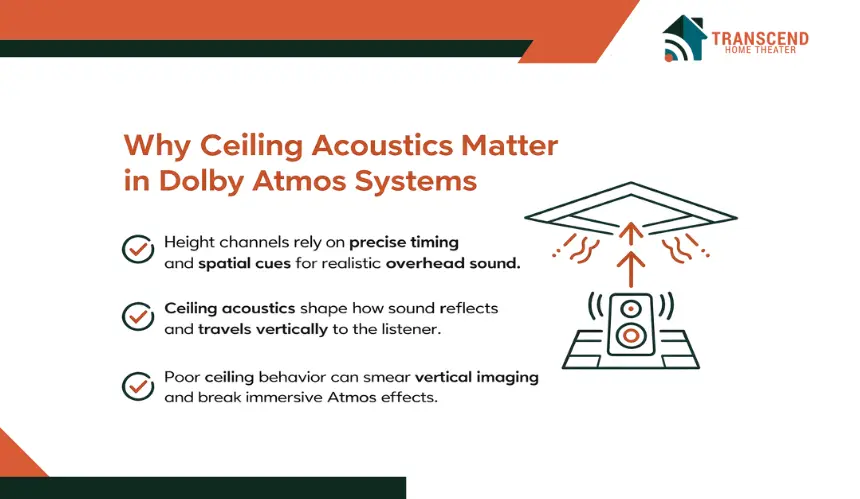
Dolby Atmos relies on precise timing and spatial cues to convince the listener that sound exists above the listening position. Unlike traditional surround formats, height channels are not meant to feel ambient or vague.
They are designed to deliver clearly localized audio objects that move vertically with intention. The ceiling becomes the first surface these sounds interact with, which makes its acoustic behavior critical.
How Does the Ceiling Influence Height Channel Perception?
Height speakers send sound upward or downward toward the ceiling plane depending on the installation method. When that sound reflects too aggressively or unevenly, the listener may perceive objects as smeared, misplaced, or less convincing. Accurate overhead imaging depends on controlled reflection timing so that direct sound remains dominant.
Ceiling acoustics also affect how smoothly sound transitions between front, side, and overhead positions. Poor control can break these transitions, making Atmos effects feel disconnected rather than continuous.
A well-managed ceiling supports consistent vertical imaging, allowing sound objects to move naturally through three-dimensional space.
Why Vertical Sound Requires Different Acoustic Control Than Walls
Wall acoustics primarily influence lateral imaging and envelopment. Ceiling acoustics, on the other hand, shape vertical localization and depth perception. The human ear is more sensitive to timing differences above the head, which means small acoustic inconsistencies at the ceiling can produce noticeable errors in perceived height.
Because of this sensitivity, ceiling treatment is not about making the room quieter. It is about managing how sound energy behaves immediately after leaving height speakers.
When handled correctly, the ceiling helps maintain clarity, realism, and emotional impact in immersive audio playback without overpowering or dulling the soundstage.
Understanding Sound Interaction at the Ceiling Plane
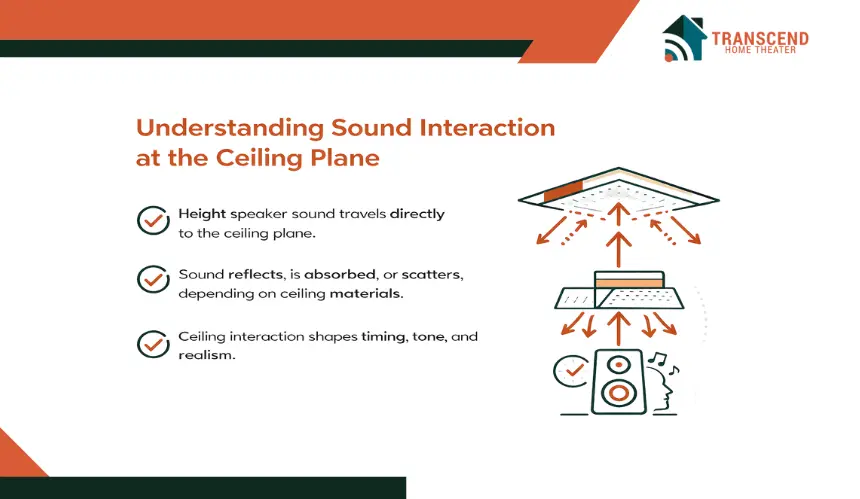
Once sound leaves a height speaker, its job is not finished. Before the listener perceives it as an overhead event, the sound interacts with the ceiling surface in ways that shape timing, tone, and spatial accuracy. This interaction happens quickly and often goes unnoticed, yet it determines whether Atmos effects feel believable or slightly off.
At this stage, the goal is not treatment or correction. It is understanding the physical behavior of sound at the ceiling so later decisions about reflection control, absorption, or diffusion are based on cause rather than guesswork.
What Happens When Height Speaker Sound Reaches the Ceiling?
Sound from height channels travels upward and meets the ceiling at short distances compared to wall reflections. When it hits the surface, part of the energy reflects back into the room while part may be absorbed or scattered depending on the material. The reflected portion often reaches the listener milliseconds after the direct sound.
These early reflections blend with the original signal. If they arrive too strong or too soon, they can alter perceived direction and soften object definition. This is especially noticeable with moving Atmos objects such as rain, aircraft, or vertical pans where timing accuracy is essential.
How Reflection Timing Affects Spatial Accuracy
The brain uses very small timing differences to determine where a sound originates in three-dimensional space. At the ceiling, early reflections arrive within a narrow time window that strongly influences vertical localization. Even slight delays or level changes can make overhead sounds feel lower, wider, or less precise.
This is why ceiling acoustics cannot be treated like a background concern. Reflection timing at the ceiling directly affects how accurately the listener tracks sound objects above them. Controlled timing supports realism, while uncontrolled timing introduces spatial ambiguity.
Why Ceiling Materials Change Acoustic Behavior
Different ceiling materials respond differently to incoming sound energy. Drywall tends to reflect a broad range of frequencies, while textured surfaces, wood panels, or suspended ceilings alter reflection strength and frequency balance.
These variations change how much detail returns to the listening position and which frequencies dominate the reflection.
Material behavior at the ceiling shapes tonal balance before any intentional acoustic treatment is added. Understanding this baseline interaction helps explain why two Atmos rooms with identical speaker layouts can sound dramatically different even before acoustic panels or diffusers are introduced.
Ceiling Reflection in Dolby Atmos Rooms
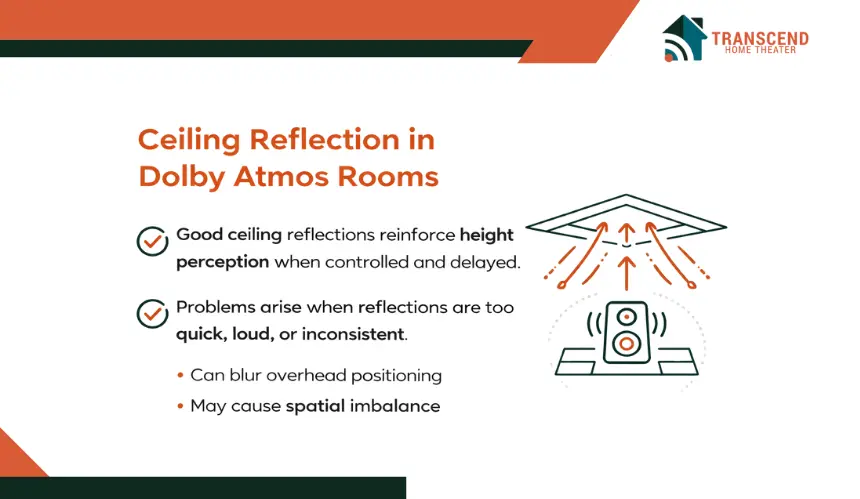
Ceiling reflections are not automatically a problem in immersive audio rooms. In fact, controlled reflection plays a role in making overhead sound feel present and enveloping. Issues arise only when reflections overpower the direct signal or arrive in an uncontrolled pattern that interferes with spatial cues.
When Do Ceiling Reflections Support Immersive Audio?
A ceiling reflection can reinforce overhead sound when it arrives slightly after the direct signal and at a balanced level. This subtle reinforcement helps the brain perceive height without sounding harsh or disconnected.
In larger rooms, these reflections can contribute to a sense of scale, making Atmos effects feel expansive rather than confined to the speaker location.
Reflections become supportive when they are symmetrical, predictable, and consistent across the listening area. This consistency helps maintain stable object placement and prevents sound from pulling toward one side or collapsing toward the ceiling plane.
When Do Ceiling Reflections Become a Problem?
Problems begin when reflections arrive too quickly or too loudly. Early reflections that closely match the direct sound can blur localization, making overhead objects feel smeared or undefined. Instead of hearing a precise point above, the listener perceives a vague area of sound.
Uneven ceiling reflections also introduce imbalance. Differences in ceiling height, surface texture, or mounting angles can cause reflections to vary from one channel to another. This inconsistency disrupts object tracking and weakens the illusion of smooth vertical movement.
How Ceiling Height and Surface Type Influence Reflection Behavior
Ceiling height plays a major role in reflection timing. Lower ceilings shorten the reflection path, increasing the chance that reflected sound interferes with direct audio. Higher ceilings extend this path, allowing reflections to arrive later and feel less intrusive.
Surface type shapes how much energy is reflected and which frequencies dominate. Hard, flat surfaces tend to reflect sound evenly across mid and high frequencies, while textured or layered surfaces soften reflections and alter tonal balance.
These factors determine whether ceiling reflections enhance immersion or introduce clarity issues that must be addressed later through targeted treatment.
Ceiling Absorption: Controlling Vertical Clarity
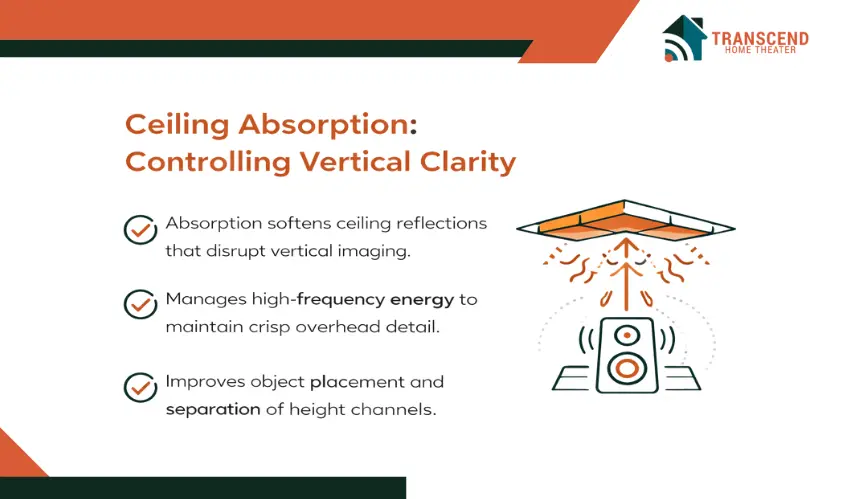
In many Dolby Atmos rooms, clarity issues do not come from the speakers themselves but from excessive sound energy returning from the ceiling too quickly. Ceiling absorption addresses this problem by reducing the strength of early reflections that interfere with precise overhead imaging. The goal is not to mute the room, but to give height channels enough acoustic space to remain intelligible and directional.
This need becomes especially noticeable in real-world residential environments, including many homes across Virginia, where dedicated theater rooms are often built into basements, bonus rooms, or finished attics with relatively low ceiling heights.
What Problems Does Ceiling Absorption Actually Solve?
Ceiling absorption primarily reduces early reflection energy that competes with the direct output of height speakers. When reflections are softened, the listener perceives cleaner object placement and improved separation between overlapping sounds. Overhead effects such as rainfall, helicopters, or ambient city noise gain definition instead of blending into a diffuse wash.
Absorption also helps stabilize vertical imaging across multiple seating positions. Without it, listeners seated slightly off-axis may experience inconsistent height perception, where overhead sounds appear to drift or lose focus depending on where they sit.
Which Frequencies Are Typically Managed at the Ceiling?
Most ceiling absorption targets mid and high frequencies, as these are the ranges most responsible for localization and clarity. High-frequency reflections are particularly influential in how sharply the brain identifies sound direction above the listener. Reducing excessive energy in this range helps maintain crisp overhead detail without dulling the overall soundstage.
Low-frequency absorption is rarely a primary ceiling concern in Atmos rooms. Bass energy behaves differently and is usually addressed through wall placement and room-wide strategies rather than ceiling-focused solutions.
Why Ceiling Absorption Must Be Used Selectively
Overusing absorption at the ceiling can flatten the soundstage and reduce the sense of height that Atmos is designed to create. This is why absorption should be applied strategically rather than uniformly. In regions with dense suburban housing, such as Northern Virginia, rooms often have shared structural constraints that already limit acoustic openness.
Selective absorption preserves immersion while correcting clarity issues. When applied thoughtfully, it allows height channels to remain vivid and emotionally engaging without introducing harsh reflections or spatial confusion.
Ceiling Diffusion: Preserving Space Without Smearing Sound
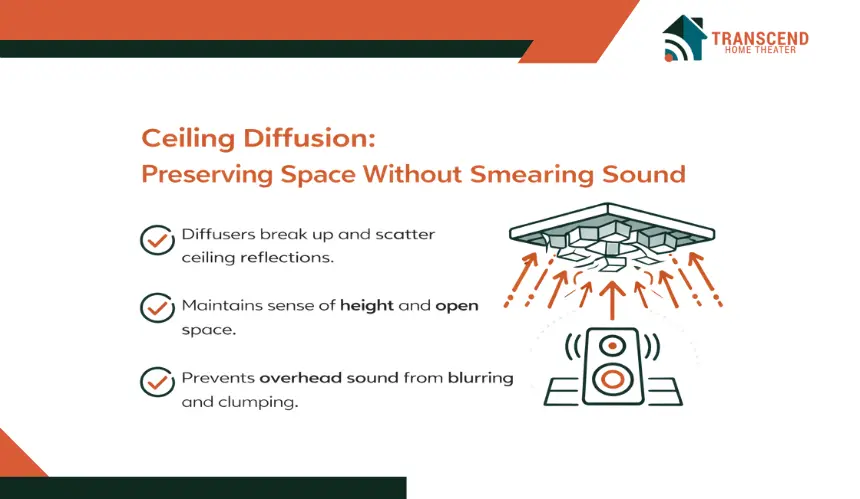
Not every Dolby Atmos room benefits from heavy absorption at the ceiling. In spaces where maintaining a sense of openness and scale matters, diffusion offers a different way to manage sound without stripping energy from the room. Instead of reducing reflections, diffusion reshapes how those reflections return to the listener.
When Is Ceiling Diffusion a Better Choice Than Absorption?
Ceiling diffusion becomes valuable in rooms where reflections are not inherently damaging but need to be redistributed. Larger rooms, taller ceilings, and multi-row seating layouts often fall into this category. In these environments, removing too much reflected energy can make overhead effects feel narrow or detached from the rest of the sound field.
Diffusion allows reflected sound to remain present while preventing it from arriving as a single, dominant echo. By scattering sound in multiple directions, diffusers reduce directional bias and help maintain a sense of height and space without overwhelming the listener.
How Diffusion Affects Atmos Height and Envelopment
Diffusers break up sound waves and return them to the room at varied angles and timing intervals. This scattering effect helps overhead audio feel broader and more natural, especially for ambient Atmos objects that are meant to surround rather than pinpoint.
Instead of hearing a sharp reflection from a specific ceiling location, the listener perceives a smoother, more enveloping overhead layer. This supports emotional immersion, allowing effects like wind, crowd ambience, or environmental textures to feel continuous and believable.
What Types of Ceiling Diffusion Are Commonly Used?
Ceiling diffusion typically relies on structured surface geometry rather than soft materials. Designs such as stepped panels or mathematically calculated diffuser patterns are used to scatter sound predictably across mid and high frequencies. The effectiveness depends on depth, placement, and ceiling height rather than sheer coverage.
Diffusion is most effective when applied with intent, not as decoration. When placed correctly, it complements the direct output of height speakers and preserves spatial complexity without introducing the clarity issues associated with uncontrolled reflections.
Common Ceiling Acoustic Mistakes in Dolby Atmos Setups
Even thoughtfully built Dolby Atmos rooms can fall short when ceiling acoustics are treated as an afterthought. These issues appear often in residential media spaces across Virginia, especially in finished basements, bonus rooms above garages, and older homes where ceiling height and structure impose natural acoustic limits.
- Over-absorbing the ceiling surface: Applying too much absorption can strip overhead effects of depth, making Atmos height channels feel flat rather than immersive.
- Applying wall-treatment logic to the ceiling: Ceiling reflections behave differently than wall reflections, and using the same approach often leads to timing conflicts that weaken vertical localization.
- Ignoring symmetry and ceiling geometry: Sloped ceilings, exposed beams, or uneven panel placement can introduce imbalance, causing overhead objects to shift or lose stability.
- Using decorative elements without acoustic purpose: Coffered ceilings or wood accents common in Virginia homes can unintentionally reflect sound in unpredictable ways if acoustic behavior is not considered.
- Delaying acoustic planning until after installation: Working with a home theater design and installation company in Virginia can help identify ceiling-related issues early, especially in region-specific room layouts where retrofitting treatments later becomes more complex and costly.
These mistakes tend to surface over time as content becomes more dynamic, gradually reducing the realism and emotional impact that immersive audio is meant to deliver.
If your Dolby Atmos system feels impressive but not fully immersive, the ceiling is often where performance is won or lost. Working with specialists who understand how overhead sound behaves can completely reshape the experience.
Transcend Home Theater helps homeowners across Virginia and Maryland design ceiling acoustics that support precise height imaging, smooth object movement, and true cinematic immersion.
Frequently Asked Questions
Do in-ceiling speakers require different acoustic planning than up-firing Atmos modules?
Yes, in-ceiling speakers interact directly with the ceiling surface at very short distances, which makes acoustic precision more critical. Planning must account for mounting depth, ceiling cavity behavior, and reflection timing, while up-firing modules rely more on ceiling consistency and surface predictability.
Can ceiling lighting and architectural features affect Dolby Atmos performance?
Absolutely. Recessed lighting, coffers, beams, and HVAC vents can alter reflection paths and scatter sound unevenly. These features often create unintended acoustic hotspots or dead zones that impact overhead object movement if not accounted for during design.
Is ceiling acoustic treatment necessary for mixed-use living rooms with Atmos?
Yes, but it must be subtle and selective. Mixed-use spaces require treatments that preserve aesthetics while managing early reflections. Solutions often prioritize targeted zones rather than full coverage to maintain both visual appeal and immersive sound performance.
How does ceiling acoustics impact dialogue clarity in Atmos movies?
Dialogue itself rarely comes from height channels, but ceiling behavior affects how clearly dialogue separates from overhead effects. Poor ceiling control can cause ambient Atmos sounds to mask speech, reducing intelligibility during complex scenes.
Should ceiling acoustics be planned before or after room calibration?
Ceiling acoustics should be addressed before electronic calibration. Room correction systems can adjust levels and timing, but they cannot fix physical reflection problems. Proper ceiling behavior allows calibration tools to work accurately instead of compensating for avoidable acoustic flaws.