
Dolby Atmos, DTS:X, IMAX Enhanced: What Content Actually Supports Them?
Key Takeaways
|

Logos and badges are everywhere. A streaming app shows “Dolby Atmos.” A 4K Blu-ray case highlights “DTS:X.” A TV menu promotes “IMAX Enhanced.” Yet once playback starts, many viewers wonder whether they are truly hearing object-based immersive audio or just standard surround sound.
This guide answers the real question behind the marketing labels: what content actually supports Dolby Atmos, DTS:X, and IMAX Enhanced, and under what conditions does that support fully activate?
Understanding the Three Formats Without the Marketing Noise
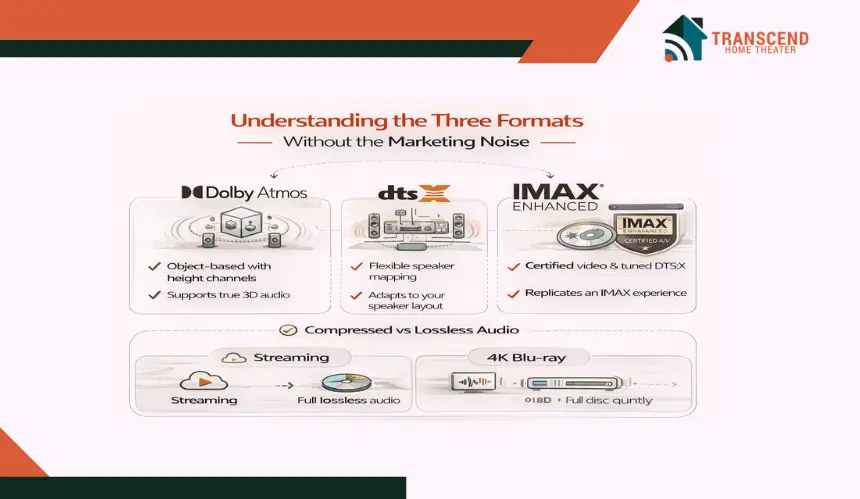
Before evaluating which movies or platforms support these formats, it helps to clearly understand what each one actually represents. Dolby Atmos, DTS:X, and IMAX Enhanced are not interchangeable labels.
They are built on different audio frameworks, certification standards, and delivery methods. Clarifying these differences prevents confusion later when comparing content libraries.
What Does Dolby Atmos Actually Add Beyond 5.1 and 7.1?
Dolby Atmos, developed by Dolby Laboratories, introduced object-based sound to mainstream cinema and home theater systems. Traditional surround formats such as 5.1 and 7.1 assign audio to fixed channels.
Atmos instead treats certain elements, like dialogue, helicopters, or rainfall, as independent audio objects that can move within a three-dimensional space. This enables height channel audio and overhead effects when ceiling speakers or upward-firing modules are present.
In home environments, Dolby Atmos is delivered in two primary ways. Streaming platforms typically use Dolby Digital Plus with Atmos metadata, which compresses the signal to fit bandwidth limitations.
Ultra HD Blu-ray discs often use Dolby TrueHD, a lossless codec that preserves higher dynamic range and fine detail. The difference between compressed streaming Atmos and lossless disc-based Atmos directly affects clarity, separation, and low-frequency impact.
The presence of the Atmos logo alone does not guarantee full performance. True immersive spatial rendering depends on codec quality, AV receiver decoding capability, and proper speaker configuration.
How Does DTS:X Differ in Encoding and Playback Flexibility?
DTS:X, created by DTS Inc., also uses object-based audio but emphasizes playback flexibility. Instead of requiring a strict speaker layout, DTS:X adapts to the system’s configuration. A compatible AV receiver dynamically maps audio objects to available speakers, making it channel-agnostic in practice.
Most DTS:X soundtracks are found on 4K Blu-ray discs and are built on DTS-HD Master Audio, a lossless format known for high bitrate delivery and strong dynamic contrast. Because streaming services prioritize compressed audio formats, DTS:X appears far less frequently on platforms like Netflix or Disney+.
For enthusiasts who prioritize bitstream output and lossless decoding, DTS:X remains closely associated with physical media playback. Its ecosystem is smaller than Dolby Atmos in streaming environments, but it is well respected in disc-based home theater setups.
What Does IMAX Enhanced Really Certify?
IMAX Enhanced is not simply an audio codec. It is a certification program developed with IMAX Corporation in collaboration with DTS. It combines video processing standards with a specially tuned DTS:X mix to replicate aspects of the IMAX theatrical experience at home.
On the video side, selected titles undergo IMAX Digital Media Remastering, which improves clarity and contrast while enabling expanded aspect ratios up to 1.90:1 in certain scenes.
On the audio side, the DTS:X track is optimized for greater dynamic range and impact. Compatible displays, AV receivers, and playback devices must meet IMAX certification requirements to activate IMAX mode.
Unlike Dolby Atmos, which is widely adopted across streaming and disc formats, IMAX Enhanced applies only to curated titles that have been specifically remastered and approved. Its value lies in combined picture and sound enhancement rather than broad catalog availability.
What Types of Content Actually Support Each Format?
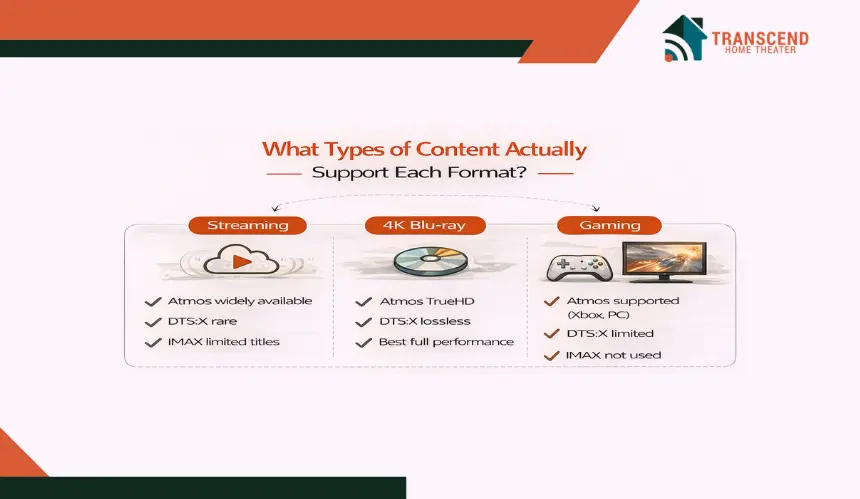
Understanding the technology is only part of the equation. The real concern for most viewers is simple: where can these formats actually be experienced in real content? Support varies significantly between streaming platforms, physical media, and gaming ecosystems. Each environment delivers different codec versions, bitrates, and levels of immersion.
Streaming Content Support (Netflix, Disney+, Prime Video, Apple TV+)
Streaming is where most viewers encounter Dolby Atmos today. Platforms such as Netflix, Disney+, Amazon Prime Video, and Apple TV+ offer a growing catalog of titles labeled with Atmos support.
However, nearly all streaming Atmos content is delivered using Dolby Digital Plus with Atmos metadata. This is a compressed format. It still provides immersive object-based audio, but it does not match the bitrate or dynamic range of lossless versions found on physical media.
DTS:X content is extremely rare on major streaming services. Most platforms do not distribute DTS-based immersive tracks at all. If a viewer is relying purely on streaming, DTS:X availability will be minimal.
IMAX Enhanced support exists in a limited, curated way. On Disney+, certain titles include expanded aspect ratio scenes and enhanced DTS-based audio mixes. The number of supported films remains selective rather than widespread.
For streaming users, Dolby Atmos has the broadest real-world support. DTS:X is largely absent. IMAX Enhanced appears only on specific titles.
4K Blu-ray and Physical Media Support
Physical media remains the most reliable source for full-format immersive audio. Ultra HD Blu-ray discs commonly include Dolby TrueHD with Atmos or DTS-HD Master Audio with DTS:X. Both are lossless formats, preserving full audio resolution without streaming compression.
Many major studio releases on 4K Blu-ray offer at least one immersive format. Some discs include Dolby Atmos, others include DTS:X, and occasionally both appear across different editions. This makes physical media the strongest environment for DTS:X support in particular.
IMAX Enhanced titles are also available on select 4K Blu-ray releases. These editions combine IMAX Digital Media Remastering for video with a DTS:X-based IMAX audio mix. The catalog is smaller than standard Atmos releases but consistent within participating studios.
For viewers seeking the most complete format support, physical media offers the highest consistency for both Dolby Atmos and DTS:X.
Gaming Support (Console & PC)
Gaming support is more selective and depends on the platform. On the Xbox Series X, certain titles are natively mixed for Dolby Atmos. In addition, the console can output system-level spatial audio for compatible games.
On PC, supported games can deliver Dolby Atmos through licensed software integration. Adoption varies by developer.
The PlayStation 5 primarily uses its own 3D audio system, though it can output immersive audio to compatible AV receivers. Native DTS:X support in gaming remains limited compared to Dolby Atmos.
IMAX Enhanced does not apply to gaming content. It is focused on film and cinematic playback.
In gaming, Dolby Atmos currently has meaningful support. DTS:X is rare. IMAX Enhanced is not part of the gaming ecosystem.
Why Some “Atmos” or “DTS:X” Labels Don’t Deliver Full Performance
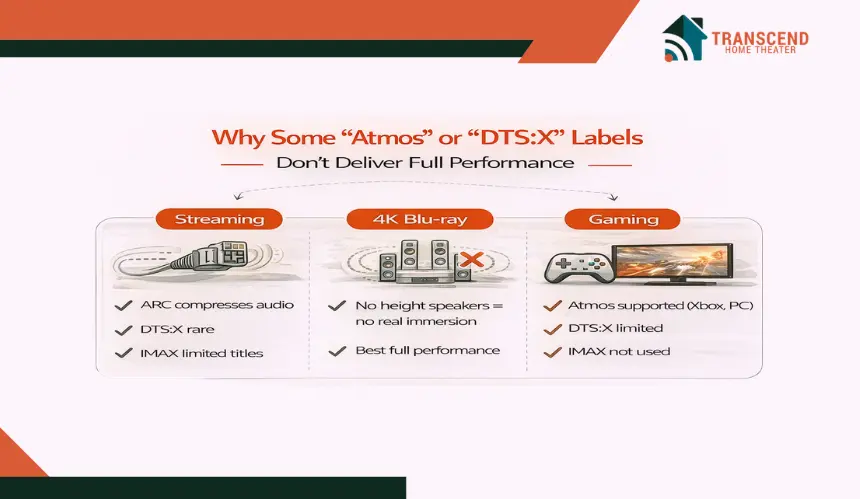
Seeing an Atmos or DTS:X badge creates an expectation. Viewers expect overhead effects, precise object movement, and cinematic depth. Yet many systems output standard surround sound instead. The issue is rarely the movie itself. It usually comes down to signal delivery and playback conditions.
Hardware Limitations That Downscale Audio
Many televisions and soundbars advertise Dolby Atmos compatibility, but compatibility does not always mean full object rendering. If a system lacks dedicated height speakers or upward-firing drivers, the immersive mix may be folded into a traditional surround layout. The Atmos metadata remains present, but spatial accuracy decreases.
HDMI bandwidth also plays a role. Standard HDMI ARC connections often compress audio signals before sending them to an AV receiver. HDMI eARC supports higher bitrate passthrough, which is necessary for lossless Dolby TrueHD or DTS-HD Master Audio tracks from 4K Blu-ray players.
Speaker configuration affects playback as well. A 5.1 setup cannot reproduce overhead channels the way a 5.1.2 or 7.1.4 system can. The format may be active, but the soundstage will not reflect the full mix created in the studio.
Device Compatibility and Passthrough Issues
Streaming devices and internal TV apps frequently limit output formats. A title may support Dolby Atmos, but if the media player is set to PCM instead of bitstream, the immersive layer may not reach the AV receiver intact.
Some televisions decode audio internally and then output a reduced version to external systems. This can prevent proper object-based playback even when the source supports it. Firmware settings, audio output configuration, and HDMI input selection all influence whether the signal passes through correctly.
Licensing and platform restrictions can also block certain formats. A device may support Dolby decoding but lack DTS passthrough capability. In that scenario, a DTS:X track will revert to a core surround signal instead of immersive audio.
When immersive formats fail to activate, the problem usually lies in signal flow. The content may support Atmos or DTS:X, but the playback chain determines whether that support reaches the speakers in its intended form.
How to Verify If Content Truly Supports Dolby Atmos, DTS:X, or IMAX Enhanced
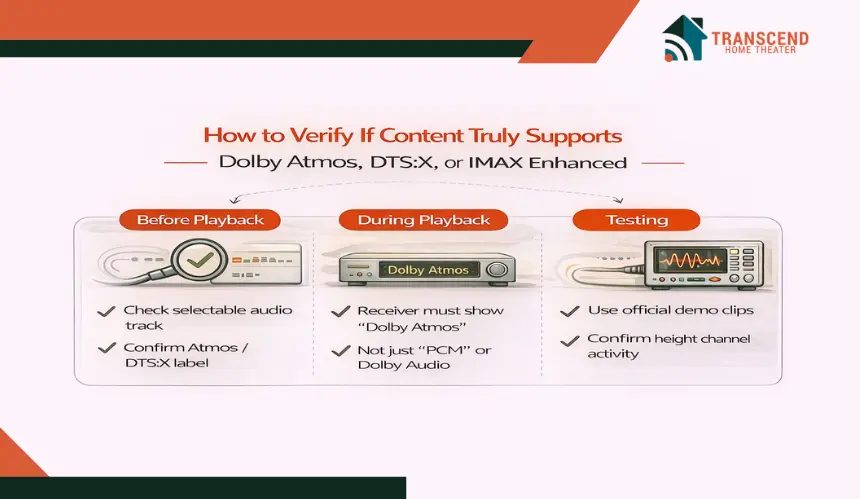
Logos on packaging or streaming thumbnails are not proof of active playback. The only way to confirm real support is to check the signal at multiple points: platform metadata, playback settings, and the AV receiver’s decoding display.
1. Checking Platform Metadata Before Playback
Streaming platforms display format badges, but deeper confirmation requires opening the title’s audio details. On services like Netflix or Disney+, users can view available audio tracks in the description panel or during playback through the language and audio settings menu.
Look specifically for:
- “Dolby Atmos” listed as an audio track
- IMAX Enhanced labeling tied to specific titles
- Multiple audio options including 5.1, Atmos, or alternate languages
If Dolby Atmos appears only in promotional banners but not in selectable audio tracks, the immersive layer may not be available for that device or subscription tier.
For IMAX Enhanced titles, confirm that the expanded aspect ratio scenes are indicated in the title description. Not every 4K stream includes those sequences.
2. Confirming Output Through Your AV Receiver
The most reliable verification happens at the AV receiver. When a Dolby Atmos or DTS:X signal is properly delivered via bitstream over HDMI, the receiver’s front panel or on-screen display will show the exact decoding format.
Look for:
- “Dolby Atmos” rather than “Dolby Audio”
- “DTS:X” instead of “DTS-HD” or “DTS”
- IMAX mode activation on compatible receivers
If the display reads “PCM” or “Multi Channel In,” the device may be decoding the audio internally and stripping object metadata before sending it to the receiver.
Receivers from brands that license technologies from Dolby Laboratories and DTS Inc. clearly indicate active decoding modes. That display is the final authority on whether immersive playback is engaged.
3. Using Test Content and Demo Clips
Official demo clips provide controlled confirmation. Dolby and DTS release downloadable or disc-based demo material designed to trigger overhead and object-based movement. If height channels activate clearly during these sequences, the signal chain is functioning correctly.
IMAX Enhanced demo content, available through certified hardware demonstrations and select showcase titles, can also confirm expanded aspect ratio switching and IMAX audio tuning.
Testing with known reference material removes guesswork. If demo clips trigger immersive decoding but certain movies do not, the limitation lies with the content source rather than the playback system.
Which Format Has the Most Real-World Content Availability?
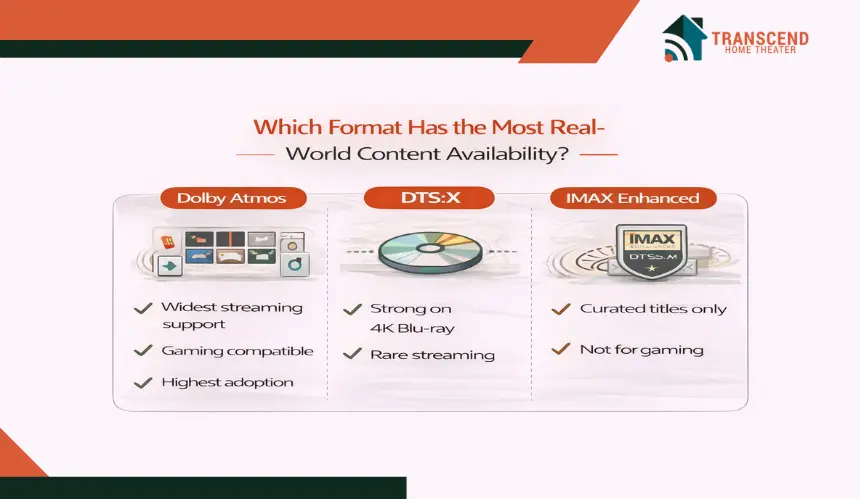
After identifying where each format appears, the comparison becomes clearer when viewed side by side. Content availability is not equal across ecosystems.
Streaming, physical media, and gaming all influence how often viewers encounter Dolby Atmos, DTS:X, or IMAX Enhanced in real titles.
Below is a simplified availability comparison based strictly on real-world distribution patterns.
Format | Streaming Availability | 4K Blu-ray Support | Gaming Support | Overall Content Volume |
Dolby Atmos | Widely available on major platforms like Netflix and Disney+ | Common in Dolby TrueHD form | Supported on platforms like Xbox Series X and PC | Highest adoption |
DTS:X | Rare on streaming services | Frequently included via DTS-HD Master Audio | Limited native game support | Moderate, disc-focused |
IMAX Enhanced | Select curated titles, primarily on Disney+ | Available on specific certified releases | Not used in gaming | Niche, curated catalog |
This comparison highlights adoption patterns rather than sound quality differences. Dolby Atmos appears across the widest range of content sources, especially in streaming and gaming environments. DTS:X remains most accessible through physical media collections. IMAX Enhanced applies only to specially remastered titles within a controlled certification ecosystem.
Immersive formats only deliver their full impact when the system behind them is designed correctly. If you want to experience Dolby Atmos, DTS:X, or IMAX Enhanced the way studios intended, a properly configured home theater makes all the difference.
Transcend Home Theater helps homeowners build performance-focused systems that unlock true object-based audio and cinematic realism. Ready to hear what you have been missing?
Frequently Asked Questions
Do I need a special HDMI cable for Dolby Atmos or DTS:X?
In most cases, a High Speed HDMI cable is sufficient for compressed streaming Atmos. However, for lossless formats such as Dolby TrueHD or DTS-HD Master Audio from a 4K Blu-ray player, an Ultra High Speed HDMI cable combined with HDMI eARC ensures stable high-bitrate audio transmission. The cable itself does not create Atmos, but insufficient bandwidth can prevent full signal delivery.
Why does my TV show Dolby Atmos but my receiver does not?
This usually happens when the television is decoding the audio internally and sending PCM to the AV receiver instead of passing the bitstream signal through. Checking audio output settings and enabling passthrough often resolves this. The AV receiver display is the final confirmation of active immersive decoding.
Is Dolby Atmos available in music streaming services?
Yes, Dolby Atmos is increasingly used in music streaming through platforms that support spatial audio mixes. Albums are specifically remastered for object-based playback, creating a three-dimensional listening experience beyond traditional stereo. Availability depends on both the streaming service and the playback device.
Are older movies being remastered into Dolby Atmos or DTS:X?
Studios frequently remaster legacy films into immersive formats for 4K re-releases. These editions are newly mixed or expanded using object-based audio techniques rather than simply converting the original surround track. Not every catalog title receives this treatment, but high-profile releases often do.
Does room size affect how well Dolby Atmos or DTS:X works?
Yes, a common home theater size like 12 ft × 16 ft with an 8–9 ft ceiling can support a solid 5.1.2 Atmos setup when speakers are positioned correctly. Larger rooms such as 15 ft × 20 ft with a 9–10 ft ceiling allow better height separation for 5.1.4 or 7.1.4 layouts. Very low ceilings or wide open spaces can reduce overhead precision, so room proportions and speaker angles matter more than size alone.