
Dolby Atmos vs Traditional Surround Sound: Key Differences Explained
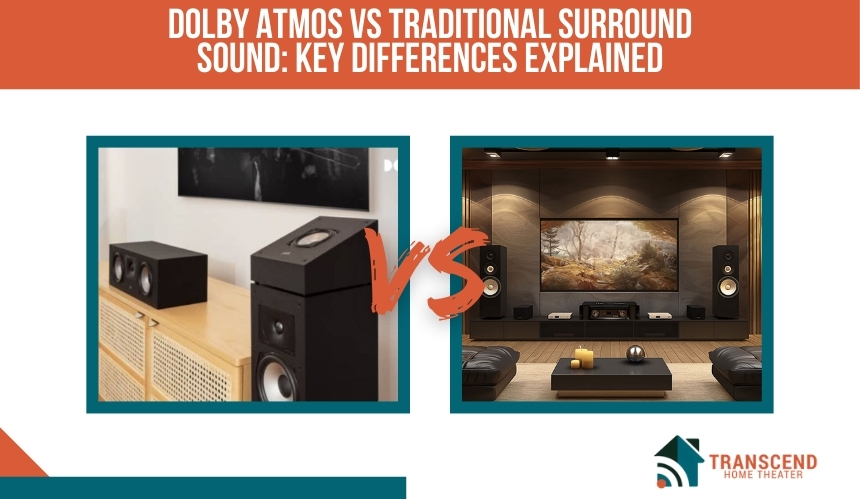
When you set up a home theater or upgrade your sound system, one of the biggest questions is whether to choose Dolby Atmos or stick with traditional surround sound. Both aim to create an immersive listening experience, but they work in very different ways.
Surround sound uses traditional channel-based audio, where sound moves around the listener on a horizontal plane. Dolby Atmos takes this further with object-based audio and added height channels, creating a three-dimensional sound field where effects like rain, helicopters, or voices can move naturally above and around you.
This difference changes how movies, games, and even music feel in your living room. This blog explains how Dolby Atmos and surround sound differ in technology, setup, and overall experience.
What Is Traditional Surround Sound?
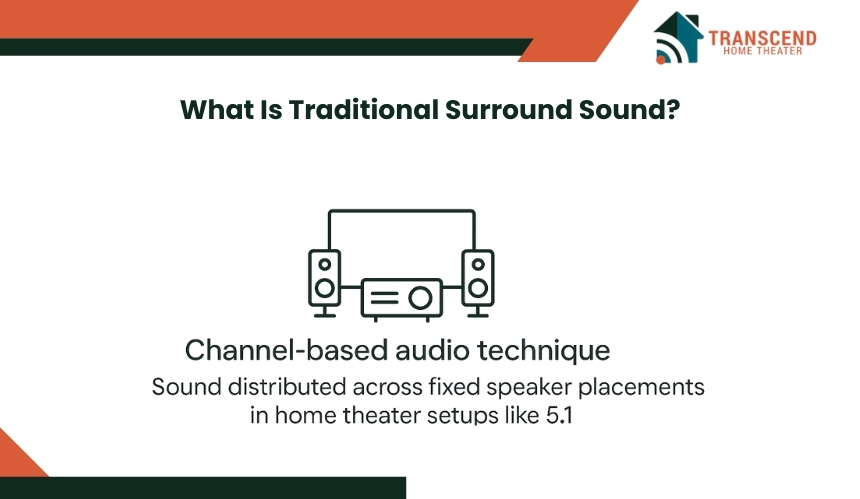
Surround sound is a channel-based audio system where sound is distributed across fixed speaker layouts such as 5.1 or 7.1 setups. Each channel is tied to a specific speaker, creating a horizontal circle of sound around the listener. This format became the standard in home theaters and cinemas for decades, offering an immersive experience but limited to one audio plane.
What Is Dolby Atmos?

Dolby Atmos is a next-generation spatial audio format that replaces channels with object-based audio. Instead of locking sounds to specific speakers, Atmos allows them to move freely in a three-dimensional sound field, including overhead.
How Does Dolby Atmos Compare to Surround Sound?
When comparing Dolby Atmos and traditional surround sound, it helps to look at how each format is designed, how it delivers audio, and what that means for your experience while watching movies, playing games, or listening to music. Let’s break it down in detail.
1. Audio Technology: Channels vs Objects
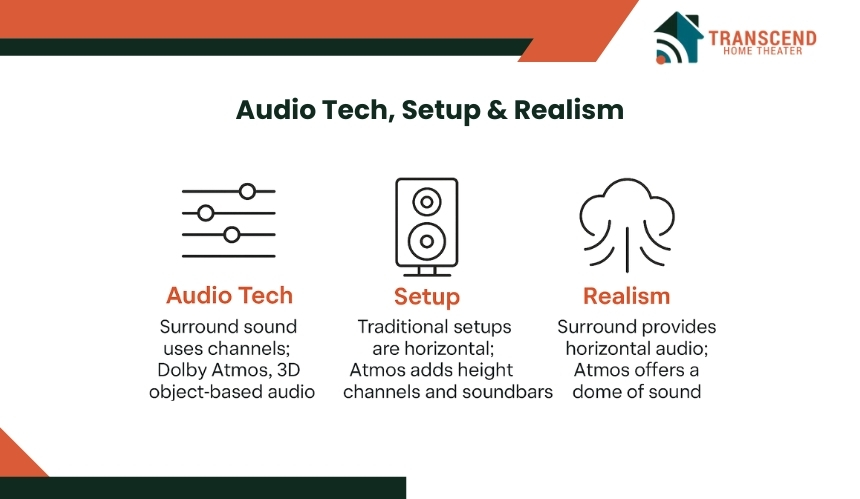
Traditional surround sound is channel-based. This means every sound is tied to a dedicated speaker channel. For example, dialogue often comes from the center speaker, music and ambient effects play through the side speakers, and low rumbles are handled by the subwoofer.
A surround sound system is designed to create a 360-degree circle of sound around the listener. Explosions may erupt behind you, footsteps can approach from the side, and music wraps around the entire room.
Dolby Atmos, on the other hand, uses object-based audio. Instead of assigning sounds to fixed channels, Atmos treats each sound as an independent “object” that can be placed anywhere in a three-dimensional space.
This means audio in dolby atoms is not confined to one speaker; it can move seamlessly above, around, and in front of you. This makes effects like rain, aircraft, or voices sound as if they are coming from precise points in space rather than just from the sides or behind.
2. Speaker Setup and Configuration
In a 5.1 surround system, you have five main speakers, front left, center, front right, rear left, rear right, plus one subwoofer (the “.1”) for bass. A 7.1 system expands on this with two extra rear speakers for even more depth behind you. These layouts are fixed, meaning the audio is always mapped to those specific speaker positions.
Dolby Atmos builds on this structure by adding height channels. This could be through ceiling-mounted speakers, up-firing Atmos speakers, or even Atmos-enabled soundbars. Configurations are often written as 5.1.2 or 7.1.4, where the last number represents how many height speakers are included.
This vertical element in the Dolby Atmos audio is what creates the “dome of sound” effect, surrounding you not just in a circle, but in a complete sphere.
3. Immersion and Realism
Surround sound does a great job of pulling you into the action. You can feel tension build as voices creep from behind or hear a car speed past from left to right. But it is limited to the horizontal plane, so while immersive, it still feels like sound is circling around you rather than completely enveloping you.
Dolby Atmos elevates immersion to another level. By layering audio vertically, Atmos can replicate real-world soundscapes more naturally. Imagine thunder cracking directly above you, or a plane soaring across the sky with audio tracking its exact movement. This ability to mirror how we experience sound in real life is what makes Atmos feel far more cinematic and lifelike than traditional formats.
4. Content Availability and Support
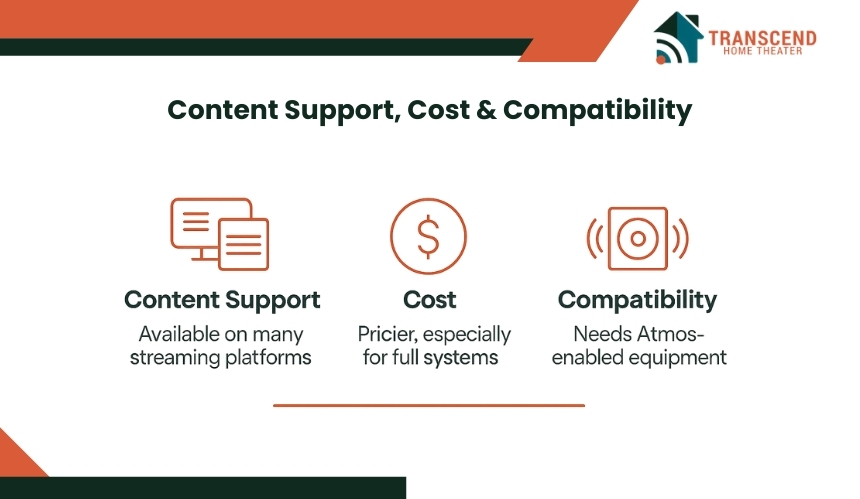
Surround sound is nearly universal. DVDs, Blu-ray discs, broadcast television, and most video games all support 5.1 or 7.1 mixes, which makes it accessible and reliable. You do not need to think twice about whether content will work; it almost always does.
Dolby Atmos is expanding quickly. Many streaming platforms (Netflix, Disney+, Apple TV+, Amazon Prime Video, HBO Max) now offer Atmos mixes for their premium tiers. Modern gaming consoles like Xbox Series X and PlayStation 5 also integrate Atmos for heightened realism.
Even the music industry is embracing Dolby Atmos, with Apple Music, Tidal, and Amazon Music offering Dolby Atmos tracks. Ultra HD Blu-rays often include Atmos soundtracks as well, making it a format that is growing in both reach and importance.
5. Compatibility and Equipment Needs
Surround sound works with virtually any AV receiver, TV, or speaker system, making it flexible and easy to set up. A basic 5.1 package can be installed in almost any living room without specialized equipment.
Dolby Atmos does require Atmos-enabled hardware. This could be an AV receiver that supports Atmos, a soundbar with built-in upward-firing speakers, or headphones designed for spatial audio. Atmos is scalable. You do not need a full ceiling-mounted speaker system to enjoy it. Even a compact Atmos soundbar can deliver a taste of the 3D experience.
6. Cost and Setup Considerations
Traditional surround sound is generally more affordable and easier to install. A solid 5.1 system can be budget-friendly and deliver excellent results without taking over your living room.
Dolby Atmos often comes at a higher price point, especially if you opt for additional ceiling speakers or a premium soundbar. Setup can also be more complex if you are building a full Atmos theater.
However, prices have dropped significantly in recent years, making it more accessible to everyday consumers who want a cinematic experience at home.
Key Differences Between Traditional Surround Sound And Dolby Atmos: A Summary
The table below highlights the main differences between traditional surround sound and Dolby Atmos. Each row in the table covers a core feature, while the columns explain how it works in standard surround formats versus in Dolby Atmos systems.
Feature | Surround Sound (5.1 / 7.1) | Dolby Atmos (3D O |
Technology | Channel-based audio | Object-based audio with 3D positioning |
Speaker Setup | Fixed layouts (5.1 or 7.1) | Flexible setups (5.1.2, 7.1.4, soundbars) |
Immersion | 360° horizontal audio field | Full dome of sound with overhead channels |
Content Support | DVDs, Blu-rays, broadcast TV, most games | Streaming, UHD Blu-rays, games, music apps |
Compatibility | Works with most receivers & speakers | Requires Atmos-enabled gear |
Cost & Setup | Affordable, simple installation | Higher cost, scalable setups, more complex |
In conclusion, surround sound is reliable and budget-friendly for most home setups. Dolby Atmos delivers a more cinematic and lifelike experience for those ready to invest in advanced audio.
Which One Is Better for You, Dolby Atmos or Surround Sound?
Choosing between Dolby Atmos and surround sound depends on how you use your system, what you watch or play most, and how much you are ready to invest. Let’s answer the most common questions to help you decide.
Is Surround Sound Good Enough for Most People?
Yes. Surround sound is still the best choice if you want reliable audio at a lower cost. A 5.1 or 7.1 system works with nearly all movies, games, and TV shows, making it the safest option for budget-conscious buyers or casual viewers.
Should You Upgrade to Dolby Atmos for Movies?
If you watch a lot of movies or series in 4K HDR on platforms like Netflix, Disney+, or Apple TV+, then Dolby Atmos is worth the upgrade. Its 3D sound field adds realism and gives you a cinema-like experience at home.
Is Dolby Atmos Better for Gaming?
Yes. Gamers benefit more from Atmos, especially in fast-paced shooters and action titles where positional audio matters. You can hear movement above, behind, and around you with greater accuracy than with surround sound.
Is Dolby Atmos Worth It for Music?
If you stream music on Apple Music, Tidal, or Amazon Music, Atmos provides a wider, more layered soundstage. For audiophiles or anyone who wants to feel “inside the mix,” it is a clear upgrade. If you only listen casually on standard services, surround sound or stereo is enough.
Which One Is Better for Your Home Theater?
If you are planning a home theater design and installation, Dolby Atmos gives you a more cinematic and future-proof setup. It adds vertical sound layers that transform movies and gaming into a full 3D experience.
Surround sound, however, is easier to install and more budget-friendly. This makes it a practical choice for mini home theaters or casual viewers.
Which One Should You Choose Overall?
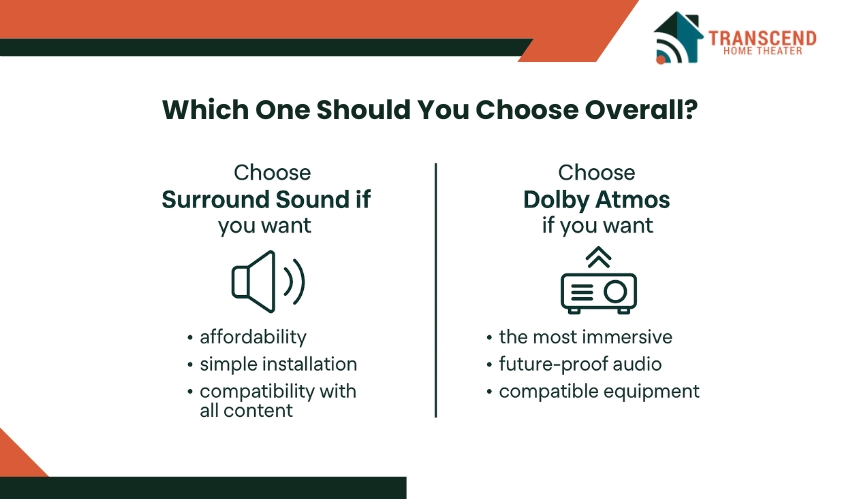
- Choose Surround Sound if you want affordability, simple installation, and guaranteed compatibility with all content.
- Choose Dolby Atmos if you want the most immersive, future-proof audio and do not mind investing in compatible equipment.
Experience the next level of sound with Transcend Home Theater. From expert home theater design to professional installation, every system is built to deliver powerful, immersive audio that transforms any space into a cinematic environment.
Frequently Asked Questions (FAQs)
No, you don’t need a big room. While Atmos shines in dedicated home theaters, it also works in smaller spaces using soundbars with up-firing speakers or even Atmos-enabled headphones. The system adapts to your room size and layout.
Not exactly. Regular speakers handle channel-based sound, but Atmos requires Atmos-enabled speakers or hardware that can process height effects. However, some receivers and soundbars can simulate Atmos effects through virtualization, even without extra ceiling speakers.
Yes, it drains slightly more internet bandwidth. Atmos audio tracks are usually larger than standard 5.1 mixes, so they require faster internet speeds and higher-tier streaming plans. Most platforms recommend at least 15 Mbps or higher for smooth Atmos playback.
Yes. If your system does not support Atmos, the audio will automatically downmix to 5.1 or 7.1 surround sound. This ensures you can still enjoy the content without losing basic functionality.
Yes. Many modern headphones, including gaming headsets and wireless models, use spatial audio processing to deliver a virtual Atmos experience. While it cannot fully match a multi-speaker setup, it still provides noticeable depth and directionality.