
Edge vs. Cloud Processing in Smart Homes: Which Is Better for Privacy & Speed in 2026
Smart homes in 2026 rely on more intelligent systems than ever before, powered by continuous data processing. Every command, sensor, and automated action depends on how that data is handled through either edge or cloud processing. Homeowners are increasingly concerned about which method offers better privacy, speed, and reliability.
Edge computing manages data locally within devices for faster automation and stronger privacy. Cloud processing operates remotely, providing advanced analytics and large-scale coordination. Both have unique strengths that define how smart homes function and evolve.
This guide explains how each approach works, compares their advantages, and helps readers decide which system fits their privacy and performance goals in 2026.
A Quick Comparison Between Edge and Cloud Processing For Smart Homes
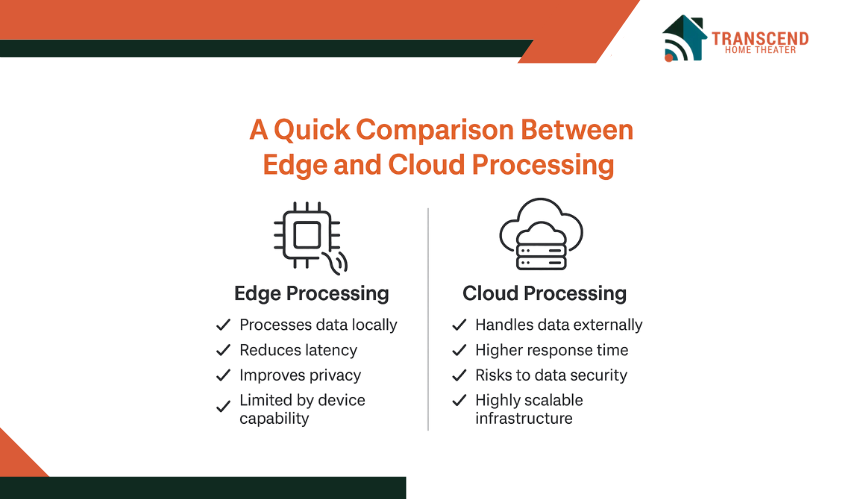
Before exploring how each approach functions, it helps to understand how edge processing and cloud processing differ at a glance. The table below highlights the core distinctions that affect smart home performance, privacy, scalability, and reliability, as we move to 2026.
Feature | Edge Processing | Cloud Processing |
Latency | Very low; processes data instantly within devices | Higher; depends on network speed and server distance |
Data Privacy | Keeps information on local devices, reducing data exposure | Sends data to remote servers, increasing potential risks |
Internet Reliance | Minimal; functions even without a connection | High; requires continuous internet access |
Processing Location | Within the smart home or device itself | In centralized data centers managed by providers |
Storage Capacity | Restricted by onboard memory | Virtually unlimited with cloud infrastructure |
Processing Power | Bound by device specifications | Enhanced by vast cloud computing resources |
System Updates | Manual or device-specific | Automated and centralized for all connected devices |
In summary, edge processing offers stronger privacy and faster response times due to local data handling, while cloud processing excels in scalability, power, and centralized management. The right choice depends on whether a smart home values real-time performance or prefers expansive, cloud-based intelligence.Partnering with a smart home automation expert can help homeowners evaluate both options and implement a balanced system that fits their privacy, performance, and scalability goals.
What Is Edge Processing in Smart Homes?
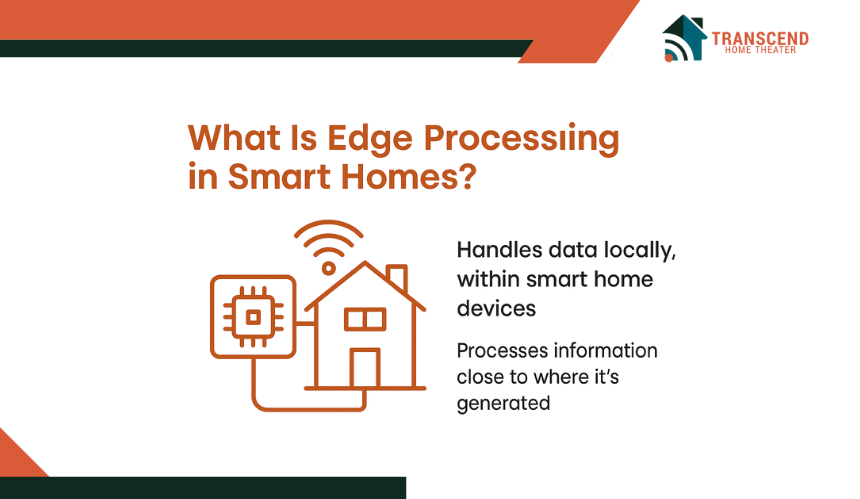
Edge processing refers to handling data locally within smart home devices instead of sending it to external servers. The system processes information close to where it’s generated, often within sensors, cameras, or voice assistants.
How Does Edge Processing Improve Smart Home Automation Speed?
This local processing advantage reduces latency, improves response times, and strengthens privacy since sensitive data stays inside the home. Devices equipped with AI-enabled chips and on-device neural processing units (NPUs) can now analyze voice commands and manage energy use instantly without depending on constant connectivity.
Because information is analyzed on-site, response times are nearly instantaneous, which is crucial for real-time decision making in home automation.
Devices like smart thermostats, motion detectors, and voice assistants can operate efficiently even when the internet connection drops.
Additionally, bandwidth optimization with edge devices ensures that only necessary or summarized data is sent to the cloud, reducing overall network load and preventing lag during peak hours.
Examples of Edge Processing in Smart Homes:
- Amazon Echo devices using Edge AI for local command recognition
- Apple HomeKit Secure Video analyzing footage directly on the device
- Samsung SmartThings Hub running automation rules locally
How Does Cloud Processing Work in Smart Homes?
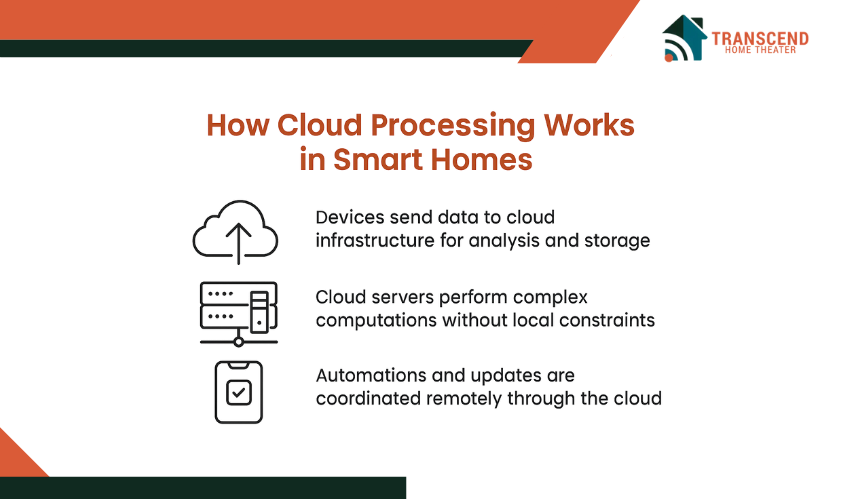
Cloud processing manages data externally through powerful remote servers. When a smart home device collects data, it transmits that information to cloud infrastructure for analysis, storage, and coordination.
How Does Cloud-Based Processing Handle Performance and AI Tasks?
Cloud processing excels when complex computations or deep learning algorithms are required. Large-scale tasks such as voice recognition, predictive maintenance, and multi-device coordination benefit from the cloud’s powerful servers and scalable infrastructure.
However, performance in cloud-based vs on-device AI systems depends on network quality. While the cloud delivers high precision and continuous learning, delays may occur if the connection is weak. This makes the cloud ideal for analytical and predictive automation rather than immediate control functions.
Examples of Cloud Processing in Smart Homes:
- Google Home processing commands through cloud-based AI models
- Amazon Alexa using server-side data for improved accuracy
- Microsoft Azure IoT Hub enabling multi-device cloud coordination
How Do Edge and Cloud Models Differ Technically?
Edge and cloud systems differ in architecture, control, and operational flow.
- Edge processing executes tasks locally, prioritizing privacy and immediacy.
- Cloud processing performs tasks remotely, focusing on scalability and continuous learning.
In 2026, hybrid architectures will become more common in smart home ecosystems that combine both. Edge devices manage time-sensitive functions like lighting or security, while cloud platforms handle learning, coordination, and updates.
Fact: Edge processing devices typically achieve response times under 10 milliseconds, critical for real-time tasks like lighting and security automation. By contrast, cloud processing latency depends heavily on internet speed and server proximity, often ranging from 50 to 200 milliseconds in typical residential network |
Privacy and Data Security in Edge vs. Cloud Processing
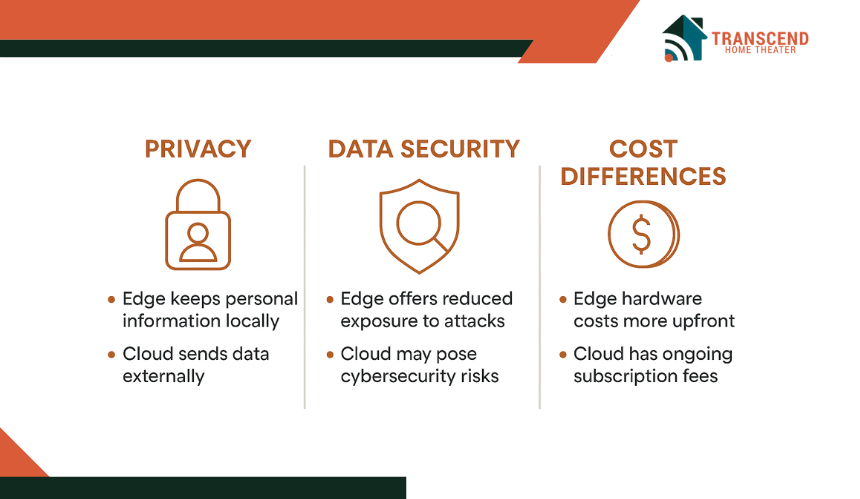
As smart homes process growing volumes of personal information, privacy has become a defining factor in choosing between edge and cloud systems.
Did you know? A 2025 consumer survey found that 72% of smart home users prioritize privacy, with 65% willing to pay more for devices that keep personal data local on edge processing platforms. |
This section examines how each model handles data security, the risks involved, and the new hybrid solutions emerging to balance both performance and protection.
How Does Edge Processing Protect Privacy in Smart Homes?
Edge processing enhances privacy by keeping user data within the home environment. Instead of sending recordings or sensor data to external servers, devices analyze and store this information locally. This drastically reduces the exposure of personal data to third-party systems and minimizes the risk of interception or unauthorized access.
Key privacy advantages of edge systems:
- Data never leaves the device, lowering the risk of leaks or misuse.
- Sensitive information, such as voice recordings or security footage, remains encrypted and confined to local storage
- Local AI models can operate even when disconnected from the internet, preventing cloud-based tracking or profiling.
- Hardware-based security modules (TPM, secure enclaves) prevent unauthorized firmware tampering.
Companies like Apple and Samsung already integrate on-device encryption and local authentication tokens to ensure privacy-first automation.
How Do Cloud-Based Smart Home Systems Handle Security?
Cloud systems rely on vast data centers that employ multiple layers of protection, including firewalls, intrusion detection systems, and encrypted data transmission.
However, since data travels across public networks, cloud models must ensure strict access control and user transparency.
Common privacy concerns of cloud-based processing include:
- Continuous data transmission to vendors and storage facilities.
- Shared access by cloud operators for analytics or service improvements.
- Increased vulnerability to large-scale cyberattacks.
Leading providers like AWS IoT Core, Google Cloud IoT, and Microsoft Azure IoT Hub follow ISO/IEC 27001 and SOC 2 Type II certifications to maintain high standards of data integrity and user privacy. Still, homeowners should regularly review cloud permissions and enable multi-factor authentication (MFA) to prevent unauthorized account access.
Did you know? Cloud-connected devices experienced higher unauthorized access incidents due to poor encryption protocols or unsecured APIs. A 2025 API Security Report found that 57% of organizations experienced at least one API-related breach in the past year. |
What Are Hybrid Privacy Models and Why Are They Growing in 2026?
Modern smart homes are adopting a hybrid smart home processing architecture that blends edge and cloud capabilities. In this approach, sensitive data such as video or biometric inputs are processed locally, while aggregated or anonymized insights are shared with the cloud for broader analysis or updates.
One of the most significant developments driving this trend is Federated Learning, which allows devices to train AI models collaboratively without sharing raw data.
Each device contributes encrypted model updates instead of personal information, ensuring user privacy while improving collective intelligence.
Emerging 2026 hybrid privacy trends:
- Federated AI in smart cameras and voice assistants.
- Use of secure data enclaves and homomorphic encryption for privacy-preserving computation.
- Compliance-first systems aligning with GDPR, CCPA, and the U.S. Data Privacy Act revisions.
What Are the Cost Differences Between Edge and Cloud Processing?
Edge systems typically require a higher upfront investment because the hardware must be capable of local computation, and devices with embedded AI chips or increased storage cost more. For example:
- For a consumer smart home, purchasing a hub or gateway with on-device AI, local storage, and processing might cost USD 300-500 for the device itself (vs. a simpler hub at USD 100-150).
- Because processing happens locally, the homeowner may avoid ongoing cloud-subscription costs and high data-transfer fees.
In contrast, cloud-based solutions rely on subscription models and server-usage fees. While the initial cost is often lower (basic device + connect subscription), expenses can accumulate because of data storage, bandwidth use, and maintenance. For example:
- Many IoT cloud platforms charge around USD 10 per month for basic plans that support up to about 30 devices.
- Data transfer fees can also apply, typically costing around USD 0.10 to 0.15 per MB for smaller data volumes.
- For a home with several smart devices, monthly cloud costs often range from USD 10 to 20, adding up to roughly USD 120 to 240 per year.
Ready to experience a smarter, faster, and more secure connected home? Transcend Home Theater brings innovation to life with customized smart home systems powered by edge and cloud intelligence. Turn your living space into a seamless, privacy-first ecosystem designed for comfort, control, and style.
Frequently Asked Questions
Can older smart home devices switch from cloud-only to edge or hybrid processing?
Yes. Many devices originally designed for full cloud operation can be upgraded via firmware or platform updates to support local (edge) processing or hybrid modes. Manufacturers are responding to demand for lower latency and stronger privacy, so device compatibility, chipset support, and platform architecture determine whether an upgrade is feasible.
Will a smart home lose functionality if the internet goes down and it uses hybrid edge-cloud processing?
In a hybrid smart home processing architecture, essential functions like security motion detection, lighting automation or door unlocking can still operate locally through their edge component even when internet access is lost. The cloud-dependent features (such as voice analytics or large-scale device coordination) may be limited until connectivity returns.
How much power does local on-device AI consume compared to cloud-based automation?
On-device AI in edge computing uses device-embedded chips (e.g., NPUs, microcontrollers) which are optimized for low-power environments. While they consume more power than a basic smart hub, they avoid constant data transmission and waiting for server responses.
Cloud-based architectures rely more on network use, data transfer and remote servers, which can indirectly increase energy footprint (through network equipment and data-centres).
Interesting: Edge devices with dedicated AI chips consume approximately 30%-50% less energy for data processing compared to continuous cloud communication and server-side computation, contributing to greener smart home footprints. |
Is hybrid processing more costly long-term than purely cloud-based smart home systems?
It depends on use pattern. A hybrid model typically involves a higher initial device investment (hardware capable of edge processing) but can lower ongoing cloud subscription fees, reduce bandwidth costs and improve reliability.
Over time, this can lead to lower total cost of ownership compared with purely cloud-based systems that rely on continuous connectivity and subscription services.
How does bandwidth optimization with edge devices affect home network performance?
By processing data locally, edge devices reduce the volume of data sent to external servers, which lowers demand on your home internet connection. This means less congestion, fewer delays and better overall network performance for other devices.
In homes with many connected devices or limited bandwidth, edge-enabled systems can significantly improve reliability and speed.