
The Evolution of Private Cinema Rooms in Luxury Homes
Key Takeaways
|
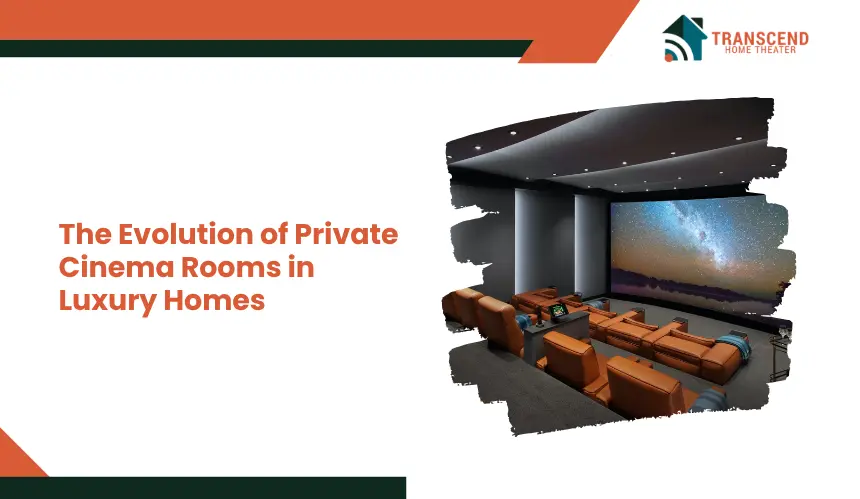
Luxury homeowners increasingly expect cinematic experiences that match or exceed commercial theaters, yet many private setups fail to deliver true immersion due to outdated design approaches, poor acoustic planning, or fragmented technology integration.
The concept of a “home theater” has shifted from a standalone room with basic AV equipment to a performance-driven environment engineered for precision, comfort, and seamless control.
This blog will examine how private cinema rooms have evolved and what defines modern high-performance implementations in luxury homes.
How Private Cinema Rooms Have Transformed into Luxury Living
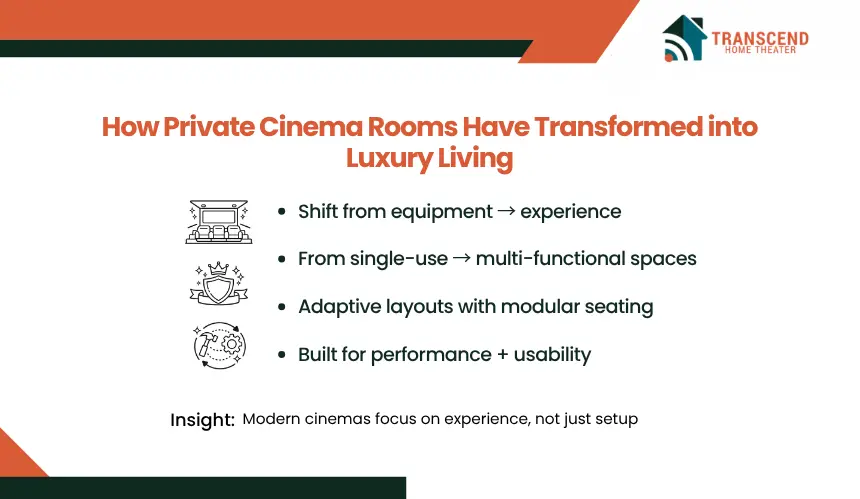
The concept of private cinema has shifted from equipment-centric setups to experience-driven environments, where performance, integration, and usability are engineered together rather than added in isolation.
From Dedicated Theater Rooms to Multi-Functional Media Spaces
Earlier implementations were designed as isolated rooms with fixed seating and limited usability outside movie viewing. Modern luxury environments prioritize spatial efficiency by transforming cinema rooms into adaptive media spaces that support multiple use cases without compromising performance.
Architectural planning now incorporates retractable screens, modular seating, and concealed acoustic treatments, allowing the same space to function as a cinema, lounge, or entertainment hub. This shift increases utilization while maintaining controlled lighting, sound isolation, and viewing geometry required for high-quality playback.
Shift from Basic Projection Setups to High-Performance AV Ecosystems
Traditional setups relied on standard projectors and basic surround sound, often resulting in inconsistent brightness, limited contrast, and uneven audio distribution. Current systems are engineered as integrated AV ecosystems where each component is calibrated to operate within defined performance parameters.
High-lumen laser projection, HDR processing, and reference-grade audio systems are aligned through signal optimization and room calibration. This ensures accurate color reproduction, balanced sound pressure levels, and minimal latency across sources, creating a consistent and predictable viewing experience regardless of content type.
Influence of Streaming Platforms and On-Demand Content Consumption
Content consumption patterns have directly influenced how cinema rooms are designed and configured. The rise of high-bitrate streaming platforms and real-time content access has shifted focus toward network infrastructure, bandwidth stability, and content delivery optimization.
Modern private cinemas are built with dedicated network pathways, media servers, and streaming integration to handle large data loads without buffering or compression loss. This allows users to access cinematic-quality content instantly while maintaining resolution integrity and synchronized audio-visual performance.
Core Technologies Driving Modern Private Cinema Experiences
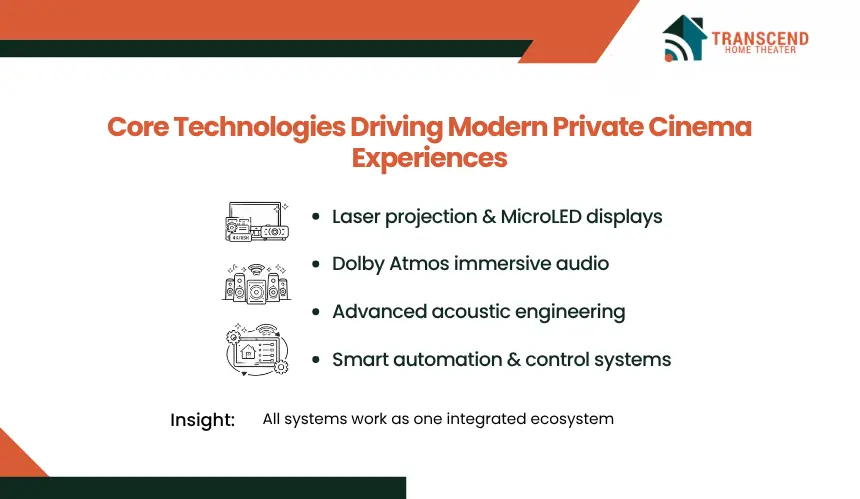
Modern private cinema rooms are defined by tightly integrated technologies where visual processing, audio engineering, and control systems operate as a unified performance stack rather than independent components.
1. Advanced Display Technologies (Laser Projection, MicroLED, 4K/8K Panels)
Display systems have moved beyond conventional projection toward high-output laser projectors and direct-view technologies such as MicroLED and high-refresh 4K or 8K panels. These systems deliver higher brightness levels, deeper contrast ratios, and precise color accuracy through advanced HDR formats and dynamic tone mapping.
Laser-based projection maintains consistent luminance over extended usage cycles, reducing degradation associated with traditional lamp systems. Direct-view displays eliminate projection limitations entirely, offering pixel-level control, zero light scatter, and improved performance in ambient lighting conditions. This directly impacts perceived image sharpness, motion clarity, and overall visual depth.
2. Immersive Audio Systems (Dolby Atmos, Spatial Audio Mapping)
Audio has evolved from channel-based surround formats to object-based sound systems that position audio dynamically within a three-dimensional space. Technologies such as Dolby Atmos enable precise placement of sound objects, allowing audio to move fluidly above, behind, and around the listener.
Speaker layouts are no longer fixed to horizontal planes; instead, ceiling channels and calibrated positioning create a fully enveloping sound field. Spatial audio mapping ensures that dialogue clarity, directional cues, and low-frequency response remain consistent across seating positions, eliminating dead zones and imbalance.
3. Acoustic Engineering and Sound Isolation Techniques
Room acoustics directly influence audio performance, making acoustic engineering a foundational element rather than an afterthought. Modern cinema rooms incorporate calculated absorption, diffusion, and bass management to control sound reflections and frequency buildup.
Materials such as acoustic panels, diffusers, and bass traps are strategically placed based on room dimensions and speaker configuration. Sound isolation techniques, including decoupled wall structures and specialized insulation, prevent sound leakage and external noise intrusion, preserving audio integrity and ensuring consistent playback conditions.
4. Smart Automation and Integrated Control Systems
Control systems have transitioned from manual operation to centralized automation platforms that manage the entire environment through a single interface. Lighting, audio, video, climate, and shading systems are synchronized to execute predefined scenes optimized for different viewing scenarios.
Integration with platforms like Control4 or Crestron allows real-time system adjustments with minimal latency. This reduces operational friction, ensures system consistency, and enables users to maintain optimal performance settings without manual recalibration.
Design Evolution: From Utility Spaces to Experiential Environments
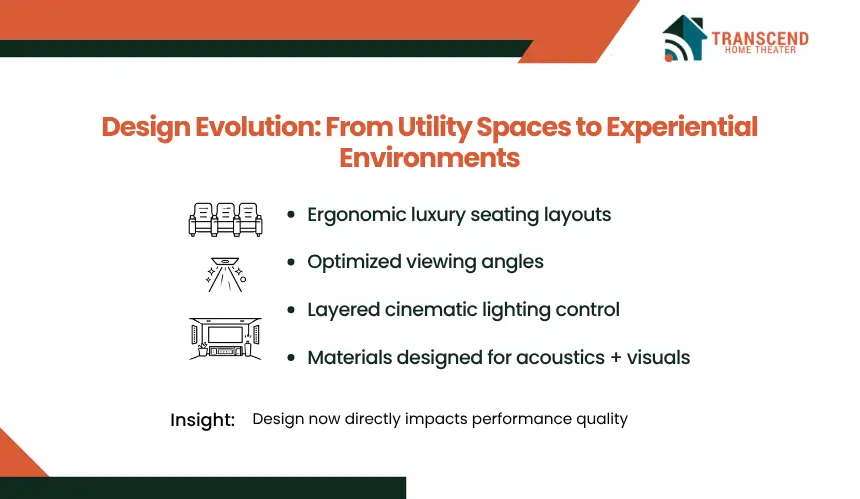
Design in private cinema rooms now functions as a performance layer, where spatial planning, material selection, and visual composition directly influence both immersion and system efficiency.
Luxury Seating, Layout Optimization, and Viewing Angles
Seating design has shifted from fixed rows to ergonomically engineered configurations that align with precise sightline calculations and acoustic positioning. Modern layouts consider screen height, viewing distance, and speaker placement to ensure consistent visual alignment and audio distribution across all seats.
Tiered platforms, motorized recliners, and adjustable headrests are positioned using geometric modeling to maintain optimal eye-level alignment with the display. This reduces visual distortion, prevents neck strain, and ensures that every seating position delivers uniform cinematic clarity.
Lighting Design and Ambient Control for Cinematic Atmosphere
Lighting systems are no longer limited to basic dimming; they are programmed to control intensity, color temperature, and zoning in relation to screen content and room conditions. Layered lighting strategies combine indirect cove lighting, step lights, and task lighting to maintain visibility without introducing glare or screen reflections.
Dynamic lighting scenes adjust automatically during playback, reducing ambient light levels to enhance contrast while preserving safe navigation within the space. This balance between visibility and darkness is critical for maintaining image depth and preventing visual fatigue.
Interior Materials, Finishes, and Acoustic Integration
Material selection now serves both aesthetic and acoustic functions, eliminating the separation between design and performance. Wall panels, ceiling treatments, and flooring materials are chosen based on their ability to manage sound reflection, absorption, and diffusion while maintaining a cohesive visual identity.
Fabric-wrapped panels, perforated wood, and specialized composites are commonly used to control mid and high-frequency reflections without compromising design intent. Finishes are selected to minimize light reflection and maintain color consistency under varying lighting conditions, ensuring that the visual environment supports both image accuracy and long-term usability.
Personalization and Lifestyle Integration in Modern Cinema Rooms
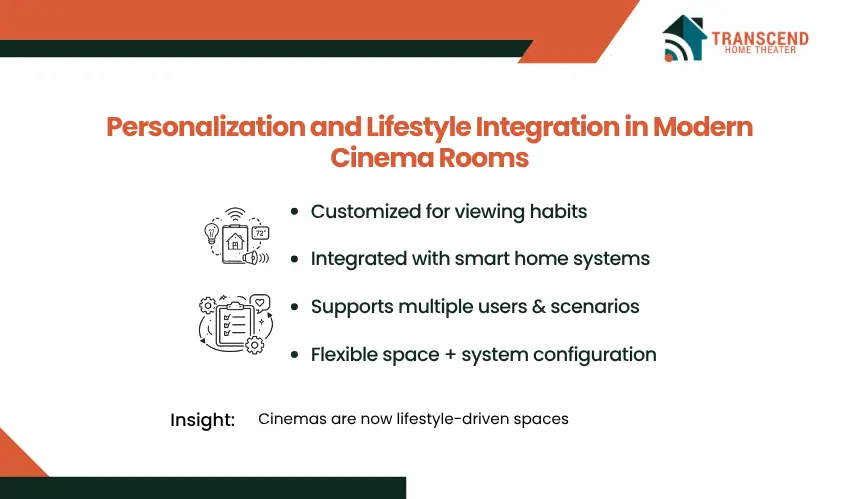
Modern private cinema rooms are no longer standardized installations; they are configured as personalized environments where system behavior, content access, and spatial functionality align with specific user lifestyles and usage patterns.
Tailored Configurations Based on Viewing Habits and Family Use
System architecture is increasingly designed around how the space is actually used rather than a fixed “cinema-only” model. Viewing frequency, preferred content types, and audience size influence decisions related to screen size, seating layout, and audio calibration.
For example, households focused on cinematic content prioritize reference-level audio tuning and controlled lighting, while multi-user environments may require wider seating distribution and flexible audio zones. This approach ensures that performance remains consistent across different usage scenarios without overengineering unnecessary components.
Integration with Whole-Home Automation Systems
Private cinema rooms are now integrated into broader smart home ecosystems, allowing synchronized control across multiple systems. Audio-visual equipment, lighting, HVAC, and shading operate within unified automation frameworks to maintain consistent environmental conditions during playback.
Scene-based automation enables predefined settings such as “movie mode” or “sports mode,” where lighting levels, audio profiles, and display configurations adjust instantly. This reduces manual intervention and ensures that system performance remains optimized regardless of user interaction.
Hybrid Use Cases (Gaming, Sports Viewing, Private Screenings)
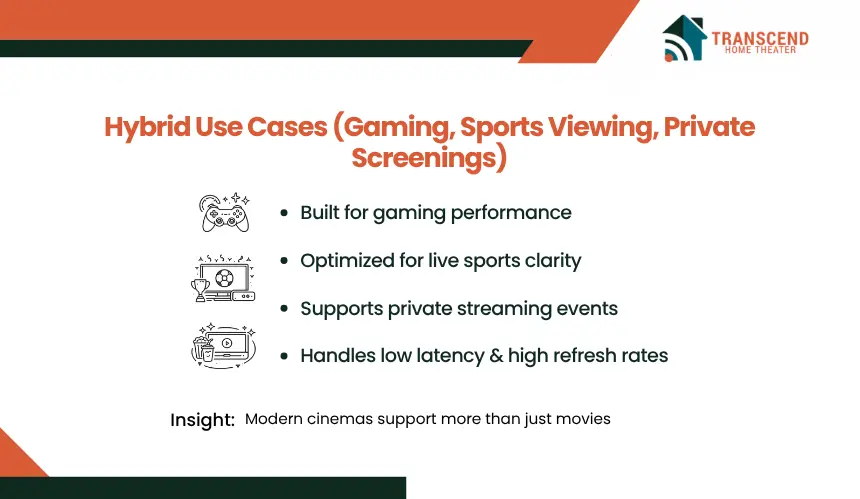
The functional scope of cinema rooms has expanded to support high-performance gaming, live sports viewing, and private streaming events. This requires systems capable of handling low-latency input, high refresh rates, and real-time content rendering without compromising audio-visual synchronization.
Gaming setups demand minimal input lag and adaptive refresh technologies, while sports viewing benefits from motion clarity and multi-source display capabilities. These hybrid use cases drive the need for versatile system configurations that maintain performance across different content formats.
How Local Design Trends Influence Private Cinema Rooms in Luxury Homes
In regions such as Virginia, Maryland, and Washington, D.C., private cinema design reflects both architectural styles and lifestyle expectations specific to high-end residential developments.
Larger property layouts in parts of Virginia allow for fully dedicated cinema rooms with advanced acoustic isolation, while urban residences in Washington DC often integrate cinema functionality into multi-purpose media spaces due to spatial constraints.
Maryland properties frequently balance both approaches, combining dedicated rooms with flexible design elements to support varied entertainment needs.
Across these locations, there is a noticeable emphasis on seamless automation, discreet equipment integration, and design consistency with the overall interior architecture, ensuring that cinema rooms enhance both property value and daily usability.
Precision, performance, and design alignment define the difference between a standard media room and a true private cinema experience. Transcend Home Theater delivers engineered solutions across Virginia, Maryland, and Washington DC, that integrate advanced AV technology, acoustic accuracy, and seamless automation into a single cohesive environment.
Frequently Asked Questions
How much space is required to build a high-end private cinema room?
Space requirements vary based on system scale and seating capacity, but a functional private cinema typically starts around 12 x 16 feet. Larger layouts allow better speaker separation, screen sizing flexibility, and acoustic treatment depth, while smaller rooms require more precise engineering to maintain performance.
Can a private cinema room be installed in an existing home without major structural changes?
Retrofitting is possible in most homes, including basements, bonus rooms, or unused living areas. The key factor is the ability to manage wiring pathways, ventilation, and sound isolation without compromising structural integrity or adjacent living spaces.
What is the typical investment range for a luxury private cinema setup?
Costs can range from $25,000 to over $200,000, depending on display technology, audio system complexity, seating quality, and automation level. High-end installations allocate budget across acoustic design, calibration, and system integration rather than focusing only on equipment.
How long does it take to design and install a private cinema room?
A complete project typically takes 4 to 12 weeks. This includes planning, acoustic modeling, equipment procurement, installation, and final calibration. Custom builds with architectural modifications or bespoke interiors may extend timelines further.
Do private cinema rooms require ongoing maintenance or recalibration?
Periodic maintenance is recommended to sustain performance. This includes software updates, system diagnostics, and occasional audio recalibration, especially after equipment upgrades or changes in room configuration.
Are private cinema systems compatible with future technology upgrades?
Modern systems are designed with modular architecture, allowing components such as displays, processors, and control systems to be upgraded without replacing the entire setup. This ensures long-term adaptability as new technologies emerge.