
What Features Define a High-Performance Home Theater in 2026?
Key Takeaways
|
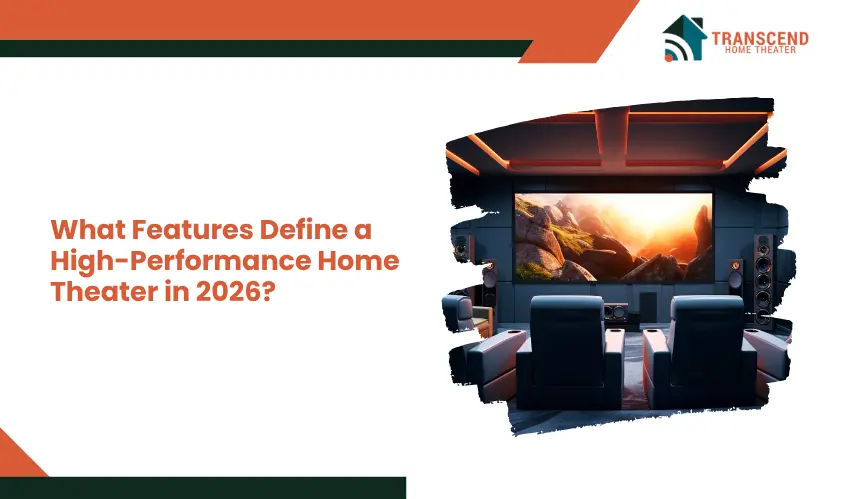
Home theater performance in 2026 is no longer judged by screen size or speaker count alone. The real shift is happening behind the scenes, where next-generation video bandwidth, AI-driven HDR processing, emerging immersive audio formats, and intelligent system control are redefining what “high-performance” actually means.
This guide breaks down the specific 2026 features that separate a standard setup from a performance-driven home theater, focusing only on the technologies that are actively shaping modern home cinema experiences.
The Biggest 2026 Shift Is Future-Ready Video Bandwidth
A major shift in 2026 home theater design is happening at the signal level. High-performance systems are now being evaluated based on how efficiently they handle next-generation video data, not just how good the display looks.
With higher frame rates, advanced HDR layers, and larger data streams becoming standard, bandwidth is no longer a background specification. It directly affects real-world viewing quality and system longevity.
Why HDMI 2.2 Matters More Than Another Spec-Sheet Checkbox
HDMI 2.2 introduces 96Gbps bandwidth capacity, which significantly expands how much visual data can pass through a home theater system without compression or signal degradation.
This becomes critical as content moves toward 4K at 120Hz, 8K at 60Hz, and higher dynamic metadata layers used in advanced HDR formats.
From a practical standpoint, this impacts multiple areas of performance:
- Uncompressed high-frame-rate gaming and sports streaming without motion artifacts
- Cleaner HDR rendering where dynamic metadata is transmitted accurately
- Reliable signal stability across AV receivers, media players, and displays
- Reduced input lag and improved synchronization in multi-device setups
Another important development tied to HDMI 2.2 is the introduction of Ultra96 certified cables, designed specifically to handle this higher bandwidth without signal drops.
In older systems, even premium components often underperform due to cable limitations. In 2026 setups, the cable ecosystem is now part of the performance equation.
From a buying perspective, there are two valid approaches:
- Future-ready approach: Build the system around HDMI 2.2 to avoid early obsolescence and ensure compatibility with upcoming content formats
- Current-need approach: If the use case is limited to standard 4K content, HDMI 2.1 may still perform well, but with limited headroom for upgrades
In 2026, a high-performance home theater is not just about what it can display today. It is about how well it can handle the next generation of video signals without bottlenecks, making bandwidth one of the most defining features of a truly advanced setup.
Picture Quality In 2026 Is Defined By Smarter HDR, Not Just Brightness
Brightness used to dominate discussions around display quality, but 2026 has shifted the focus toward how intelligently a system processes and renders content in real time.
High-performance home theaters are now distinguished by their ability to preserve creative intent across different lighting conditions, scenes, and content types. This is where newer HDR advancements are redefining visual performance.
How Dolby Vision 2 Is Redefining Real-World HDR Performance
Dolby Vision 2 introduces a more refined approach to HDR by enhancing how displays interpret dynamic metadata on a scene-by-scene and frame-by-frame basis.
Instead of applying uniform brightness or contrast adjustments, it allows the system to adapt continuously, ensuring that each scene is rendered with precise detail, depth, and tonal balance.
This has a direct impact on how content actually feels when viewed:
- Shadow detail remains intact in darker scenes without crushing blacks
- Highlights appear controlled and realistic, avoiding overexposure in bright sequences
- Color gradients transition more smoothly, reducing banding in complex visuals
- Ambient light adaptation improves visibility without distorting the original image intent
Another key advancement is how Dolby Vision 2 works alongside newer display technologies to maintain consistency across environments.
Whether the room is dimmed for movie night or partially lit for casual viewing, the system adjusts dynamically without requiring manual recalibration.
From a performance standpoint, there are two distinct ways users experience this:
- Cinema-focused experience: Prioritizes accuracy and creator intent, ideal for dedicated viewing environments
- Adaptive viewing experience: Balances accuracy with visibility, making it suitable for multi-purpose living spaces
In 2026, a high-performance home theater is not defined by how bright the screen can get, but by how accurately and intelligently it can interpret HDR content in real time, making smarter HDR processing a critical differentiator.
Audio Performance Now Includes Format Flexibility, Not Just Speaker Power
Audio systems in 2026 are no longer judged only by how loud or immersive they sound. The real shift is happening at the format level, where compatibility with newer spatial audio standards and decoding flexibility is becoming a defining factor.
A high-performance home theater is now expected to handle multiple audio ecosystems seamlessly, especially as content platforms begin experimenting with newer formats.
What Is Eclipsa Audio And Why Is It Entering High-End Home Theater Discussions
Eclipsa Audio, built on the IAMF (Immersive Audio Model and Formats) framework, represents a new direction in spatial audio. Unlike traditional formats that rely heavily on fixed channel mapping, this approach focuses on object-based audio delivery that adapts to different playback environments, making it more flexible across devices and platforms.
One of the biggest reasons this format is gaining attention is its integration into streaming ecosystems like YouTube, where creators are beginning to explore more advanced audio layering. This introduces a new type of content experience where sound placement and movement feel more dynamic, even outside traditional cinema content.
From a performance perspective, this changes what users should look for in a modern system:
- Decoding flexibility across multiple immersive formats, ensuring compatibility with evolving content
- Accurate object positioning, allowing sound to move naturally within the room
- Scalability across different speaker configurations, from compact setups to full spatial layouts
- Better alignment with streaming-based audio innovation, not just physical media formats
There are two practical ways to interpret this shift:
- Early adoption mindset: Prioritize systems that support emerging formats like Eclipsa Audio to stay aligned with future content trends
- Stability-first mindset: Focus on widely supported immersive audio systems while ensuring upgrade paths for newer formats
In 2026, high-performance audio is no longer just about depth or clarity. It is about how well a system can adapt to evolving audio formats and deliver consistent spatial accuracy across different types of content, making format flexibility a key part of modern home theater design.
High-Performance Display Choices Are Moving Beyond Traditional OLED Vs Projector Debates
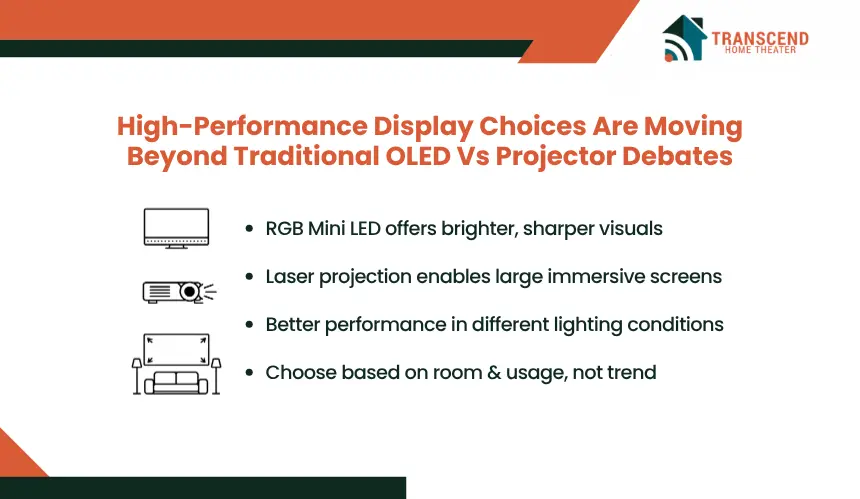
The display conversation in 2026 is no longer limited to choosing between OLED panels and projectors. High-performance systems are now defined by how effectively a display technology aligns with room conditions, screen size expectations, and brightness demands.
New advancements are making large-format viewing more practical without forcing trade-offs that were common in older setups.
Why RGB Mini LED And Next-Gen Laser Projection Are Leading The Shift
RGB Mini LED technology is emerging as a strong contender in premium home theater setups due to its ability to deliver higher peak brightness with improved color accuracy and local dimming precision. Unlike earlier LED implementations, RGB-based backlighting allows more controlled color output, which enhances saturation without compromising contrast.
At the same time, next-generation laser projection systems, especially triple-laser configurations, are pushing projection quality closer to flat-panel performance. These systems are designed to handle:
- Large-scale screen sizes with consistent brightness across the surface
- Improved color volume for HDR content, making visuals appear more lifelike
- Better performance in semi-controlled lighting environments, reducing the need for completely dark rooms
This evolution changes how users approach display selection:
- Living space optimization: RGB Mini LED displays perform well in brighter, multi-purpose environments where ambient light cannot be fully controlled
- Dedicated cinema setup: Laser projection systems are better suited for immersive, large-screen experiences where viewing conditions can be managed more precisely
Another important factor in 2026 is that display performance is now closely tied to how well the system integrates with HDR processing and signal handling, rather than being judged as a standalone component.
In practical terms, a high-performance home theater display is no longer about picking a single “best” technology. It is about selecting a display system that aligns with the room, usage pattern, and desired scale of immersion, which is why newer display technologies are redefining performance expectations.
Smart Control In 2026 Is Becoming More Adaptive And AI-Assisted
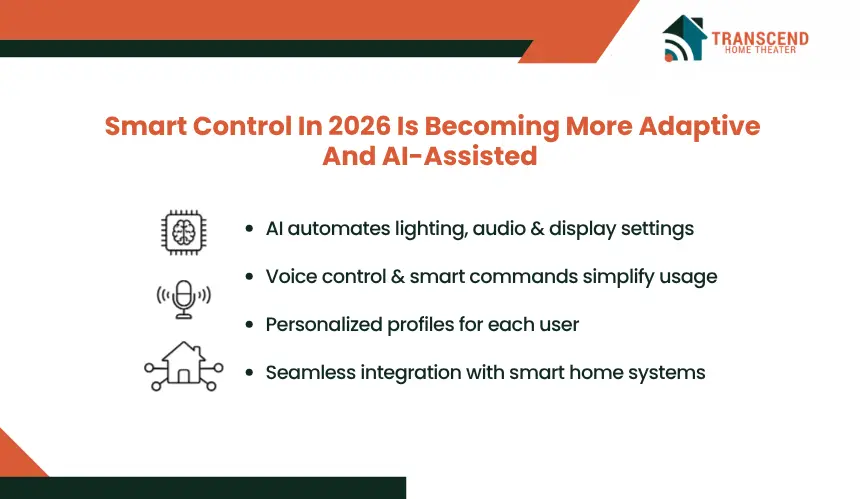
Performance in 2026 is no longer limited to what you see and hear. It also depends on how seamlessly the system responds to the user without friction. High-performance home theaters are now expected to operate as part of a connected ecosystem, where control systems use AI-driven logic, automation routines, and contextual awareness to simplify the entire experience.
How AI-Driven Automation Is Reducing Friction In Home Theater Use
Modern control systems are evolving from basic remote or app-based commands into adaptive environments that anticipate user behavior. Instead of manually adjusting multiple components, the system can coordinate actions across devices based on usage patterns, time of day, or selected content modes.
This directly improves real-world usability:
- Automatic scene activation, where lighting, audio levels, and display settings adjust instantly when content starts
- Intelligent source switching, reducing delays and eliminating manual input selection across devices
- Voice and contextual control integration, allowing users to trigger complex actions through simple commands
- Personalized viewing profiles, where preferences are stored and applied based on the user or activity
Another important shift is how these systems integrate with broader smart home ecosystems. High-performance setups are now designed to work with advanced control platforms and automation frameworks, ensuring that the home theater functions as part of a unified environment rather than a standalone system.
From a user perspective, this introduces two clear benefits:
- Consistency: The system behaves predictably without requiring repeated adjustments
- Efficiency: The entire setup becomes easier to use, even for non-technical users
In 2026, a high-performance home theater is not only about delivering premium audio and video. It is also about how effortlessly the system can be controlled and how intelligently it adapts to the user, making AI-assisted automation a critical part of the overall experience.
A home theater should feel effortless, immersive, and built for what’s next, not just what works today. That level of precision comes from thoughtful system design, not guesswork. Transcend Home Theater focuses on building future-ready setups that align with 2026 technologies, ensuring every detail, from signal flow to automation, works in perfect sync for a truly elevated experience.
Frequently Asked Questions
How much space is needed for a high-performance home theater in 2026?
A dedicated room is not always required, but space planning plays a critical role. In 2026 setups, factors like viewing distance, seating layout, and acoustic spacing determine performance more than room size alone. Even compact spaces can deliver strong results when designed with proper screen-to-seat ratios and speaker placement geometry.
Are streaming platforms fully optimized for high-end home theater systems?
Most major streaming platforms like Netflix, Disney+, Apple TV+, and Amazon Prime Video are improving rapidly, but optimization still varies by content type. Some platforms now support higher bitrate streaming, improved compression codecs, and spatial audio layers, while others still limit quality due to bandwidth constraints. A high-performance system performs best when paired with premium streaming tiers or local media playback solutions.
How important is acoustic treatment in modern home theater setups?
Acoustic treatment plays a critical role in how sound is perceived inside a room. In 2026, even advanced audio systems can underperform without proper control of reflections and low-frequency buildup. Solutions like acoustic panels, bass management, and sound diffusion techniques help maintain clarity, balance, and accurate sound positioning.
Can a high-performance home theater be integrated into an open living space?
Yes, but it requires careful planning. Open spaces introduce challenges like ambient light interference and sound dispersion, which can affect performance. In 2026, solutions such as light-controlling window treatments, directional audio setups, and adaptive system calibration allow high-end performance even in shared environments.
How often should a home theater system be upgraded to stay current?
Upgrade frequency depends on how quickly technology evolves within specific components. In 2026, most systems are designed with longer lifecycles, but elements like connectivity standards, processing capabilities, and software-based features may require updates every few years to stay aligned with newer content formats and user expectations.