
Where to Spend vs Save in a Home Theater Build (Real Budget Breakdown)
Key Takeaways:
|
In the early 2000s, as DVD players and surround sound systems became mainstream, many first-time home theater setups followed a simple rule: spend the most on the biggest screen available. By the mid-2010s, when 4K displays and streaming platforms like Netflix and Amazon Prime Video took over, expectations shifted toward sharper visuals and immersive sound.
Yet a common pattern remained, where significant budgets produced underwhelming results because spending was concentrated in the wrong areas. The gap between cost and experience often comes down to allocation, not capability. This blog breaks down where budget decisions actually impact performance and where saving makes no noticeable difference.
Why Budget Allocation For Home Theaters Matters More Than Total Budget
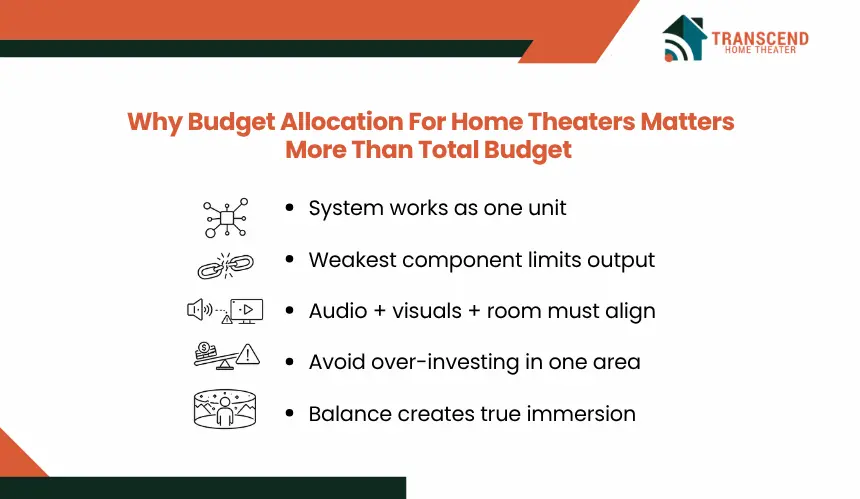
A home theater system performs as a unified environment where each component influences the final output. Increasing overall spend does not guarantee better results if critical elements are underfunded or misaligned.
Most performance limitations emerge from imbalance. For example, pairing a high-end display with entry-level speakers creates a visual experience that lacks depth in audio, reducing immersion. Similarly, investing heavily in premium electronics while ignoring room acoustics leads to sound distortion, echo, and uneven frequency response. The system ultimately performs at the level of its weakest link, not its most expensive component.
Another key factor is the difference between perceived upgrades and measurable performance gains. Higher price tiers often introduce diminishing returns, where incremental improvements in resolution, materials, or design do not translate into noticeable real-world benefits. In contrast, reallocating that same budget toward acoustics or speaker quality produces a significantly greater impact on clarity, spatial imaging, and overall realism.
Budget allocation also determines long-term flexibility. Components like speakers and room treatments tend to remain relevant for years, while displays, source devices, and processing technologies evolve more rapidly. Prioritizing stable, high-impact elements ensures that the system maintains performance even as individual components are upgraded over time.
Effective budgeting is not about maximizing spend in isolated categories but about distributing resources based on performance influence. Systems designed with this approach consistently deliver a more balanced, immersive, and scalable home theater experience.
Where Should You Spend More in Home Theaters for Maximum Performance Impact?
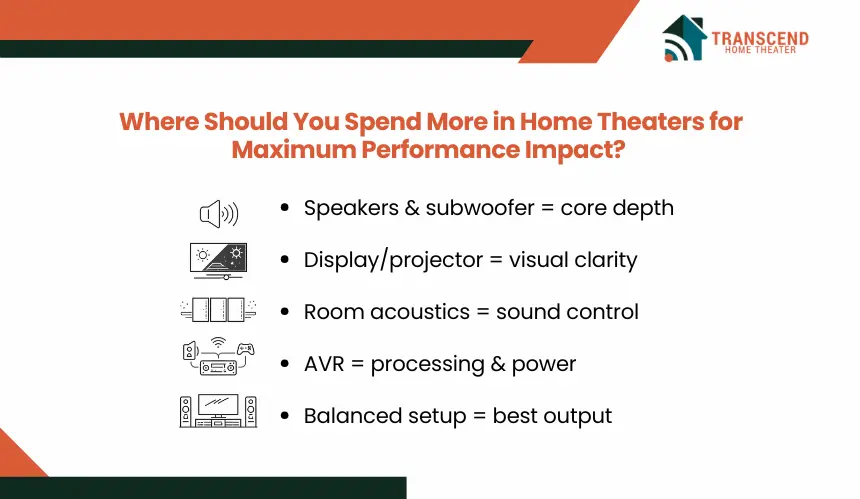
Not all components contribute equally to the home theater experience. Certain elements directly influence how sound is perceived, how visuals are interpreted, and how immersive the environment feels. Allocating more budget to these areas produces measurable improvements rather than marginal upgrades.
Speakers and Subwoofer Define the Experience
Audio reproduction shapes spatial awareness, dialogue clarity, and emotional impact. A well-designed speaker system ensures accurate frequency response, balanced mids for speech intelligibility, and controlled highs that avoid listener fatigue. The subwoofer extends low-frequency output, enabling depth and physical impact in soundtracks that cannot be replicated by standard speakers.
In most environments, upgrading from basic speakers to a well-matched system results in a more noticeable improvement than upgrading display resolution. Poor audio compresses the experience, while accurate sound staging creates directional cues and realism that align with on-screen action.
Display or Projector Determines Visual Realism
Visual quality depends less on resolution alone and more on contrast ratio, brightness consistency, and color accuracy. A display with strong black levels and high dynamic range renders scenes with depth, preventing washed-out images and preserving detail in both dark and bright areas.
Screen size must align with viewing distance to maintain immersion without pixelation or eye strain. In larger rooms, projectors offer scale advantages, while high-end televisions provide superior brightness and clarity in controlled lighting conditions. The goal is not maximum size, but optimal visual balance.
Room Acoustics Shape Overall Performance
Sound behavior within the room directly alters what the listener hears, regardless of equipment quality. Hard surfaces reflect sound waves, creating echo and phase interference, while untreated corners amplify bass inconsistencies.
Basic acoustic treatment such as absorption panels, carpets, and strategic furniture placement reduces reflections and stabilizes frequency response. Even modest treatment produces a disproportionate improvement in clarity compared to upgrading electronics alone.
AV Receiver as the System’s Control Hub
The AV receiver manages signal processing, amplification, and format decoding. Its role extends beyond connectivity, as it determines how audio signals are distributed across channels and how effectively speakers are driven.
Support for formats like Dolby Atmos enables three-dimensional sound placement, while adequate power output ensures speakers perform without distortion at higher volumes. Choosing a receiver with scalable channel support allows future expansion without replacing the entire system.
Where Can You Save Without Compromising Experience in Home Theaters?
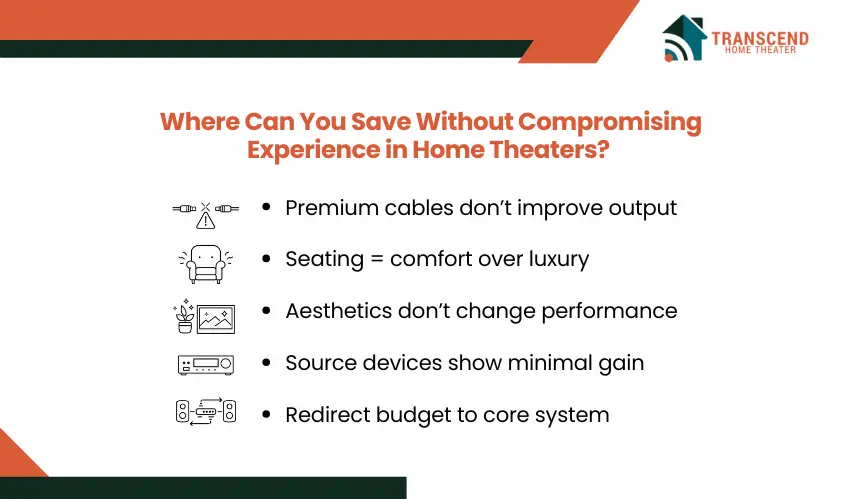
After allocating budget to high-impact components, several areas offer minimal performance return despite higher pricing. Strategic cost control in these categories preserves overall system quality while preventing unnecessary expenditure.
Premium Cables Rarely Improve Performance
Digital signal transmission through HDMI or optical cables operates within defined standards. As long as cables meet certification requirements for bandwidth and reliability, performance remains consistent across price tiers. Expensive branding or exotic materials do not enhance picture quality or sound clarity.
For speaker wiring, adequate gauge and proper insulation ensure stable signal delivery. Beyond that, additional cost does not translate into audible improvement. Budget is better redirected toward components that actively shape output rather than transmit it.
Seating Should Be Comfortable, Not Overpriced
Seating influences viewing posture and long-term comfort but does not directly affect audio or visual performance. High-end theater recliners often add cost through materials and aesthetics rather than functional gains.
Ergonomic support, correct viewing height, and proper spacing between seats have a greater impact on the experience than luxury finishes. A well-planned layout with practical seating achieves the same usability without consuming a disproportionate share of the budget.
Aesthetic Upgrades Have Limited Functional Impact
Visual enhancements such as decorative wall panels, ambient lighting systems, and themed interiors contribute to atmosphere but do not improve system output. In some cases, poorly chosen materials can even interfere with acoustics by increasing reflections.
Basic lighting control that reduces glare on the screen is sufficient for most setups. Decorative elements should follow after performance-critical components are addressed, not compete with them for budget allocation.
Source Devices Offer Diminishing Returns
Media playback devices primarily decode and deliver content, making their performance dependent on source quality rather than hardware cost. Streaming devices, gaming consoles, and standard media players often produce comparable results when handling the same content formats.
Upgrading to high-end players yields limited benefit unless the system relies on specialized media formats or local high-bitrate files. In most cases, investing in better speakers or display calibration produces a more noticeable improvement than upgrading the source device.
How Should You Allocate Your Budget Across Different Price Levels?
A realistic home theater budget starts by separating room and construction costs from the equipment budget. Industry cost guides place professional home theater projects broadly in the $10,000 to $60,000 range, while building a room shell from scratch can add roughly $50 to $250 per square foot before speakers, display, or electronics are even selected.
Based on established industry benchmarks and real-world system builds, most high-performing setups follow a consistent allocation pattern:
The Golden Rules of Allocation for Home Theaters
Regardless of your total spend, these general percentages keep the system balanced:
- Speakers & Subwoofers: 35% – 40% (The longest-lasting part of your investment).
- Display/Projector: 25% – 30% (The visual centerpiece).
- Electronics (AVR/Amps): 20% – 25% (The “brains” of the operation).
- Acoustics & Misc: 10% – 15% (Often overlooked, but critical for performance)
Entry-Level Budget ($4,000 to $8,000 in Equipment)
At this tier, the goal is not maximum channel count but a system with strong fundamentals. Most buyers get better results by concentrating their budget on speaker quality, subwoofer performance, and a reliable display instead of stretching it across Atmos add-ons, premium accessories, or decorative upgrades.
Using a $6,000 system as a realistic benchmark within this range, the allocation often looks like this:
- $2,400 to $2,700 for speakers and subwoofer
- $1,800 to $2,100 for the display
- $900 to $1,200 for the AV receiver
- $300 to $600 for cables, mounting, and basic setup essentials
In practical terms, this budget supports a strong 3.1 or 5.1 setup with clear dialogue, controlled bass, and a display that can hold up for movies, streaming, and sports. The mistake at this level is trying to force advanced surround formats into a budget that still needs core component quality. A properly built 5.1 room at this tier usually outperforms a thinly spread Atmos system.
Mid-Range Budget ($8,000 to $15,000 in Equipment)
This tier is where a home theater begins to feel purpose-built rather than assembled around compromises. The budget is large enough to improve both output quality and system balance, which means the gains become easier to hear and see in everyday use.
Using a $12,000 system as a realistic benchmark within this range, the allocation often looks like this:
- $4,200 to $4,800 for speakers and subwoofer
- $3,000 to $3,600 for the display or projector/screen combination
- $2,200 to $2,600 for the AV receiver or processing
- $1,000 to $1,200 for acoustic treatment and calibration
- $600 to $800 for cables, mounts, and power management
What changes here is not just component quality but system control. This tier can support a better center channel, deeper low-frequency extension, a more capable AVR, and targeted room treatment that improves clarity and seat-to-seat consistency. It is also the first range where 5.1.2 Dolby Atmos becomes realistic without weakening the rest of the setup.
High-End Budget ($15,000 to $30,000+ in Equipment, Before Construction)
At the upper end, the build shifts from component selection to performance engineering. By this point, the conversation is less about buying better individual products and more about making the room, speaker layout, processing chain, and calibration work as one system.
Using a $22,000 system as a realistic benchmark within this range, the allocation often looks like this:
- $7,700 to $8,800 for speakers and subwoofers
- $5,500 to $7,500 for the display chain
- $3,300 to $4,400 for processing and amplification
- $2,200 to $3,300 for acoustic treatment and calibration
- $1,000 to $1,200 for cabling, control, and power infrastructure
This level can support dual subwoofers, higher-output speakers, advanced surround layouts, and a projection or premium large-format display setup that is matched to the room rather than chosen in isolation. The real advantage of this tier is consistency.
When acoustic treatment, speaker placement, and calibration are budgeted properly, the system performs predictably across the room instead of sounding impressive only from one seat.
What Budgeting Mistakes Reduce Home Theater Performance?
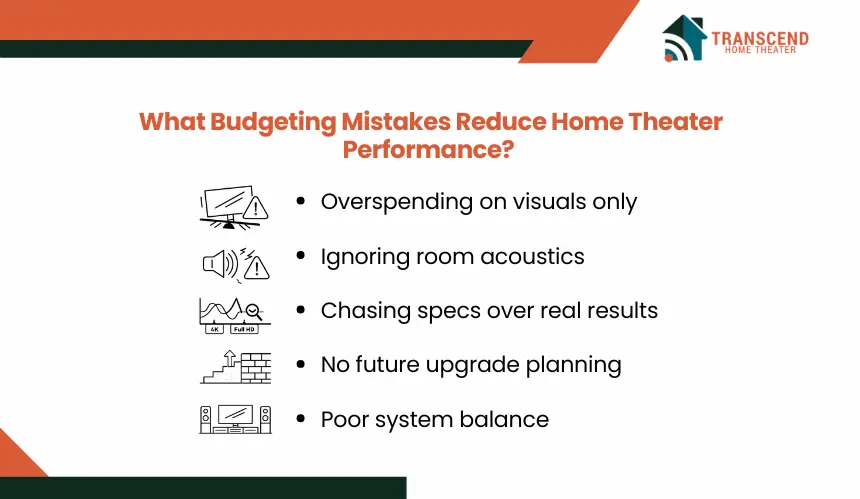
Even with a solid budget, poor allocation decisions can limit system output and reduce overall experience. These issues are not caused by lack of spending, but by placing money in areas that do not directly improve performance.
Overspending on Visuals While Neglecting Audio
A common imbalance occurs when most of the budget is directed toward a high-end display while audio is treated as secondary. This results in sharp visuals paired with weak dialogue clarity, limited soundstage, and insufficient low-frequency impact.
Because audio defines spatial realism and immersion, underinvestment in speakers and subwoofer creates a disconnect between what is seen and what is heard. Balanced allocation ensures that sound quality supports visual detail rather than falling behind it.
Ignoring Room Limitations
Room dimensions, surface materials, and layout directly affect how sound travels and reflects. Hard surfaces create echo and phase interference, while poor speaker placement leads to uneven coverage across seating positions.
Spending on high-end equipment without addressing these constraints reduces system efficiency. Budgeting for basic acoustic control and layout planning prevents performance loss caused by the environment itself.
Chasing Specifications Instead of Real-World Performance
Higher specifications such as resolution, peak brightness, or channel count do not always translate into noticeable improvements. Many systems are built around feature lists rather than how those features perform in a specific room.
For example, increasing channel count without proper spacing or calibration leads to overlapping sound rather than accurate positioning. Decisions based on measurable output and listening conditions produce better results than spec-driven upgrades.
Lack of Long-Term Upgrade Planning
Some systems are built without considering future expansion, leading to early replacement of key components. Limited channel support, insufficient power handling, or incompatible formats restrict upgrade paths.
Allocating budget toward scalable components, such as a capable AVR or expandable speaker layout, reduces long-term cost by allowing incremental improvements instead of full system replacement.
How to Build a Scalable Home Theater Without Overspending Upfront
A well-planned home theater is not built in a single phase. Performance improves more efficiently when the system is designed to scale, allowing upgrades to be layered without replacing core components.
Step 1: Start With Core Performance Drivers
Initial investment should focus on components that define baseline output quality. A strong front soundstage with left, center, and right speakers, paired with a capable subwoofer and a properly sized display, establishes the foundation for both audio clarity and visual consistency.
Spreading budget across secondary features too early weakens this foundation. Prioritizing core components ensures that every future upgrade builds on an already stable system rather than compensating for early compromises.
Step 2: Upgrade in Logical Phases
Expanding the system in stages allows performance to improve without unnecessary duplication of cost. A typical progression moves from a 3.1 setup to 5.1, then to height channels or advanced formats once the primary system is fully optimized.
Each phase should address a specific performance gap. Adding surround channels improves spatial coverage, while introducing height channels enhances vertical sound placement. This structured approach prevents overlapping upgrades that do not deliver measurable gains.
Step 3: Balance Immediate Needs With Future Flexibility
System design should account for both current usage and future expansion. Choosing an AV receiver with additional channel capacity, or selecting speakers that can integrate into a larger configuration, prevents early obsolescence.
Budget decisions at the initial stage should avoid locking the system into a fixed configuration. Flexibility ensures that improvements can be added incrementally rather than requiring a complete system replacement.
When Professional Home Theater Installation Adds Value
In complex room layouts or higher-budget builds, professional home theater design and installation becomes a performance decision rather than a convenience.
In many homes across Virginia, basement layouts and dedicated media rooms require careful speaker positioning and acoustic planning.
In Maryland, mixed-use living spaces often introduce reflection and layout challenges that affect sound distribution. In Washington DC, space constraints and shared structures make controlled sound management and calibration more critical.
In these environments, factors such as ceiling height, wall materials, and room dimensions directly affect audio reflection, bass distribution, and viewing angles. Professional planning ensures correct speaker positioning, proper acoustic treatment placement, and calibration tuned to the room’s actual response rather than theoretical specifications.
In homes where space, layout, and sound control can make or break performance, guessing is expensive. A structured approach ensures every component works exactly as intended from day one. Transcend Home Theater delivers precision-driven setups that eliminate trial and error and turn any room into a consistently immersive experience.
Frequently Asked Questions
Is a projector actually better than a big TV for most home theaters?
Projectors make the most sense when the room can be darkened and the goal is a genuinely cinematic image size. Crutchfield notes that projector performance improves when ambient light is reduced, while brighter models and ambient light rejecting screens can help in mixed-light rooms. In brighter family rooms, a large TV is often the more practical choice.
Should I buy one better subwoofer or two smaller subwoofers?
A single higher-quality subwoofer is usually the right starting point for tighter budgets, but dual subwoofers can improve headroom, reduce distortion, and smooth bass response across multiple seats. SVS specifically notes gains in dynamic range and lower compression with dual subs, which matters most in larger rooms or seating rows.
Is buying a used AV receiver a smart way to save money?
Used AV receivers can be a smart value play when the system does not need current HDMI 2.1 features. Crutchfield notes that older HDMI gear is backward-compatible, but capabilities are limited by the oldest HDMI version in the chain. That becomes important if the setup needs 4K/120, VRR, ALLM, or modern eARC behavior for gaming and streaming.
Do I need soundproofing or just acoustic treatment in a shared-wall home?
That depends on the problem being solved. If the issue is echo, harsh reflections, or muddy dialogue inside the room, acoustic treatment is the direct fix. If the issue is bass or movie noise leaking into adjacent rooms or through shared walls, sound isolation becomes the more relevant investment. CEDIA treats those as separate design considerations.
When does an acoustically transparent screen actually make sense?
An acoustically transparent screen becomes useful when the build uses front projection and the goal is to place the front speakers behind the image, closer to commercial cinema geometry. CEDIA defines an acoustically transparent screen as one that allows sound to pass through. For smaller TV-based rooms, that feature is usually unnecessary.
Can I prewire for Dolby Atmos now and add the height speakers later?
Prewiring early is usually the cleaner and less expensive move, especially before drywall is closed. Dolby’s setup guidance shows that Atmos layouts build on standard 5.1 or 7.1 foundations by adding height channels such as 5.1.2, and it recommends careful speaker positioning around a central seating point. That makes phased upgrades far easier later.