
Which Types of Homes Benefit Most from Automation Installation?
Key Takeaways:
|
Home automation delivers the greatest value when it solves specific operational challenges within a property. Factors such as home size, occupancy patterns, security requirements, accessibility needs, and system complexity all influence how much a homeowner benefits from automation installation.
This article examines the home categories that typically see the strongest practical return from automation investment.
1. Large Multi-Story Homes
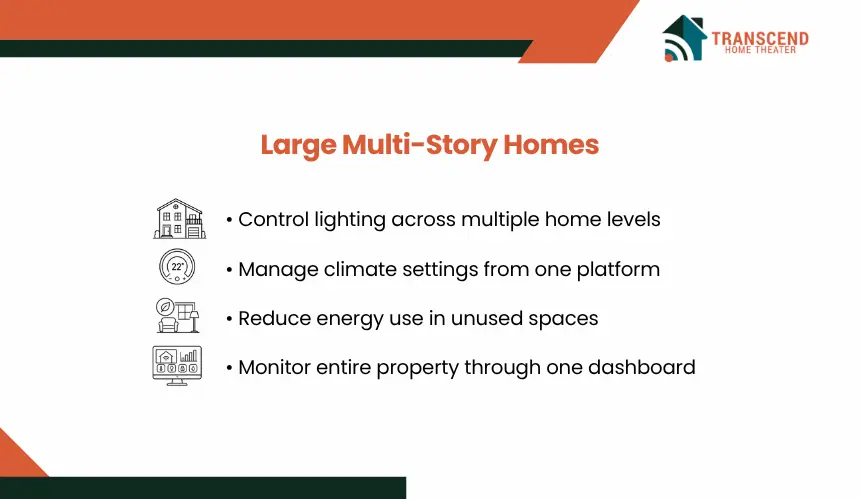
Large multi-story homes often experience the highest operational gains from automation because managing comfort, security, and energy usage becomes more complex as square footage and room count increase. Automation reduces the need for manual control while providing centralized oversight of systems throughout the property.
Managing Lighting, Climate Control, and Security Across Multiple Floors
In larger homes, occupants frequently move between floors and living areas throughout the day. Manually adjusting lights, thermostats, security settings, and window coverings across multiple zones can become inefficient and inconsistent.
A centralized automation platform allows homeowners to control these systems from a single interface, mobile device, or voice assistant. Instead of managing each area independently, property-wide settings can be adjusted instantly based on occupancy, schedules, or specific household routines.
Reducing Energy Waste in Underused Rooms and Areas
Many multi-story homes contain guest rooms, bonus spaces, finished basements, home offices, or secondary living areas that remain unoccupied for significant portions of the day. These spaces can continue consuming electricity and HVAC resources even when not actively used.
Smart sensors, occupancy detection, automated lighting controls, and zoned climate management help reduce unnecessary energy consumption. By responding to real-time usage patterns, the system allocates resources only where they are needed, improving overall operational efficiency
Simplifying Whole-Home Monitoring From a Single Platform
As the number of entry points, connected devices, and building systems increases, monitoring the entire property becomes more demanding. Homeowners may need visibility into security cameras, door locks, environmental sensors, garage access, and other critical systems.
Automation consolidates these functions into a unified dashboard, allowing real-time monitoring and management from virtually any location. This centralized approach improves awareness, accelerates response to unusual events, and reduces the complexity associated with managing a large residential property.
2. Homes With Frequent Travelers or Seasonal Occupancy
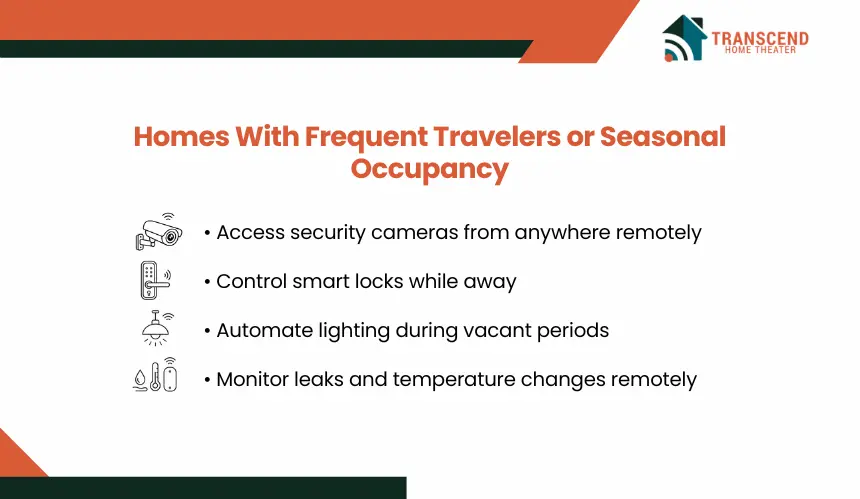
Homes that remain vacant for extended periods benefit from automation because critical systems can be monitored and controlled remotely. The primary advantage is not convenience, but maintaining security, environmental stability, and operational visibility when the property is unoccupied.
Remote Access to Security Cameras and Smart Locks
Frequent travelers often need immediate visibility into property activity without being physically present. Connected surveillance systems, video doorbells, smart locks, and motion sensors provide real-time notifications and remote access to entry points.
This capability is particularly valuable for homeowners who split time between residences or travel regularly for business. Rather than relying solely on periodic property checks, occupants can verify access events, manage deliveries, and respond to security alerts from a mobile device.
Automating Occupancy Simulation During Vacant Periods
Vacant homes can become more noticeable when lighting patterns remain unchanged for extended periods. Automation platforms can create dynamic occupancy schedules by adjusting interior lights, exterior lighting, shades, and selected devices throughout the day.
In residential communities across Maryland, including neighborhoods near downtown Chevy Chase, MD, occupancy simulation is commonly used to maintain the appearance of an actively occupied property while homeowners are away for extended periods.
Monitoring Temperature, Leaks, and Critical Home Systems Remotely
Environmental monitoring is often the most overlooked automation benefit for seasonal or travel-heavy households. Connected sensors can detect water leaks, temperature fluctuations, humidity changes, power interruptions, or HVAC system failures before they cause significant property damage.
For homes located near established residential corridors such as Connecticut Avenue and areas surrounding the Chevy Chase Circle, remote monitoring provides an additional layer of protection by allowing homeowners to receive alerts and take corrective action regardless of their physical location.
3. Smart Security-Focused Homes
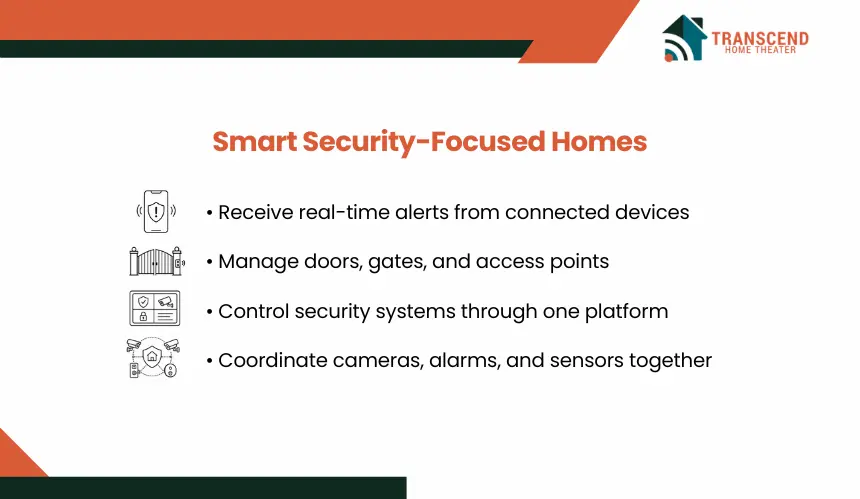
Homes with elevated security requirements benefit from automation because individual security devices can operate as a coordinated system rather than as isolated components. The result is faster threat detection, improved situational awareness, and more efficient incident response.
Real-Time Alerts and Connected Surveillance Systems
Traditional security systems often rely on passive recording or delayed notification. Automated security platforms continuously analyze activity from cameras, motion sensors, glass-break detectors, and door contacts to generate immediate alerts when unusual events occur.
This allows homeowners to verify activity in real time and determine whether a response is necessary before a situation escalates.
Automated Door, Gate, and Entry-Point Management
Security vulnerabilities frequently occur at access points. Smart locks, automated gates, garage door controls, and credential-based entry systems provide greater control over who can access the property and when.
Temporary access permissions can be assigned to contractors, service providers, or guests without distributing physical keys, reducing unauthorized access risks while maintaining accountability through activity logs.
Integrating Sensors, Alarms, Cameras, and Mobile Devices
The greatest security advantage comes from system integration. When sensors, surveillance equipment, alarm panels, and mobile applications communicate through a unified automation platform, multiple actions can be triggered from a single event.
In established residential communities throughout Maryland, homeowners often prioritize security systems that provide centralized visibility across multiple entry points and outdoor areas. This demand is especially common in neighborhoods with larger properties and more complex residential layouts.
For many homeowners evaluating home automation in Chevy Chase, MD, integrated security ecosystems are a leading investment priority because they combine surveillance, access control, environmental monitoring, and mobile management within a single operational framework.
For example, an unauthorized entry detection can simultaneously activate recording devices, illuminate exterior lighting, lock selected access points, and send notifications to the homeowner. This level of coordinated response significantly improves response time and overall property awareness.
4. Busy Family Homes
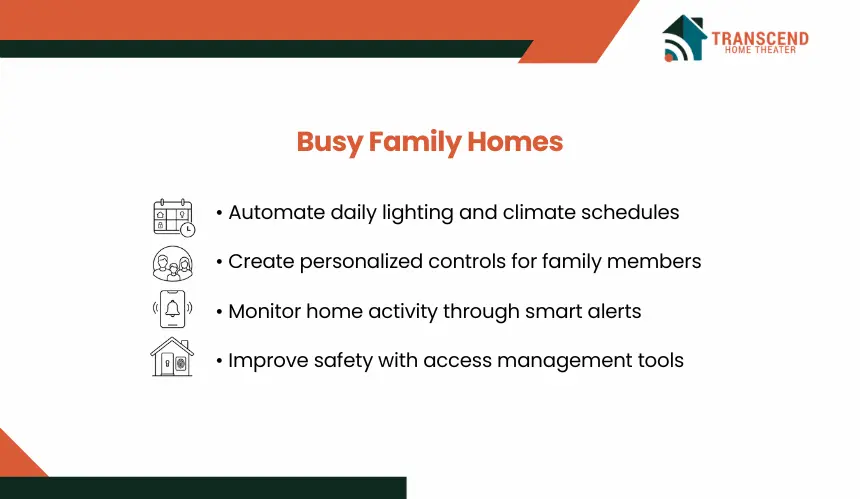
Busy family households benefit from automation because multiple occupants, varying schedules, and frequent movement throughout the home create ongoing management demands. Automation reduces routine system adjustments while improving coordination, safety, and day-to-day operational efficiency.
Automating Routine Lighting and Climate Schedules
Family homes often experience predictable occupancy patterns throughout the day. Morning departures, school schedules, work routines, evening activities, and bedtime hours can all be aligned with automated lighting and climate settings.
Rather than relying on manual adjustments, automation platforms can activate predefined schedules that maintain comfort while reducing unnecessary energy consumption during unoccupied periods.
Managing Multiple Occupants Through User-Specific Controls
Homes with several occupants often require different access permissions, preferences, and automation settings. Modern systems can recognize individual users through mobile devices, credentials, or personalized profiles.
This allows family members to receive customized lighting scenes, temperature preferences, access permissions, and notifications without affecting the experience of other occupants within the household.
Improving Safety Through Alerts, Monitoring, and Access Management
Safety requirements often increase as household activity becomes more complex. Automated notifications can provide awareness of unlocked doors, unexpected motion activity, garage door status, water leaks, smoke detection events, or other conditions requiring attention.
Parents can also monitor property access events, receive notifications when children arrive home, and manage temporary access for caregivers, visitors, or service providers. These capabilities create greater visibility into household activity without requiring constant manual oversight
Energy Efficiency and Long-Term Cost Offsets
Some home automation costs may be balanced by efficiency gains over time. Smart thermostats can reduce wasted heating and cooling, automated lighting can limit unnecessary electricity use, and energy monitoring tools can reveal high-consumption patterns.
These savings depend on household behavior, system programming, HVAC usage, and property size. The best results usually come when automation rules match real occupancy patterns instead of relying only on manual control.
5. Luxury and Custom-Built Homes
Luxury and custom-built homes often contain a larger number of interconnected systems, making automation a practical control solution rather than a convenience upgrade. As property complexity increases, centralized management becomes essential for maintaining a consistent user experience across the entire residence.
Centralized Control of Entertainment, Lighting, Shading, and Comfort Systems
High-end homes frequently incorporate dedicated media rooms, multi-zone audio systems, motorized shades, architectural lighting, wine storage areas, and advanced HVAC configurations. Managing these systems independently can create operational inefficiencies and inconsistent performance.
A centralized automation platform allows homeowners to control multiple technologies through a unified interface, reducing system fragmentation and simplifying day-to-day operation.
Personalized Scenes and Whole-Home Automation Experiences
Custom residences are often designed around specific lifestyle preferences. Automation enables multiple systems to respond simultaneously to predefined scenarios rather than requiring individual adjustments.
For example, a single command can coordinate lighting levels, shade positions, climate settings, entertainment equipment, and outdoor features based on how a particular space is being used. This creates a more predictable and tailored living environment throughout the property.
Integrating Advanced Technologies During Construction or Renovation
Custom-built homes provide opportunities to incorporate automation infrastructure before walls are finished and systems are fully installed. Early integration allows for cleaner wiring pathways, centralized equipment placement, improved network design, and greater long-term scalability.
This approach also simplifies future technology upgrades by ensuring that control systems, low-voltage infrastructure, networking equipment, and connected devices are designed to operate as part of a unified ecosystem from the beginning.
In neighborhoods such as Rollingwood, Martin’s Additions, and the areas surrounding Chevy Chase Club, homes often feature larger floor plans, dedicated entertainment spaces, and extensive outdoor living areas that can benefit from integrated automation control.
6. Aging-in-Place and Accessibility-Focused Homes
Aging-in-place and accessibility-focused homes benefit from automation because physical interaction with household systems can become more difficult over time. Automation reduces reliance on manual controls while improving independence, accessibility, and response capabilities during everyday activities.
Voice-Controlled Operation of Essential Home Systems
Traditional switches, thermostats, remotes, and control panels may become less practical for individuals with mobility, vision, or dexterity limitations. Voice-enabled automation platforms allow occupants to operate lighting, climate controls, entertainment systems, and window coverings through simple verbal commands.
This reduces physical effort while maintaining access to essential home functions throughout the property.
Automated Lighting and Pathway Illumination
Falls are one of the most common residential safety concerns for older adults and individuals with mobility challenges. Automated lighting systems can respond to motion detection, occupancy sensors, scheduled routines, or environmental conditions without requiring manual activation.
Strategically placed lighting can automatically illuminate hallways, staircases, bathrooms, and entry pathways when movement is detected, improving visibility during nighttime navigation.
Emergency Notifications, Monitoring, and Caregiver Support Features
Accessibility-focused automation systems can extend beyond convenience by providing additional layers of monitoring and communication. Connected sensors can detect unusual inactivity, environmental hazards, smoke events, water leaks, or emergency situations requiring attention.
Notifications can be delivered to family members, caregivers, or designated contacts, enabling faster awareness of potential issues. For households supporting long-term independent living, these capabilities help bridge the gap between personal autonomy and proactive safety oversight.
In communities throughout Chevy Chase, MD, many homes were originally built decades ago and are being adapted to support long-term occupancy rather than relocation. Automation technologies can often be integrated during accessibility upgrades without requiring major structural modifications.
Across Maryland, homeowners increasingly view automation as a practical component of aging-in-place planning because it supports accessibility, safety, and household management through technologies that can adapt to changing mobility needs over time.
Frequently Asked Questions
Which home automation features should homeowners prioritize first?
Homeowners should usually prioritize systems tied to daily function, risk reduction, and energy control. Smart locks, lighting automation, thermostats, leak sensors, video doorbells, and security alerts often deliver the clearest early value. Entertainment, shading, and scene-based controls can be added later once the core automation platform is stable.
Is wired or wireless automation better for residential homes?
Wired automation is usually better for new construction, major renovations, and large custom homes because it offers stronger reliability, cleaner infrastructure, and better long-term scalability. Wireless automation works well for existing homes where opening walls is impractical. Many modern systems use a hybrid setup for flexibility and performance.
Can an older home be upgraded with automation without major remodeling?
Older homes can often support automation through wireless switches, smart thermostats, retrofit lighting controls, plug-in modules, sensors, and network-based security devices. The main limitations are electrical capacity, Wi-Fi coverage, wall materials, and existing wiring conditions. A site assessment helps determine which upgrades can be installed cleanly.
How much planning is needed before installing a whole-home automation system?
Whole-home automation requires planning around network strength, device compatibility, control zones, user access, low-voltage wiring, and future expansion. Poor planning can create disconnected devices, weak signal areas, and difficult system management. A clear automation map helps align lighting, HVAC, security, audio, and shading into one reliable ecosystem.
Does home automation increase property value?
Home automation can support property value when it improves practical function, energy efficiency, security, and buyer appeal. Integrated systems are usually more valuable than scattered smart devices because they feel intentional and easier to use. Appraisal impact varies, but automation can strengthen marketability in higher-end and technology-forward homes.
What is the biggest mistake homeowners make with automation installation?
The most common mistake is adding devices without a central control strategy. Random smart bulbs, cameras, locks, and thermostats may work individually but become difficult to manage together. A better approach starts with the home’s core needs, then selects compatible devices that connect through a scalable automation platform.