
Matter Protocol Explained: The Future of Smart Home Device Compatibility in 2026
A Direct Answer: Matter is an open-source smart home protocol designed to make connected devices from different brands work together seamlessly. |
For years, smart home users have struggled with fragmented platforms and brand-specific limitations. Devices often required separate hubs, apps, or ecosystems, creating frustration instead of convenience. Matter was created to eliminate these barriers by standardizing communication over IP-based networks such as Wi-Fi, Thread, and Ethernet.
This article will cover how the Matter protocol works, what’s new expected in the 2026 update, how it enhances device compatibility, and what it means for the future of smart homes.
What Is the Matter Protocol and How Does It Work?

Matter is often described as the universal language of smart home devices. It provides a common framework that allows connected products from different manufacturers to communicate efficiently without needing multiple hubs or platform-specific integrations.
By using standard IP-based communication, Matter ensures that devices like lights, locks, cameras, and thermostats can connect directly to each other and to popular ecosystems such as Google Home, Apple Home, Amazon Alexa, and Samsung SmartThings.
Understanding the Foundation of Matter Protocol
The foundation of Matter lies in its open-source architecture, which was developed by the Connectivity Standards Alliance (CSA), previously known as the Zigbee Alliance.
This alliance includes over 200 technology companies that collaborate to simplify and unify the smart home experience. Matter uses Internet Protocol (IP) as its core transport layer, making it compatible with existing home networks through Wi-Fi, Thread, and Ethernet.
The Core Goals of Matter Protocol
The primary goal of Matter is to eliminate fragmentation in the smart home industry by creating a single, reliable, and secure connectivity standard. It focuses on four key objectives that define its architecture and purpose:
- Interoperability Across Brands: Devices certified under the Matter protocol can work seamlessly with one another, regardless of manufacturer or ecosystem.
- Simplified Setup Process: Users can easily pair new devices through a standardized onboarding flow using QR codes or app-based discovery, minimizing technical complexity.
- Security and Privacy First: Matter enforces strong encryption, secure device authentication, and local data processing to protect user privacy and prevent unauthorized access.
- Developer Accessibility: Through its open-source SDK, Matter allows developers to create compatible devices faster and more efficiently without being locked into specific platforms.
By addressing these goals, Matter establishes itself as the cornerstone for next-generation smart homes. It ensures that users can choose devices based on quality and function rather than ecosystem compatibility.
Device Categories Supported by the Matter Protocol
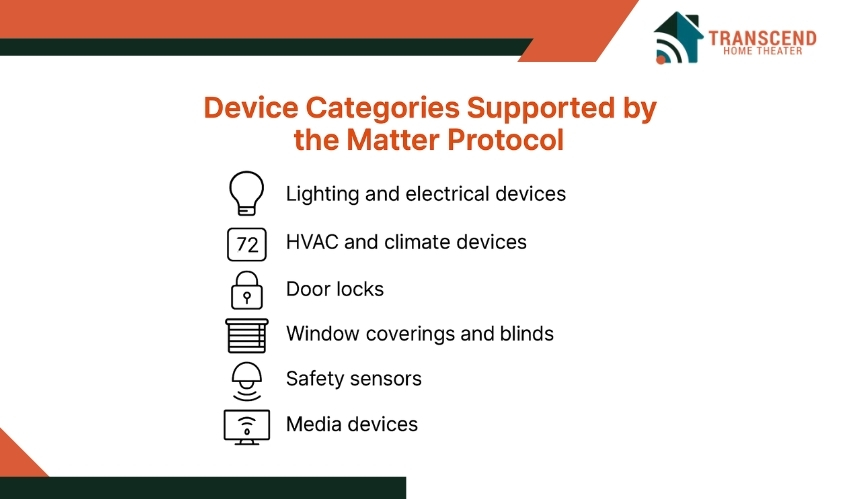
One of the main strengths of the Matter protocol lies in its ability to unify a wide range of smart home devices under one communication standard. Instead of functioning as a single-purpose system, Matter brings together almost every essential category of connected technology, allowing users to create a seamless and brand-agnostic smart home ecosystem.
Matter 1.0 (Released October 2022)
This was the first public release of the protocol and introduced the foundation of device interoperability.
Supported device categories included:
- Lighting and electrical devices (bulbs, switches, plugs)
- HVAC and climate devices (thermostats, fans)
- Door locks
- Window coverings and blinds
- Safety sensors (motion, contact)
- Media devices (smart TVs, streaming units)
- Bridges (to connect older systems like Zigbee devices)
Purpose of Matter 1.0: Establish core smart home functionality across lighting, climate, and access control.
Matter 1.1 (Released May 2023)
This version was more developer-focused, improving reliability and streamlining device certification.
Key updates of Matter 1.1 include:
- No new categories were added, but performance enhancements were made.
- Improved device commissioning and diagnostic capabilities.
- Expanded documentation for developers building Matter-compatible products.
Purpose of Matter 1.1: Strengthen usability and simplify integration for manufacturers.
Matter 1.2 (Released October 2023)
This was a major expansion release with nine new device categories added to the standard.
New supported categories included:
- Refrigerators and freezers
- Dishwashers
- Laundry washers
- Robotic vacuums
- Smoke and CO alarms
- Air quality sensors
- Air purifiers
- Fans (more advanced control profiles)
- Room air conditioners
Purpose of Matter 1.2: Extend Matter from lighting and locks into household appliances and air quality management.
Matter 1.3 (Released May 2024)
This update pushed Matter further into multimedia and energy management.
New supported categories included:
- Smart TVs and media playback devices (expanded capabilities)
- Electric vehicle chargers
- Energy management systems and meters
- Water management and leak detection
- Cooktops, ovens, and extractor hoods
Purpose of Matter 1.3: Enable smarter energy tracking and integrate entertainment devices and major appliances.
Matter 1.4 (Expected late 2025)
This version (currently in progress) is expected to introduce support for more complex automations and extended interoperability across commercial IoT and healthcare-related devices. While official details have not been fully published, early previews suggest expansion into:
- Cameras and video doorbells
- Smart irrigation systems
- Health monitoring sensors (under review)
Matter vs. Other Smart Home Standards
Before the introduction of Matter, smart home connectivity relied on multiple competing standards that often created confusion and compatibility gaps.
Systems like Zigbee, Z-Wave, Thread, and Wi-Fi each offered unique benefits but lacked the unified interoperability that modern users expect. Matter redefines this landscape by integrating the best aspects of these technologies into a single, open protocol that simplifies communication across devices and platforms.
Comparing Matter with Existing Standards
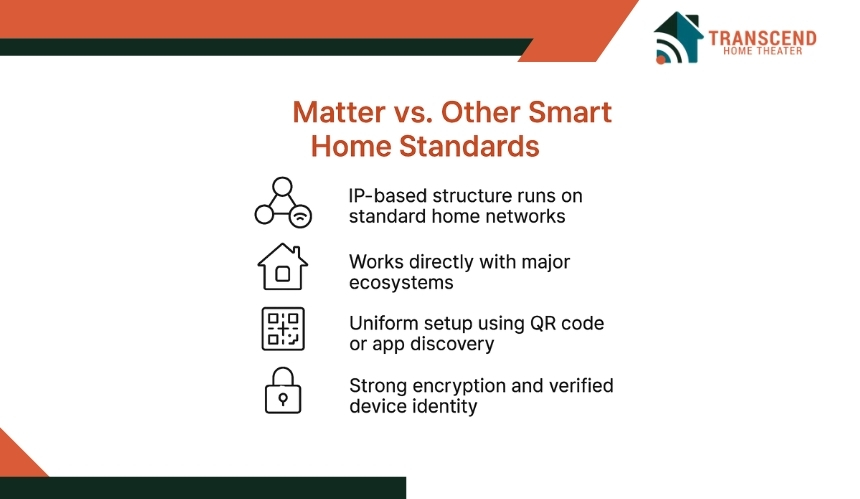
While all major smart home protocols aim to connect devices, they differ in how they manage communication, range, security, and scalability. Matter stands apart for its IP-based structure, which allows it to run directly on standard home networks without extra bridges or translators.
The table below covers the core differences between Matter and other popular smart home standards to help clarify how each technology functions and where Matter holds its advantages.
Feature | Matter | Zigbee | Z-Wave | Thread | Wi-Fi |
Communication Type | IP-based (Wi-Fi, Thread, Ethernet) | Proprietary Mesh | Proprietary Mesh | IP-based Mesh | Direct IP |
Ecosystem Support | Multi-brand (Apple, Google, Amazon, Samsung) | Limited (via hubs) | Limited (via hubs) | Backbone for Matter | Wide but fragmented |
Security Model | High (depends on network type) | AES-128 | AES-128 | AES-128 | Variable |
Range and Reliability | High (depends on network type) | Moderate | Long range, lower speed | Medium | High bandwidth, higher power use |
Backward Compatibility | Strong (via bridges and updates) | Partial | Partial | Moderate | Strong |
This table shows that while Zigbee and Z-Wave were successful in creating mesh networks for smaller ecosystems, they struggled with widespread adoption due to proprietary limitations.
Key Advantages of Matter Over Legacy Standards
Matter addresses long-standing issues that prevented earlier standards from achieving universal compatibility. Its open-source framework enables collaboration among top manufacturers while ensuring consistent functionality across all certified devices.
Major advantages include:
- Native Cross-Platform Operation: Works directly with major ecosystems without requiring adapters or gateways.
- Simplified Onboarding: Uniform setup across brands using QR codes and app-based discovery.
- Enhanced Security: Strong encryption and verified device identity at every connection point.
- Future-Ready Design: Built on Internet Protocol, making it adaptable to both current and upcoming smart home technologies.
These qualities make Matter a true convergence point for the smart home industry, streamlining both user experience and developer implementation.
Where Communication Standards Other than Matter Still Hold Relevance
Although Matter is positioned as the universal standard, older protocols still play important roles. Thread remains integral as a low-power mesh networking technology that supports Matter’s backbone, providing stability for devices such as sensors and switches.
Meanwhile, Zigbee and Z-Wave continue to serve existing smart home systems that predate Matter and are often connected through compatible bridges.
For advanced use cases, Wi-Fi continues to handle high-bandwidth applications like video streaming or cameras, complementing Matter’s connectivity model rather than competing with it.
Setting Up a Matter-Enabled Smart Home: A Step-by-Step Guide
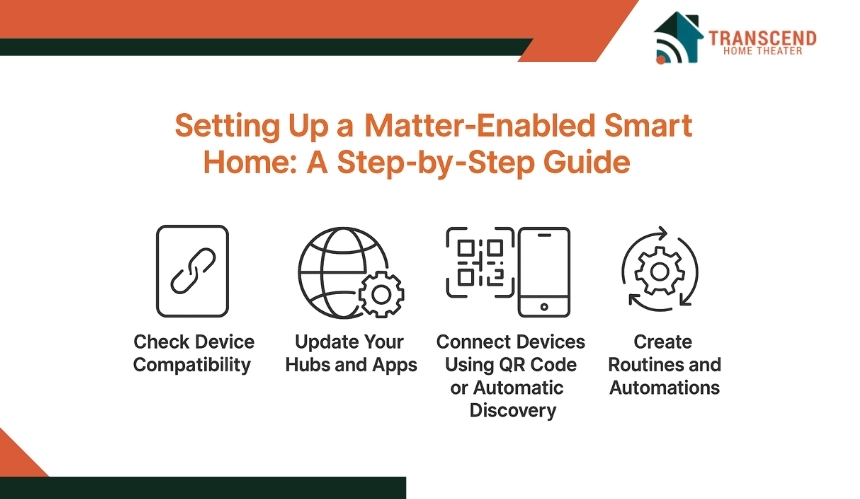
Building a Matter-enabled smart home is simpler than ever. The protocol was designed to streamline setup across devices, ensuring that homeowners can easily connect, control, and automate products from different brands through a unified ecosystem.
Whether using Google Home, Apple Home, or Alexa, the setup process follows a consistent pattern with only a few steps required. For those seeking a smoother setup or advanced integration, consulting a smart home automation expert can help optimize device placement, network configuration, and long-term reliability.
Step 1: Check Device Compatibility
Before purchasing or connecting any product, verify that it carries the Matter-certified logo. This certification ensures that the device follows the official Connectivity Standards Alliance (CSA) specifications and can operate with other certified devices. Many brands display this logo on packaging or in product listings, indicating full interoperability across supported ecosystems.
Step 2: Update Your Hubs and Apps
Ensure that your controlling platform, such as Google Home, Apple Home, Amazon Alexa, or Samsung SmartThings, is running the latest firmware version. Updates typically include improved Matter integration and new pairing capabilities. Keeping both your apps and network hubs current ensures smooth communication between devices.
Step 3: Connect Devices Using QR Code or Automatic Discovery
Once your system is ready, open the smart home app of your choice and select the option to add a new Matter device. You can scan the device’s QR code or allow the app to automatically discover it through your local Wi-Fi or Thread network. Because Matter uses IP-based communication, setup is usually completed within seconds without requiring multiple apps or additional gateways.
Step 4: Create Routines and Automations Across Platforms
After connecting your devices, you can build routines that involve products from different brands. For example, a Matter-compatible motion sensor can trigger lights from another manufacturer or adjust a thermostat connected through a separate ecosystem.
Because all devices share a standardized protocol, automation becomes predictable and stable regardless of brand origin.
Step 5: Manage Security and Access Permissions
Finally, review your app’s security and sharing settings. Matter allows multiple household members to access and control devices, but it also provides options to manage permissions for guests or family members. Limiting control access to verified accounts adds another layer of privacy and protection to your network.
Matter Protocol 2026 Update: What to Expect
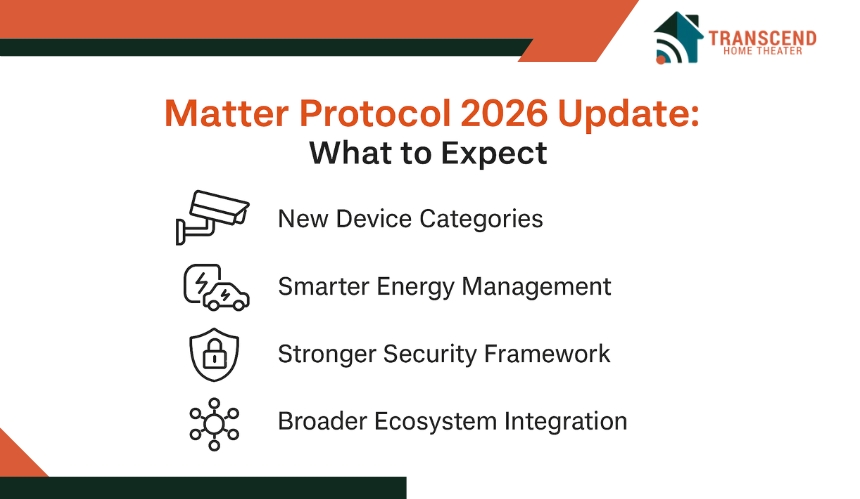
The upcoming Matter 2026 update will further enhance device compatibility, automation, and data security across connected ecosystems. This version aims to make smart homes more intelligent, energy-efficient, and accessible for both users and developers.
- New Device Categories: Expected additions include cameras, video doorbells, irrigation systems, and health and air-quality sensors, expanding Matter’s reach into home security and wellness.
- Smarter Energy Management: Integration with EV chargers, solar systems, and smart meters will help users monitor and optimize energy use in real time.
- Stronger Security Framework: Enhanced encryption, device authentication, and privacy controls will address data protection as Matter scales to more critical applications.
- Developer Tools Upgrade: A refined SDK and faster CSA certification process will simplify product testing and speed up market readiness.
- Broader Ecosystem Integration: Matter 2026 is expected to extend beyond homes, supporting smart buildings and multi-unit networks for scalable automation.
For homeowners preparing to embrace the next wave of connected living, partnering with Transcend Home Theater can make all the difference. Their smart home automation experts can design, install, and optimize Matter-ready systems that bring comfort, security, and efficiency together in one seamless experience.
Frequently Asked Questions
Will Matter work with future technologies like 5G and Wi-Fi 7?
Yes. Matter is designed around Internet Protocol (IP), which allows it to adapt easily to new networking standards. As 5G and Wi-Fi 7 become more common, Matter will be able to utilize their faster speeds and lower latency to enhance real-time automation and communication between devices.
Can Matter be used for voice-controlled automations?
Absolutely. Matter fully supports integration with voice assistants like Alexa, Siri, and Google Assistant. Future updates will allow users to create cross-platform voice commands, meaning a single voice instruction can trigger devices from multiple brands simultaneously.
How will Matter influence subscription-based smart home services?
Matter’s open-source structure is expected to reduce dependence on paid ecosystems. However, some manufacturers may still offer premium app-based services, advanced automation, or cloud analytics. Overall, Matter promotes freedom of choice by enabling interoperability without mandatory subscriptions.
Can existing Zigbee or Z-Wave devices be upgraded to Matter?
Some devices can transition through bridge hubs or firmware updates, depending on manufacturer support. Several brands are already releasing hybrid hubs that translate Zigbee or Z-Wave signals into the Matter ecosystem, allowing older devices to coexist within newer smart home setups.
What role does Matter play in sustainability and energy efficiency?
Matter supports smart energy management by improving how devices communicate and share power usage data. Through better coordination between smart plugs, meters, and appliances, Matter helps homeowners reduce waste, schedule operations efficiently, and contribute to sustainable energy consumption.
Are Matter-certified products region-specific or globally compatible?
Matter devices are designed for global interoperability. While electrical standards and regulations vary by region, certification ensures that any Matter-enabled product can communicate universally with others, regardless of brand or geographic location.
Will Matter eventually support AI-based personalization?
Yes. Future Matter releases are expected to integrate with AI-driven learning models that personalize automation based on user behavior, environment, and preferences. This evolution will make smart homes not only connected but also context-aware and adaptive to lifestyle patterns.