
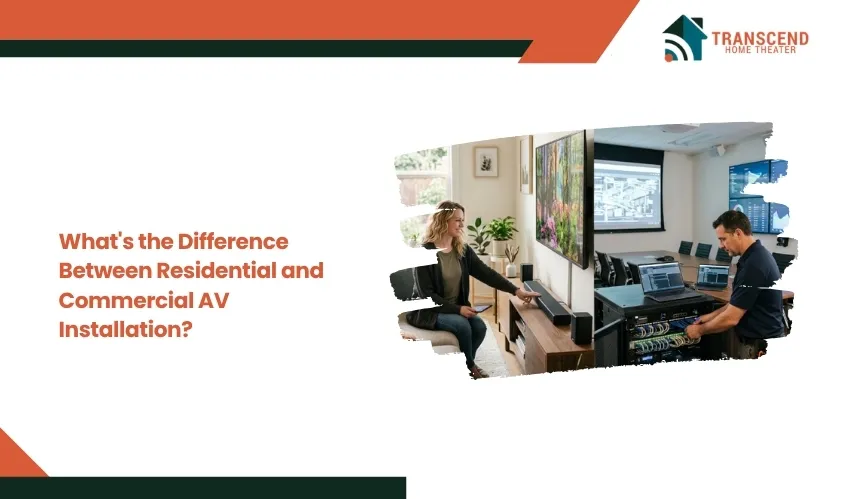
What's the Difference Between Residential and Commercial AV Installation?
Key Takeaways:
|
Residential and commercial AV installation differ mainly in purpose, scale, equipment, infrastructure, and support needs. Residential AV systems are designed for home entertainment, comfort, and personal control, such as home theaters, whole-home audio, smart TVs, and streaming setups.
Commercial AV systems are built for business communication, collaboration, presentations, digital signage, paging, and multi-user environments. They usually require stronger cabling, network integration, centralized control, higher-grade equipment, and ongoing technical support.
Understanding these differences helps homeowners and businesses choose an AV system that fits the space, usage demands, and long-term performance goals.
What Is the Main Difference Between Residential and Commercial AV Installation?
Residential and commercial AV installations serve different purposes. Residential systems are designed around personal entertainment and convenience, while commercial systems support communication, collaboration, customer experiences, and day-to-day business operations.
Residential AV Installation Focuses on Comfort and Entertainment
Residential AV systems are built to enhance the living experience inside a home. The design usually centers on activities such as watching movies, listening to music, gaming, or controlling smart home features from a single interface.
Common residential applications include:
- Home theaters
- Whole-home audio systems
- Smart televisions and streaming devices
- Multi-room media distribution
- Voice-controlled automation
System decisions are often influenced by homeowner preferences, room aesthetics, and lifestyle habits rather than operational requirements.
Commercial AV Installation Focuses on Communication and Business Use
Commercial AV systems are designed to support productivity, information sharing, and customer engagement. Instead of serving a single family, these environments must accommodate employees, visitors, clients, or large audiences.
Commercial applications commonly include:
- Conference room technology
- Video conferencing platforms
- Digital signage systems
- Training rooms and presentation spaces
- Public address and paging systems
- Video walls and display networks
These systems are expected to operate consistently throughout the workday and support multiple users simultaneously.
The Biggest Difference Is Scale, Use Case, and System Demand
The primary distinction between residential and commercial AV installation lies in how the system will be used. Residential environments prioritize user comfort and entertainment quality, whereas commercial environments prioritize functionality, reliability, and operational efficiency.
Residential installations generally remain simpler because they serve fewer users and operate within a more controlled environment
How AV System Design Differs Between Homes and Businesses
The design phase determines how an AV system will perform within its environment. Residential and commercial projects follow different planning priorities because each space has unique usage patterns, user expectations, and physical constraints.
How Is Residential AV Design Built Around Personal Preferences?
Residential AV design is customized around the homeowner’s lifestyle and the characteristics of individual rooms. Factors such as seating arrangements, viewing angles, interior aesthetics, and preferred entertainment activities influence the final layout.
For example, a home theater may require speaker placement based on seating positions, while a whole-home audio system may prioritize convenience and room-to-room accessibility. Equipment is often concealed within cabinetry, walls, or entertainment centers to preserve the appearance of the living space.
Personalization plays a major role because the system is intended to match the habits and comfort preferences of a limited number of users.
Homeowners planning home theater design and installation in Maryland often evaluate room dimensions, seating locations, lighting conditions, and speaker placement together to create an immersive viewing experience that matches the layout of the home.
How Is Commercial AV Design Built Around Workflow and Function?
Commercial AV design focuses on how people interact with the space during business activities. Room capacity, presentation requirements, collaboration needs, and user accessibility all influence system planning.
A conference room, training facility, retail environment, or auditorium may require different display sizes, microphone coverage, control interfaces, and signal routing methods. The goal is to ensure that technology supports productivity rather than creating operational obstacles.
Design decisions are often based on repeatable performance and ease of use for multiple users with varying technical experience.
Why Are Acoustic and Visual Requirements More Complex in Commercial Spaces?
Commercial environments often present greater challenges because larger rooms and higher occupancy levels affect sound and image quality. Background noise, ceiling height, lighting conditions, and audience distribution must all be considered during the design process.
To maintain consistent performance, commercial projects may incorporate:
- Acoustic treatments to control echo and reverberation
- Multiple speakers for even sound distribution
- Microphone coverage zones
- High-brightness displays for visibility in different lighting conditions
- Strategic screen placement for larger audiences
Residential spaces typically involve fewer variables, making system calibration and room optimization less complex.
What Equipment and Technology Are Used in Each Type of AV Installation?
Although both environments use audio and video technology, the hardware requirements differ significantly. Residential systems typically prioritize user experience, while commercial systems require equipment that supports higher workloads, larger spaces, and multiple users.
What Equipment Is Commonly Used in Residential AV Systems?
Residential AV installations usually rely on consumer-focused equipment designed for entertainment and home automation. These components are selected based on room size, media preferences, and ease of use.
Common residential AV components include:
- Smart televisions and projectors
- Surround sound speakers and soundbars
- AV receivers
- Streaming devices
- Whole-home audio controllers
- Smart home control systems
Many homeowners prefer systems that blend into the interior environment while providing centralized control through mobile devices or voice assistants.
What Equipment Is Used in Commercial AV Systems?
Commercial AV systems use hardware designed for continuous operation and larger audiences. Businesses often require equipment that can support presentations, conferencing, public communication, and digital content delivery.
Common commercial AV components include:
- Commercial-grade displays
- Video conferencing systems
- Ceiling speakers and distributed audio systems
- Wireless microphones
- Digital signage platforms
- Amplifiers and DSP processors
- Touchscreen control panels
Facilities such as offices, schools, medical buildings, and event spaces frequently depend on these systems to maintain consistent communication throughout the day.
Why Does Commercial AV Require Stronger Infrastructure?
Commercial installations often depend on supporting infrastructure that extends beyond the visible equipment. Signal distribution, network capacity, cable management, and centralized control all influence system reliability.
For example, many businesses in Frederick, MD, occupy renovated historic buildings near Downtown Frederick and Carroll Creek. Integrating modern AV systems into these properties may require structured cabling solutions, equipment racks, and carefully planned wiring routes that preserve existing architectural features.
Additional infrastructure commonly found in commercial projects includes:
- Network switches and AV-over-IP systems
- Equipment racks and rack-mounted components
- Structured low-voltage cabling
- Signal extenders and matrix switchers
- Centralized monitoring and control systems
Residential systems generally require less infrastructure because they serve fewer rooms and operate within a smaller physical footprint.
Residential and Commercial AV Installation Differences
The installation phase varies considerably between residential and commercial projects. Differences in project scope, coordination requirements, and regulatory considerations often affect timelines, labor requirements, and deployment strategies.
Why Is Residential Installation Usually More Personalized?
Residential AV projects are generally completed within a limited number of rooms and involve direct collaboration with the homeowner. Installation decisions often focus on clean wiring, device placement, and setup preferences that fit the household’s daily routine.
Technicians may conceal wiring behind walls, integrate equipment into furniture, and adjust system settings based on the family’s viewing and listening preferences. Since the number of users is relatively small, system configuration can be tailored to individual habits rather than standardized procedures.
Project schedules are typically shorter because fewer devices and less supporting infrastructure are involved.
Why Does Commercial Installation Require More Planning and Coordination?
Commercial projects involve multiple stakeholders, including business owners, architects, electricians, IT teams, and facility managers. Coordination becomes necessary because AV systems frequently interact with existing networks, communication platforms, and building systems.
Large installations may require:
- Site surveys and room assessments
- Equipment staging and testing
- Coordination with low-voltage contractors
- Integration with corporate networks
- User training after deployment
Many organizations schedule installation work during evenings or weekends to reduce interruptions to employees and customers.
How Do Codes and Compliance Affect Commercial AV Projects?
Commercial installations are subject to additional requirements that are rarely encountered in residential projects. Building regulations, accessibility standards, fire safety measures, and cable ratings can all influence how a system is deployed.
Across Maryland, commercial facilities often must coordinate AV upgrades with broader construction or renovation projects to ensure compliance with local building requirements and occupancy standards. Schools, healthcare facilities, and government buildings may face additional documentation and approval processes.
Examples of compliance considerations include:
- Fire-rated cabling requirements
- ADA accessibility standards
- Equipment mounting and load specifications
- Emergency communication integration
- Permit and inspection requirements
Residential projects generally face fewer regulatory challenges because the systems are installed within private living spaces rather than public or commercial environments.
Cost, Maintenance, and Support Differences Between Residential and Commercial AV Systems
The long-term investment required for an AV system extends beyond the initial installation. Residential and commercial projects differ in what creates the expense, from room count and customization to system scale and business continuity needs.
What Factors Influence Residential AV Costs?
Residential AV costs are largely determined by the level of customization and the number of spaces being served. A basic living room setup requires significantly fewer components than a dedicated home theater or a whole-home automation system.
Common factors that affect residential pricing include:
- Display and speaker selection
- Number of rooms connected to the system
- Smart home integration requirements
- Custom cabinetry or hidden wiring
- Automation and control features
Because these systems are used by a limited number of people, maintenance needs are typically limited to occasional upgrades, calibration, or component replacement.
Why Are Commercial AV Systems More Expensive?
Commercial AV projects often involve larger coverage areas, higher equipment standards, and more extensive infrastructure. Reliability becomes a priority because system downtime can interrupt meetings, training sessions, customer interactions, or business operations.
Major cost drivers include:
- Multiple displays and audio zones
- Video conferencing infrastructure
- Centralized control systems
- Network integration requirements
- Structured cabling and equipment racks
- Professional programming and configuration
Businesses investing in commercial AV system installation in Frederick, MD, often evaluate scalability as well, ensuring future expansions can be accommodated without replacing the entire system.
Why Does Commercial AV Usually Require Ongoing Support?
Commercial environments depend on technology that operates continuously throughout the workday. As a result, regular maintenance becomes part of the ownership cycle rather than an occasional service.
Ongoing support may include:
- Firmware and software updates
- Troubleshooting and diagnostics
- Preventive maintenance inspections
- User training for employees
- Remote monitoring and system optimization
Residential systems generally require less frequent service because usage patterns are lighter and fewer users interact with the equipment. Commercial systems, by comparison, benefit from proactive support to maintain consistent performance and minimize operational disruptions.
Which Type of AV Installation Is Right for Your Space?
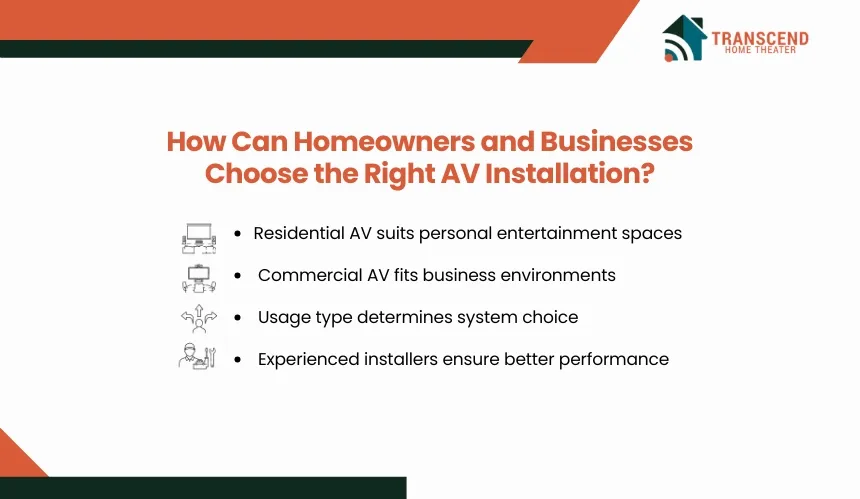
The right AV solution depends on how the space is used, who will interact with the system, and the level of performance required. Matching the installation type to the environment reduces unnecessary complexity and ensures the system supports its intended purpose.
When Is Residential AV Installation the Better Choice?
Residential AV installation is best suited for private living environments where entertainment, convenience, and smart home functionality are the primary goals.
A residential solution is often appropriate for:
- Home theaters
- Family rooms and media rooms
- Whole-home audio systems
- Smart home automation setups
- Outdoor entertainment areas
Homeowners typically prioritize ease of use, aesthetics, and personalized control features that fit daily routines.
When Does Commercial AV Installation Make More Sense?
Commercial AV installation is designed for environments that require communication, collaboration, or public engagement. These systems are built to support multiple users and maintain dependable performance during daily operations.
Commercial AV solutions are commonly used in:
- Corporate offices
- Conference and meeting rooms
- Schools and training facilities
- Medical offices
- Retail stores and hospitality spaces
- Houses of worship and event venues
The focus shifts from personal preferences to operational efficiency, user accessibility, and long-term scalability.
Why Does Industry Experience Matter When Choosing an AV Installer?
Residential and commercial projects involve different technical requirements, equipment standards, and support expectations. An installer familiar with the specific environment can identify infrastructure needs, anticipate challenges, and recommend systems that align with how the space will actually function.
For example, businesses expanding throughout Frederick County or homeowners renovating older properties may face different design constraints than newly constructed spaces. Experience with the intended application often leads to smoother integration, better system performance, and fewer issues after installation.
Whether you need a custom home theater or a fully integrated commercial AV solution, Transcend Home Theater provides AV system installation tailored to the way each space is used. Serving homeowners and businesses throughout the Greater Washington, DC metropolitan area, including Maryland, Northern Virginia, and Northwest DC, the team creates reliable, high-performance audio and video environments built for long-term use.
Frequently Asked Questions
Can residential AV equipment be used in a small business?
Residential AV equipment can work in very small offices, but it may not support daily commercial use, multiple users, or longer operating hours. Businesses often need commercial displays, stronger audio distribution, network compatibility, warranty coverage, and centralized controls to reduce downtime during meetings, presentations, or customer-facing operations.
How can someone tell if an AV system needs to be scalable?
A system needs scalability when the space may add more rooms, users, displays, cameras, speakers, or control zones later. Scalable AV design uses structured cabling, network-ready hardware, expandable control systems, and equipment racks so future upgrades do not require major rewiring or full system replacement.
What should be checked before upgrading an existing AV setup?
An upgrade should start with a review of cabling, network capacity, display compatibility, speaker placement, control interfaces, and equipment age. Many performance issues come from outdated infrastructure rather than the visible devices. A proper assessment identifies whether the system needs minor adjustments, component upgrades, or complete redesign.
Who should manage a commercial AV system after installation?
Commercial AV support is often shared between the AV provider and the internal IT or facilities team. The AV installer usually handles programming, calibration, hardware troubleshooting, and system optimization, while IT may manage network access, video conferencing platforms, and security settings connected to the broader business network.
Why do some AV systems have poor sound even with expensive speakers?
Poor sound often comes from room acoustics, incorrect speaker placement, weak calibration, reflective surfaces, or mismatched amplifiers rather than speaker quality alone. Echo, uneven coverage, and background noise can reduce clarity. Proper tuning, acoustic planning, and microphone placement are essential for both home theaters and commercial meeting spaces.
Is AV-over-IP necessary for every commercial installation?
AV-over-IP is useful when audio and video signals must travel across multiple rooms, displays, or control points through a network. Smaller spaces may not need it. Larger offices, campuses, training centers, and multi-zone buildings benefit because AV-over-IP allows flexible routing, easier expansion, and centralized system management.
Is HomeKit better than Alexa or Google for motorized shades?
HomeKit may be better for Apple-focused households that prefer Siri control, local automation, and tighter integration with iPhone, iPad, Apple Watch, and HomePod. Alexa and Google Home may suit homes with broader third-party devices. The best option depends on device compatibility, preferred voice assistant, and automation goals.