
Key Takeaways
|
Ultra-Short-Throw vs Long-Throw Projectors: Pros, Cons & Room Suitability

Choosing the right projector is less about brand or resolution and more about how the device physically fits into a room. One of the most common points of confusion for buyers is the difference between ultra-short-throw and long-throw projectors, especially when trying to match performance with real-world space constraints.
Both projector types can produce large, immersive images, but they rely on very different placement principles, room layouts, and usage expectations. This guide breaks down ultra-short-throw and long-throw projectors in a clear, practical way, focusing on how each option performs in different room environments.
Understanding Projector Throw Distance
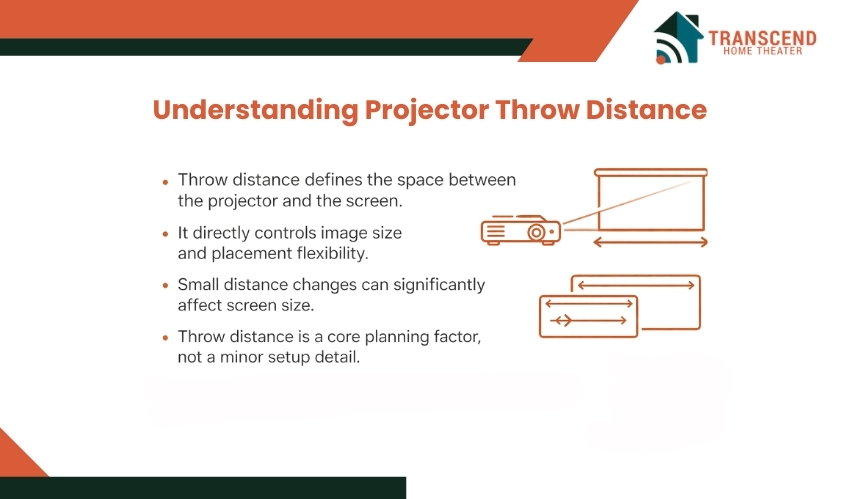
Before comparing projector types, it is important to understand the core concept that directly affects placement, image size, and room compatibility. Throw distance defines how a projector interacts with physical space, which is why it plays a larger role in real-world performance than many technical specifications.
Definition and Role of Throw Distance
Throw distance refers to the physical measurement between the projector lens and the projection surface. This distance determines how large the image becomes at a fixed position.
Even small changes in placement can significantly alter image size, making throw distance a foundational factor in projector planning rather than a minor setup detail.
Relationship Between Throw Ratio and Screen Size
Throw ratio expresses the relationship between projection distance and image width. A lower throw ratio allows a projector to create a large image from a short distance, while a higher ratio requires more room depth to achieve the same screen size. This relationship directly influences which projector types are compatible with compact rooms versus larger spaces.
Why Throw Distance Shapes Room Compatibility
Throw distance affects furniture placement, viewing angles, and installation flexibility. Rooms with limited depth restrict how far a projector can be positioned, while deeper rooms allow more adjustment freedom. Understanding this limitation early helps prevent mismatches between projector type and room layout before moving into detailed comparisons.
What Is an Ultra-Short-Throw Projector
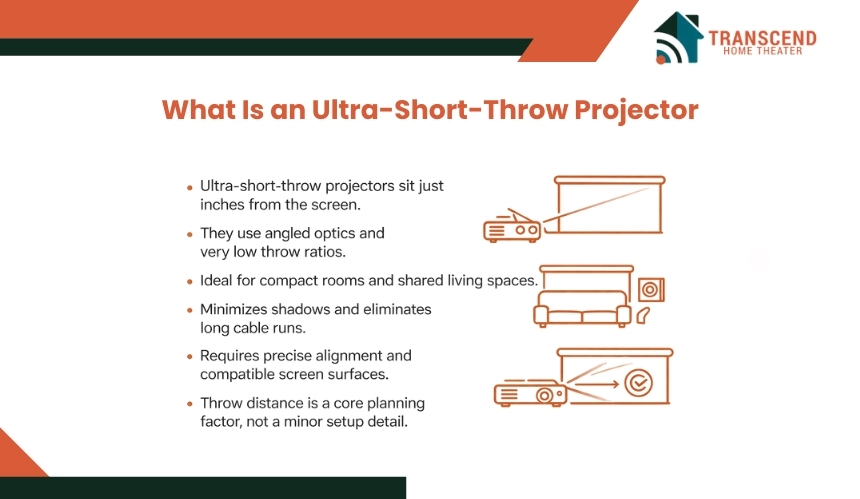
Ultra-short-throw projectors are designed for environments where space is limited but a large image is still desired. Instead of projecting across the room, these models rely on specialized optics that allow them to sit very close to the screen or wall while producing a wide, immersive display.
1. Core Design and Projection Method
An ultra-short-throw projector uses an extremely low throw ratio combined with angled optics to project upward onto the screen from just a few inches away. This design changes how the image is formed, relying more on precise geometry than distance. Because of this setup, placement accuracy and surface alignment play a much larger role in overall image quality.
2. Advantages of Ultra-Short-Throw Projectors
The most noticeable benefit of this projector type is how little room depth it requires. Large images can be achieved without ceiling mounts or long cable runs, making these projectors easier to integrate into living rooms or shared spaces. Shadow interference is also reduced since viewers rarely pass between the projector and the screen during use.
3. Limitations to Consider
Ultra-short-throw projectors are more sensitive to surface imperfections and alignment issues. Even slight wall unevenness or screen misplacement can affect image uniformity. In addition, these projectors often depend on specific screen materials to control light reflection, which can increase overall setup cost and reduce flexibility compared to traditional projection systems.
What Is a Long-Throw Projector
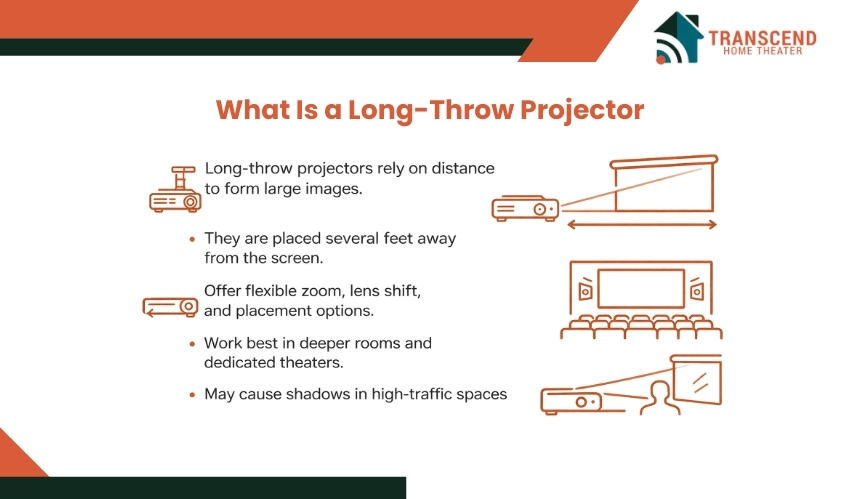
Long-throw projectors follow the traditional projection approach, using distance to create large, well-balanced images. These projectors are designed to sit several feet away from the screen, making them well-suited for rooms where depth and placement flexibility are available.
1. Core Design and Projection Method
A long-throw projector uses a higher throw ratio to project images across greater distances. This design allows the projector to sit farther back in the room, often on a ceiling mount or rear shelf.
Because image size scales gradually with distance, placement adjustments are more forgiving and easier to fine-tune during setup.
2. Advantages of Long-Throw Projectors
One of the main strengths of long-throw projectors is flexibility. They offer broader zoom ranges, lens shift options, and compatibility with a wide variety of screen sizes. These projectors also span a larger range of brightness levels and price points, making them adaptable for both casual viewing and dedicated home theater environments.
3. Limitations to Consider
Long-throw projectors require sufficient room depth to perform properly. In smaller spaces, achieving a large image can be difficult without compromising viewing distance or placement comfort. Shadows and obstructions can also become an issue if people frequently move between the projector and the screen, particularly in multi-use rooms.
Ultra-Short-Throw vs Long-Throw Projectors
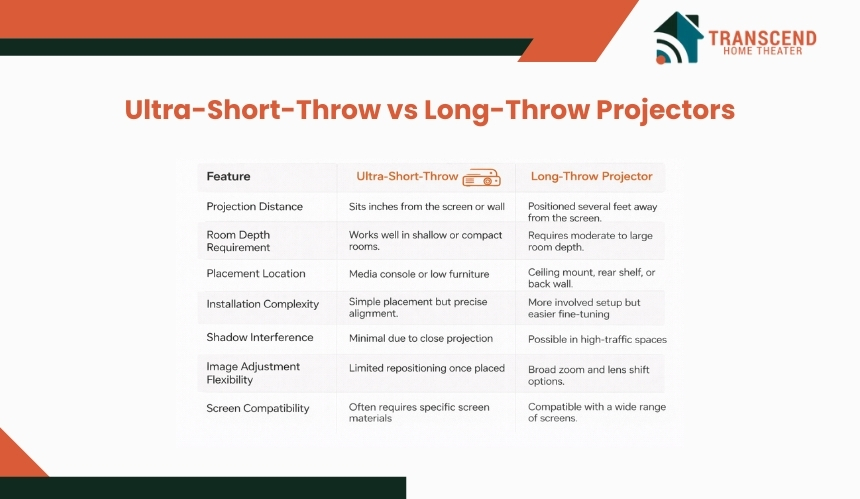
Now that both projector types have been explained individually, this section brings them together in a clear, side-by-side comparison. The goal here is not to favor one option over the other, but to show how each performs across practical factors that matter most when selecting a projector for a specific room and usage scenario.
The table below outlines the key differences in placement, space requirements, flexibility, and everyday usability. These are the factors most likely to influence whether a projector fits naturally into a room or creates ongoing setup challenges.
Feature | Ultra-Short-Throw Projector | Long-Throw Projector |
Projection Distance | Sits inches from the screen or wall | Positioned several feet away from the screen |
Room Depth Requirement | Works well in shallow or compact rooms | Requires moderate to large room depth |
Placement Location | Media console or low furniture | Ceiling mount, rear shelf, or back wall |
Installation Complexity | Simple placement but precise alignment | More involved setup but easier fine-tuning |
Shadow Interference | Minimal due to close projection | Possible in high-traffic spaces |
Image Adjustment Flexibility | Limited repositioning once placed | Broad zoom and lens shift options |
Screen Compatibility | Often requires specific screen materials | Compatible with a wide range of screens |
Typical Use Case | Living rooms and multi-purpose spaces | Dedicated home theaters and larger rooms |
This comparison highlights how the choice between ultra-short-throw and long-throw projectors is primarily shaped by room layout, placement freedom, and daily usage patterns.
With these differences clearly defined, the next section focuses on how to choose the right projector type based on individual space and viewing needs.
Choosing the Right Projector for Your Space
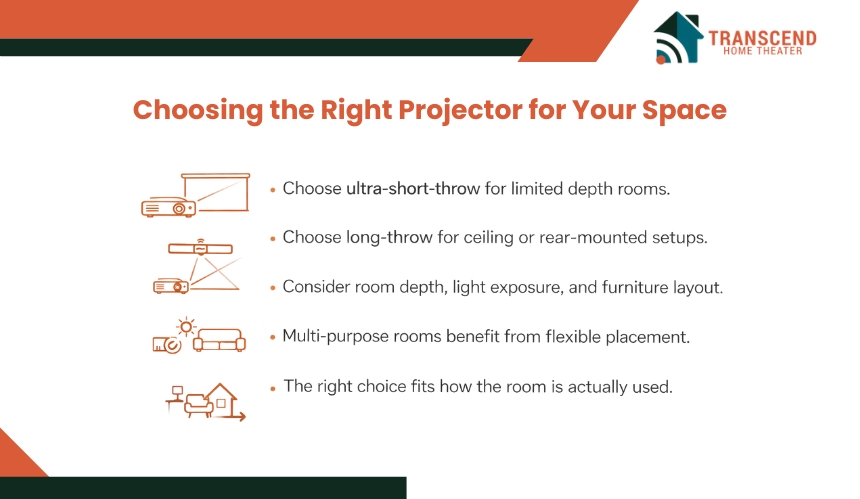
At this point in the comparison, the decision becomes more practical than technical. The right projector is the one that fits naturally into the room and supports how the space is actually used. The guidance below keeps the choice simple and outcome-focused.
Choose an Ultra-Short-Throw Projector If
You want a large screen experience in a room with limited depth. Ultra-short-throw projectors work best when the projector needs to stay close to the wall and cannot be mounted far back. This option suits living rooms, apartments, and shared spaces where furniture placement and foot traffic make traditional projection difficult.
Choose a Long-Throw Projector If
You have enough room depth to place the projector several feet from the screen. Long-throw projectors are ideal when ceiling mounting or rear placement is possible and when flexibility in screen size or image positioning is important. This setup works especially well in dedicated media rooms or home theaters.
Local Considerations for Projector Setup in the DMV Area
- Room layout and depth variations: Homes across Maryland, Northern Virginia, and Northwest DC often feature open floor plans or compact living spaces. In townhomes and older residences found in areas like Takoma Park, Kensington, and parts of Northwest DC, limited room depth can restrict traditional projector placement and influence which projector type integrates more naturally.
- Natural light exposure and window design: Many homes in locations such as Potomac, Bethesda, Arlington, and McLean include large windows and open sightlines. Strong daytime light, especially in south-facing rooms, can affect image clarity if light control or screen selection is not considered during planning.
- Ceiling height and mounting flexibility: Ceiling heights vary widely across the region. Properties in Frederick, Fairfax Station, and Clifton often allow ceiling-mounted installations, while lower ceilings in urban or older homes may limit mounting options and impact projector positioning.
- Multi-purpose room usage: Living spaces in the DMV area are frequently shared for entertainment, work, and family use. Projector setups that accommodate flexible furniture arrangements and minimize permanent structural changes tend to perform better in these environments.
- Seasonal viewing conditions: Seasonal daylight changes influence viewing comfort throughout the year. Evaluating when and how the projector will be used helps ensure consistent performance during both bright summer days and darker winter evenings.
This localized perspective helps align projector selection with real-world housing characteristics common throughout the DMV region, supporting better long-term performance and usability.
If you’re ready to turn projector specs into a setup that actually works in your space, Transcend Home Theater can help bridge that gap. From room evaluation to projector selection and clean installation, their expertise ensures your viewing experience feels effortless, immersive, and built for how you live, not just how the tech looks on paper.
Frequently Asked Questions
Can ultra-short-throw projectors fully replace a TV setup
Ultra-short-throw projectors can function as TV alternatives, but the experience depends on lighting control and screen choice. They are better suited for viewers who want large-format viewing without wall mounting, rather than those expecting the plug-and-play brightness consistency of a television.
Are ultra-short-throw projectors suitable for gaming?
Gaming suitability depends on input lag, refresh rate support, and signal processing rather than projection distance. Some ultra-short-throw models are optimized for low-latency gaming, while others prioritize cinematic image processing, making spec evaluation essential for gamers.
Do long-throw projectors perform better in bright rooms?
Long-throw projectors may offer higher brightness options, but ambient light still impacts image clarity. Room light management, screen material, and wall color influence daytime performance more than throw type alone, especially in open or sunlit spaces.
Does wall or surface quality affect ultra-short-throw projection?
Surface quality plays a critical role in ultra-short-throw projection. Minor wall imperfections can distort the image due to the steep projection angle. Dedicated projection screens are often recommended to maintain uniform brightness and sharpness across the image.
How long do projector light sources typically last today?
Modern projectors commonly use laser or LED light sources that last between 20,000 and 30,000 hours. Actual lifespan depends on usage patterns, brightness settings, and thermal management rather than whether the projector is ultra-short-throw or long-throw.