
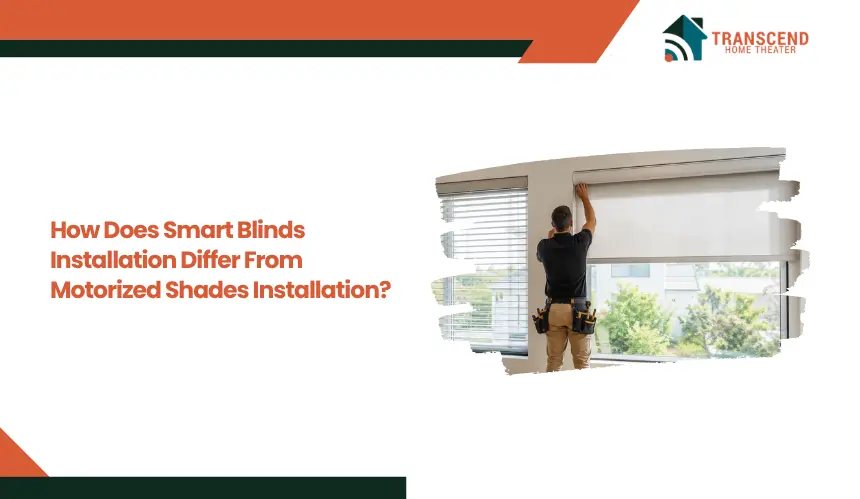
How Does Smart Blinds Installation Differ From Motorized Shades Installation?
Key Takeaways:
|
Many homeowners assume smart blinds and motorized shades use the same installation process because both automate window coverings. In practice, the differences extend into wiring requirements, mounting systems, smart home integration, calibration, and automation capabilities.
Some systems only provide motorized movement, while others connect with voice assistants, scheduling platforms, occupancy sensors, and centralized smart home ecosystems. This article explains how installation, functionality, infrastructure, and long-term operation differ between smart blinds and motorized shades.
Understanding the Core Difference Between Smart Blinds and Motorized Shades
Many consumers use the terms interchangeably, but smart blinds and motorized shades are not defined by the same functionality. The distinction is based on automation intelligence, system connectivity, and the way the window treatment interacts with a broader control ecosystem.
What Makes Window Treatments Motorized?
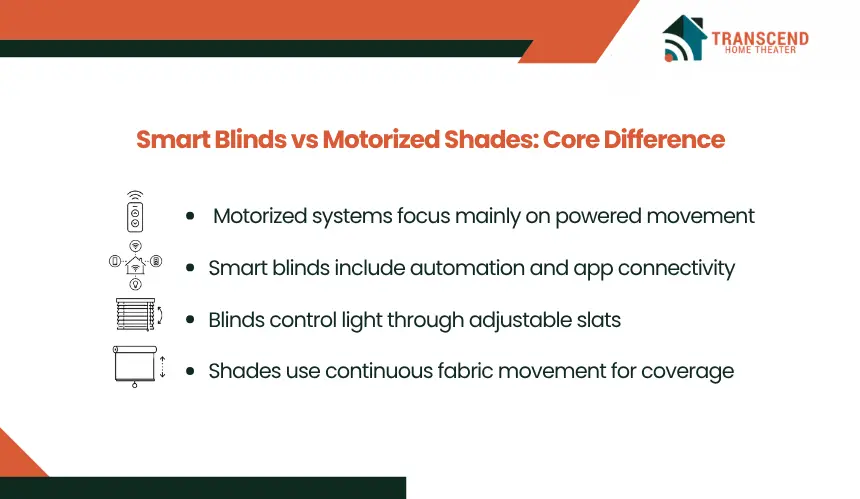
Motorized window treatments use an internal electric motor to raise, lower, tilt, or position blinds and shades without manual operation. Control typically happens through a handheld remote, wall switch, or dedicated channel controller connected directly to the motor system.
The defining characteristic is powered movement rather than automation logic. A motorized shade may stop at preset positions and operate on a timer, but many systems function independently without Wi-Fi connectivity, cloud access, or smart home integration. Their primary role is operational convenience rather than adaptive automation.
Most motorized systems rely on either rechargeable battery packs, plug-in transformers, or hardwired electrical connections. The installation process focuses mainly on mounting accuracy, motor alignment, and stable power delivery rather than network communication or ecosystem compatibility.
What Makes Blinds “Smart”?
Smart blinds combine motorized movement with connected automation technology. In addition to powered operation, they communicate with mobile applications, smart hubs, voice assistants, and home automation platforms through protocols such as Wi-Fi, Zigbee, Z-Wave, Bluetooth, or Matter.
This connectivity enables automated behaviors based on schedules, environmental conditions, occupancy patterns, or integrated smart home scenes. A smart blind system can automatically adjust during peak sunlight hours, synchronize with sunrise and sunset cycles, or respond to temperature sensors that help regulate indoor heat gain.
Unlike standalone motorized systems, smart blinds often require digital configuration during installation. Device pairing, firmware synchronization, automation programming, and network stability become part of the setup process because system performance depends on both physical installation and software communication.
Why Product Terminology Often Creates Confusion
The confusion largely comes from overlapping marketing language across manufacturers and retailers. Many products labeled as “smart shades” only include remote-controlled motors, while some advanced motorized systems offer limited automation without full smart ecosystem support.
Blinds and shades also represent different physical window treatment categories. Blinds use adjustable slats that tilt for directional light control, while shades rely on continuous fabric panels that raise or lower as a single surface. Either category can include motorization, but only connected systems with automation intelligence qualify as fully smart solutions.
This distinction affects installation planning because buyers may assume app control, voice integration, or automation scenes are included when the product only supports basic motorized operation. Understanding the difference early helps prevent compatibility issues with existing smart home infrastructure later.
How Installation Requirements Differ Between Smart Blinds and Motorized Shades
The installation gap between smart blinds and motorized shades becomes more noticeable during electrical setup, network configuration, and system calibration.
While both systems require precise mounting and motor alignment, smart blind installations introduce additional infrastructure and connectivity requirements that can affect installation time, placement strategy, and long-term scalability.
Wiring, Power Sources, and Electrical Planning
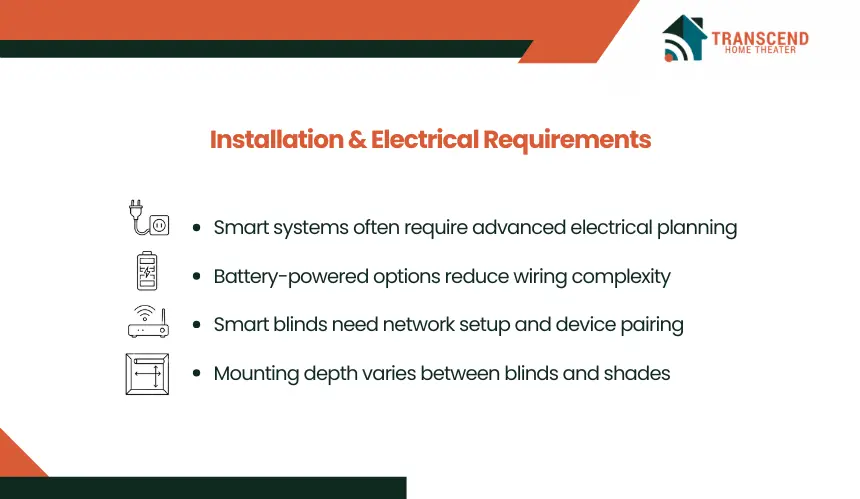
Power delivery affects both installation complexity and future maintenance requirements. Motorized shades are commonly installed using rechargeable battery tubes, plug-in adapters, or low-voltage hardwired connections, depending on window size, motor load, and daily operating frequency.
Smart blinds often demand more deliberate electrical planning because continuous connectivity increases power consumption beyond basic motor movement alone. Systems that maintain Wi-Fi communication, cloud synchronization, or sensor responsiveness may require more stable power management to avoid latency, dropped connections, or charging interruptions.
Hardwired installations usually require concealed low-voltage cabling routed behind drywall, inside window recesses, or through ceiling channels before trim work is completed. Retrofit projects in finished homes can become more labor-intensive when power access was not planned during construction.
Battery-powered smart systems reduce wiring demands but introduce charging cycles and accessibility considerations. Large or high-mounted windows may require ladder access for battery servicing if charging ports are not positioned strategically during installation.
Mounting Differences Between Blinds and Shades
Blinds and shades distribute mechanical load differently, which changes bracket placement, mounting depth, and clearance requirements. Smart blinds contain tilting slats, lift cords, internal ladders, and motorized tilt mechanisms that increase headrail complexity and require accurate leveling across the full window span.
Motorized shades typically use roller assemblies or fabric cassette systems with fewer moving components. Their installation focuses more heavily on tube alignment, fabric tension consistency, and smooth rolling clearance rather than slat synchronization. This makes motorized shades installation mechanically simpler in some window configurations, especially when fewer automation layers are involved.
Inside-mounted smart blinds may require deeper window recesses because integrated motors, communication modules, and battery compartments occupy additional headrail space. Shallow window frames can restrict compatibility or force outside mounting configurations that alter light gaps and visual alignment.
Large-format shades covering wide glass panels also create different structural demands. Heavier blackout fabrics or dual-layer systems may require reinforced brackets and stronger motors to maintain smooth movement without fabric drift or roller strain over time.
Smart Hub and Network Configuration Requirements
Motorized shades with remote control functionality usually operate through direct radio frequency communication between the remote and motor. Installation ends once motor limits and channel assignments are configured correctly.
Smart blinds add an additional digital layer that requires network onboarding, hub integration, and software-based communication testing. Depending on the ecosystem, installers may need to configure dedicated bridges, connect devices to smart hubs, assign room groupings, and verify compatibility with platforms such as Alexa, Google Home, Apple HomeKit, or Samsung SmartThings.
Signal interference, router placement, wall density, and wireless protocol limitations can all affect responsiveness. Homes with concrete walls, metal framing, or weak Wi-Fi coverage may require mesh networking adjustments or additional repeaters to maintain stable automation performance.
Why Smart Installations Usually Require Additional Calibration
Smart systems rely on both mechanical precision and software synchronization. After physical installation, blinds often require digital calibration to establish opening limits, slat positioning memory, automation timing, and synchronized multi-window movement.
This calibration becomes especially important in large rooms where multiple blinds operate simultaneously. Minor alignment inconsistencies can create uneven positioning, delayed responses, or automation drift across grouped window treatments.
Some systems also integrate environmental triggers such as solar sensors, occupancy detection, or daylight harvesting routines. These features require threshold adjustments and behavioral tuning during setup so the automation reacts accurately to changing indoor conditions rather than triggering unnecessary movement throughout the day.
How Smart Blinds and Motorized Shades Differ in Daily Automation and User Experience
Once installation is complete, the operational behavior of smart blinds and motorized shades begins to diverge more clearly. The difference is no longer centered on physical setup, but on how each system manages light control, automation responsiveness, user interaction, and environmental adaptation during daily use.
Scheduling and Environmental Automation
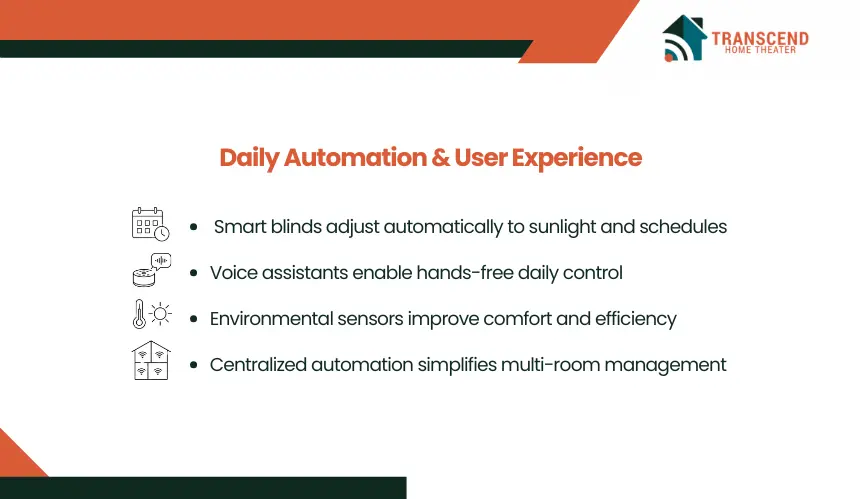
Smart blinds are designed to operate dynamically based on time, sunlight exposure, indoor temperature, or occupancy behavior. Instead of relying solely on manual commands, the system can trigger movement automatically according to predefined automation logic.
For example, blinds positioned on south-facing windows may partially close during peak afternoon heat to reduce solar gain and minimize HVAC load. In colder months, scheduled opening routines can increase passive daylight exposure to stabilize indoor temperatures naturally.
Motorized shades generally support simpler automation behavior. Many systems allow timed opening and closing cycles, but they often lack adaptive environmental response unless paired with external automation controllers. Their operation is typically event-based rather than condition-based.
This distinction affects long-term energy management and comfort consistency. Smart systems actively react to changing indoor conditions, while standard motorized systems mainly automate movement convenience.
Voice Assistant and Smart Home Integration
Smart blinds function as connected devices within a larger automation ecosystem rather than isolated window coverings. Integration with voice assistants and centralized platforms allows blinds to participate in coordinated routines alongside lighting systems, thermostats, security devices, and occupancy sensors.
A single automation scene can simultaneously lower blinds, dim interior lighting, and adjust climate controls during media viewing or nighttime scheduling. This interconnected behavior reduces the need for repeated manual adjustments throughout the day.
Motorized shades with standalone remote systems do not usually participate in broader automation workflows unless additional controllers or bridge devices are introduced separately. Their functionality remains more localized to direct user commands rather than ecosystem-wide automation coordination.
The practical difference becomes more noticeable in larger homes where centralized automation management reduces operational fragmentation across multiple rooms and window groups.
Operational Differences in Light Control and Privacy
Blinds and shades manage daylight differently because their mechanical structures control light through separate movement patterns. Smart blinds use adjustable slats that can redirect incoming sunlight without fully exposing or darkening the room.
This allows incremental daylight control throughout the day. Slat angle adjustments can reduce glare on television screens, workstations, or reflective flooring surfaces while still preserving partial outdoor visibility.
Motorized shades primarily operate through vertical fabric movement. Light control usually depends on raising or lowering the entire shade surface rather than redirecting light directionally. Privacy and brightness adjustment, therefore, occur in broader increments.
This operational difference affects room usability in spaces where lighting conditions change frequently, such as home offices, conference rooms, kitchens, or media areas exposed to shifting sunlight angles.
Noise, Speed, and Motion Characteristics
The motor behavior of blinds and shades differs because each system moves different mechanical loads. Smart blinds often control both lifting and slat tilting functions, creating more segmented movement cycles during operation.
Motorized shades usually perform a smoother linear rolling motion because the fabric wraps continuously around a tube assembly. This often produces quieter movement profiles with fewer directional adjustments during operation.
Operational sound levels also vary based on motor torque, window size, material weight, and movement frequency. Large wood blinds or wide slat systems may generate more mechanical noise during tilt adjustments compared to lightweight roller shades.
In frequently automated environments, quieter operation becomes increasingly important. Bedrooms, conference spaces, and open-concept living areas benefit from low-noise motor systems that operate repeatedly without becoming disruptive during scheduled automation cycles.
How Smart Blinds and Motorized Shades Differ in Cost and Long-Term Maintenance
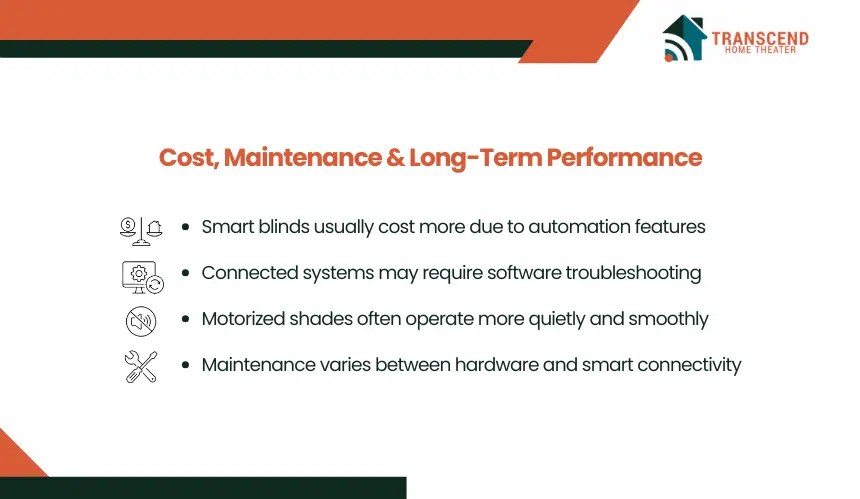
Smart blinds typically involve higher long-term costs because they combine motorized hardware with automation software, wireless communication systems, and smart home integration. Motorized shades are often less expensive when the primary goal is remote-controlled movement without advanced automation features or ecosystem connectivity.
Maintenance requirements also differ operationally. Smart blinds may require firmware updates, network troubleshooting, and periodic synchronization adjustments alongside mechanical servicing. Motorized shades usually involve more direct maintenance related to fabric alignment, roller performance, or motor responsiveness rather than software-related diagnostics.
The complexity of future repairs can also vary. Troubleshooting smart blinds may involve both physical components and automation systems, while motorized shades are generally easier to diagnose because their operation depends more heavily on localized motor control instead of connected smart infrastructure.
Frequently Asked Questions
Can smart blinds or motorized shades be added to existing window coverings?
Existing window coverings can sometimes be upgraded, but compatibility depends on the headrail design, shade tube, motor space, weight, and control hardware. Many older blinds and shades are not designed for retrofit motors, so replacing the full system often delivers better alignment, quieter movement, and more reliable automation performance.
What happens to smart blinds if the internet goes down?
Smart blinds may lose app-based control, voice commands, cloud automation, or remote access during an internet outage, depending on the system. Many models still work through local controls, wall switches, remotes, or Bluetooth-based access. Systems using local hubs usually maintain more functionality than cloud-only smart home setups.
Are motorized shades better for large windows than smart blinds?
Motorized shades often work better for wide glass areas because roller systems distribute fabric movement more smoothly across large spans. Smart blinds can still work on large windows, but slat weight, headrail stability, tilt alignment, and motor torque become more critical. Large openings usually require stronger hardware and precise measurement.
Do smart blinds use more electricity than motorized shades?
Smart blinds can use more power when they stay connected to Wi-Fi, sensors, hubs, or automation platforms throughout the day. Motorized shades usually consume power mainly during movement. Battery life depends on window size, motor load, usage frequency, wireless protocol, and whether the system runs scheduled automation multiple times daily.
Which option is easier for renters or apartments, smart blinds or motorized shades?
Battery-powered motorized shades are often more renter-friendly because they can reduce wiring work, wall changes, and smart home setup complexity. Smart blinds may still suit apartments if they use rechargeable batteries and minimal hardware, but renters should check mounting permissions, window depth, and whether removal will leave visible bracket marks.
Do smart blinds and motorized shades need professional measurement?
Professional measurement is strongly recommended because small errors affect bracket placement, side gaps, slat clearance, fabric tracking, and motor strain. Automated window treatments leave less room for adjustment than manual coverings.
Accurate width, height, mounting depth, frame condition, and obstruction checks help prevent poor movement and uneven coverage.