
Soundproofing vs Acoustic Treatment: What Actually Matters for Home Theaters?

A Quick answer: For most home theaters, acoustic treatment matters more than soundproofing. It directly improves how movies and music sound inside the room by controlling reflections, echo, and bass behavior. Soundproofing only becomes essential when stopping noise from entering or leaving the space is a real problem. |
Home theater owners often feel frustrated when expensive speakers still sound muddy, dialogue feels unclear, or bass overwhelms the room. That frustration usually comes from sound behavior inside the room, not from sound leaking through walls.
Acoustic treatment addresses this exact issue by shaping how sound reflects, decays, and reaches the listener. Soundproofing, on the other hand, focuses on structural isolation and does nothing to improve sound quality once audio is already playing inside the space.
This article breaks down what actually matters for home theaters by separating two commonly confused concepts based on function, results, and real-world use cases.
Why Soundproofing and Acoustic Treatment Are Often Confused
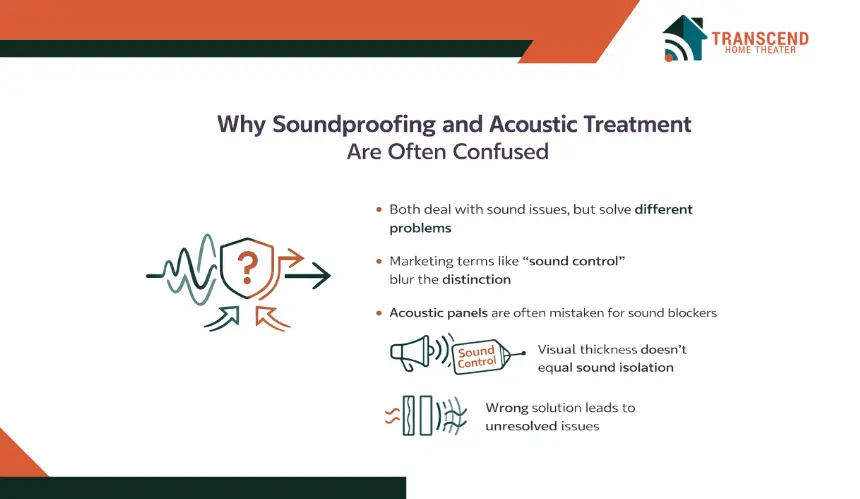
Soundproofing and acoustic treatment are often grouped together because both deal with sound problems, but the problems themselves are rarely identified correctly. Home theater owners usually notice poor audio performance or complaints about noise and assume a single solution should address everything.
Marketing language adds to the misunderstanding by using general terms like sound control or noise reduction without explaining whether the goal is isolation or sound quality. Acoustic panels and foam are frequently presented as solutions for blocking sound, even though they only affect how sound behaves after it is already inside the room.
Visual similarity also plays a role. Thick panels and textured surfaces look like they should stop sound from traveling through walls, but soundproofing depends on structural mass and airtight construction. Without understanding this difference, many people apply the wrong solution and never resolve the issue they were actually trying to fix.
What Problem Soundproofing Is Designed to Solve in a Home Theater
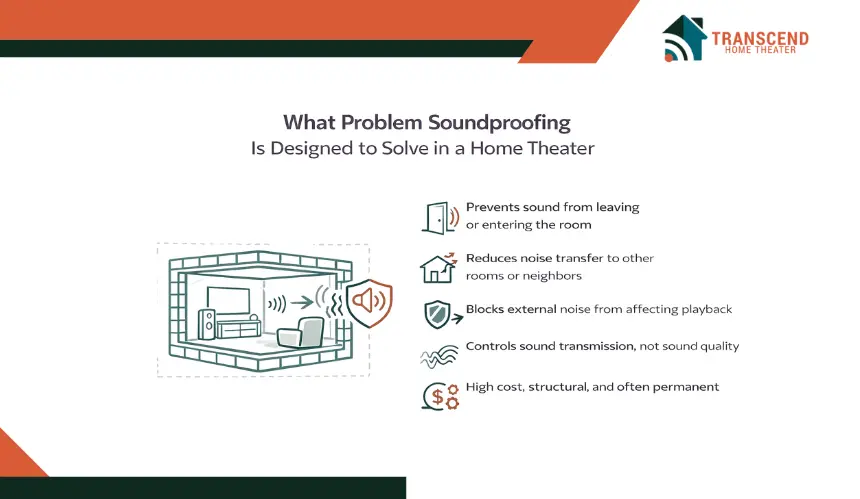
Soundproofing focuses on preventing sound from leaving the home theater or entering it from outside sources. This includes reducing dialogue, explosions, and bass vibrations from traveling into adjacent rooms, upstairs spaces, or neighboring properties. It also limits external noise, such as traffic or household activity, from interfering with playback inside the theater.
This approach addresses sound transmission, not sound quality. Even a perfectly soundproofed room can still suffer from echo, poor clarity, or overpowering bass if internal acoustics are ignored. Soundproofing only controls where sound goes, not how it behaves once it is produced.
How Soundproofing Works at a Structural Level
Effective soundproofing relies on construction techniques that increase mass, eliminate air gaps, and reduce physical vibration paths. Walls, ceilings, and floors must be treated as sound barriers rather than decorative surfaces. The goal is to limit how airborne noise and low-frequency energy pass through building materials.
Because of this, soundproofing typically involves permanent changes such as added drywall layers, sealed framing, and isolation methods.
These measures are most effective when planned during construction or major remodeling, which is why soundproofing is often impractical as a retrofit solution.
When Soundproofing Is Necessary for a Home Theater
Soundproofing becomes important when noise transmission is a real concern. This commonly applies to shared walls, multi-story homes, apartments, or theaters used at high volume during late hours. In these cases, isolation protects both the listener’s experience and the surrounding living environment.
In dedicated spaces where noise complaints are not an issue, soundproofing often provides little benefit relative to its cost and complexity. Identifying whether sound transfer is actually the problem helps determine if soundproofing is a requirement or an unnecessary investment.
What Acoustic Treatment Actually Improves Inside the Room
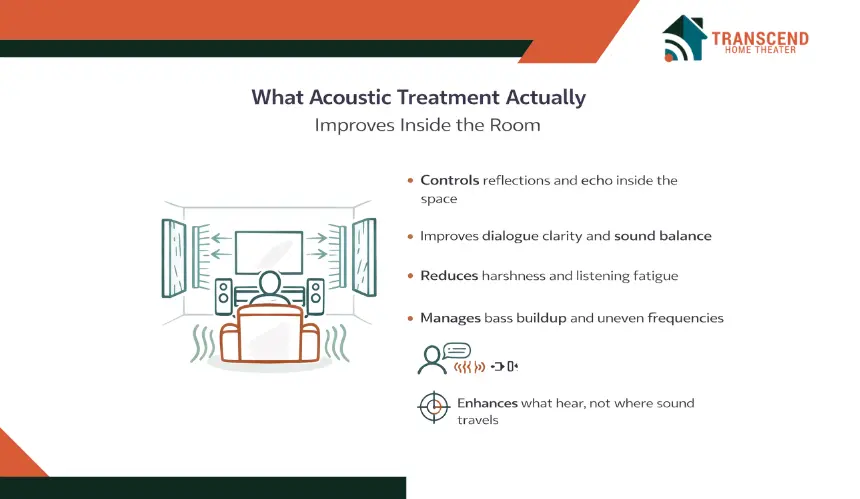
Once sound is produced inside a home theater, its behavior is shaped by the room itself. Walls, ceilings, floors, and furniture all interact with sound waves in ways that can either support clarity or degrade it. Acoustic treatment focuses entirely on this internal behavior, which is why it has a direct impact on listening quality.
How Acoustic Treatment Changes What You Hear at the Listening Position
Acoustic treatment improves how sound reaches the listener by controlling reflections, decay time, and frequency balance. When sound bounces uncontrollably off hard surfaces, it arrives at the ears at different times, reducing clarity and making dialogue harder to understand. Proper treatment manages these reflections so sound feels focused, balanced, and intentional.
This process does not reduce volume or block sound from leaving the room. Instead, it refines how sound energy spreads and settles within the space. The result is cleaner dialogue, more precise effects placement, and a smoother listening experience that feels less tiring over long viewing sessions.
Which Acoustic Problems Are Most Common in Home Theaters
Most untreated home theaters suffer from excessive echo, uneven sound levels, or bass buildup in certain areas. Low frequencies tend to collect in corners and along walls, creating boomy or overwhelming bass that masks detail. Mid and high frequencies often reflect repeatedly, causing harshness or a hollow sound.
These issues are not related to speaker quality or system calibration. They are symptoms of uncontrolled room acoustics. Acoustic treatment targets these specific problems by absorbing or dispersing sound energy where it causes distortion or imbalance.
What Acoustic Treatment Tools Are Designed to Control
Acoustic treatment uses purpose-built materials to interact with sound inside the room. Absorptive panels reduce reflections at key points, bass traps manage low-frequency buildup, and diffusive surfaces scatter sound to maintain a natural sense of space. Each tool addresses a different acoustic issue without affecting sound transmission outside the room.
Because these solutions work within the listening environment, they are adjustable, scalable, and effective even in existing rooms. This flexibility is why acoustic treatment delivers the most noticeable improvement for most home theater setups.
Why Soundproofing Needs Vary Across Virginia, Maryland, and DC
Housing styles across Virginia, Maryland, and Washington, DC, create different soundproofing considerations. DC and nearby areas of Northern Virginia feature many row houses, townhomes, and multi-unit residences where shared walls and stacked floors are common.
In these environments, sound transfer is more noticeable, particularly with bass-heavy home theater systems.
In contrast, many suburban areas of Maryland and Virginia include detached homes with greater spacing between rooms and neighboring properties. In these settings, sound transmission is often less disruptive, and isolation provides limited practical benefit.
Local housing density, shared structures, and proximity to neighbors play a major role in determining whether soundproofing is necessary or optional.
Functional Differences Between Soundproofing and Acoustic Treatment
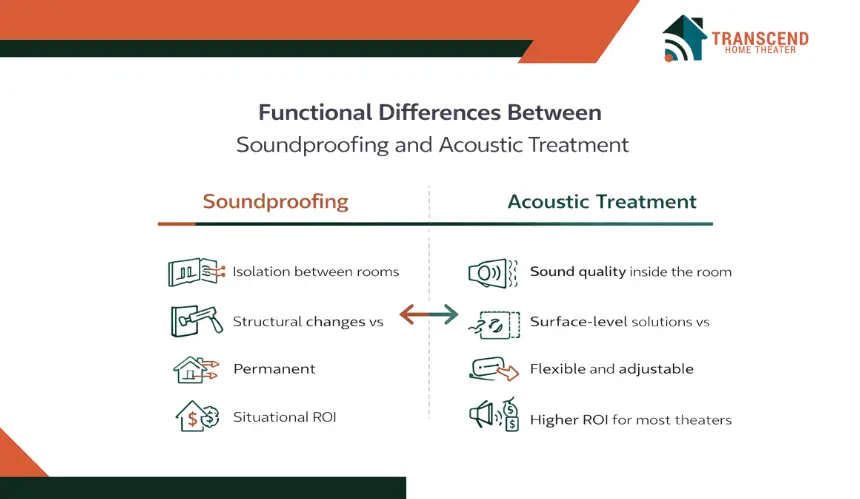
The differences between soundproofing and acoustic treatment become much clearer when viewed side by side. The table below highlights how each approach functions, what problems it solves, and when it is actually useful in a home theater context.
Aspect | Soundproofing | Acoustic Treatment |
Primary purpose | Limits sound transmission between rooms | Improves sound behavior inside the room |
Main problem addressed | Noise leaving or entering the space | Echo, clarity issues, and uneven sound |
Impact on sound quality | No improvement to in-room audio quality | Directly enhances clarity and balance |
Typical methods | Structural mass, sealing, isolation | Absorption, bass control, diffusion |
Installation scope | Construction-level, often permanent | Surface-level, adjustable and flexible |
Best use case | Shared walls, neighbors, late-night use | Most home theater listening environments |
Return on investment | Situational and condition-dependent | Noticeable improvement for most rooms |
This comparison reinforces why acoustic treatment is usually the priority for home theater performance, while soundproofing remains a targeted solution for specific noise control needs.
Can Soundproofing and Acoustic Treatment Work Together?
Soundproofing and acoustic treatment can work together, but only when they are applied for the right reasons and in the correct order. They do not overlap in function, so combining them only makes sense when a home theater has both sound quality issues inside the room and noise transmission problems outside it.
In advanced setups, soundproofing is used to isolate the space from surrounding areas, while acoustic treatment is applied afterward to refine how sound behaves within that isolated room.
This layered approach prevents external noise interference and allows precise control over reflections, bass response, and listening clarity. Without acoustic treatment, an isolated room can still sound uneven or uncomfortable.
For most homeowners, combining both is unnecessary. Acoustic treatment alone resolves the majority of performance complaints. Soundproofing should only be added when isolation is a confirmed requirement, not as a substitute for proper acoustic control.
Common Mistakes Homeowners Make When Treating Sound Problems
Misunderstanding how sound behaves in a home theater often leads to decisions that feel logical but produce disappointing results. These mistakes usually stem from applying the wrong solution to the wrong problem rather than from poor equipment choices.
- Assuming acoustic panels will block sound from leaving the room
Many homeowners install foam or fabric panels expecting noise complaints to disappear. These materials only affect reflections inside the room and have no meaningful impact on sound transmission through walls, ceilings, or floors. - Treating volume issues as equipment problems instead of room problems
When dialogue sounds unclear or the bass feels overwhelming, the instinct is often to upgrade speakers or adjust settings. In most cases, uncontrolled reflections and low-frequency buildup are the real causes, not hardware limitations. - Over-treating high frequencies while ignoring bass behavior
Adding too many thin absorptive panels can remove brightness while leaving bass untouched. This creates a dull listening experience with a persistent low-frequency boom that masks detail and impact. - Placing treatment randomly without addressing the listening position
Panels and traps are sometimes installed based on appearance rather than sound paths. Without considering reflection points and seating location, treatment becomes inconsistent and less effective. - Investing in soundproofing without confirming noise transfer issues
Structural isolation is expensive and disruptive. When noise leakage is not actually causing problems, soundproofing adds cost without improving the listening experience inside the theater.
Avoiding these mistakes starts with clearly identifying whether the issue involves sound behavior inside the room or sound movement between rooms. Once that distinction is made, the correct solution becomes much easier to apply.
Frequently Asked Questions
Can furniture and decor affect home theater sound performance?
Soft furnishings such as couches, rugs, and curtains interact with sound by absorbing some mid and high frequencies. While they can slightly reduce echo, they are not precise enough to replace purpose-built acoustic solutions.
Their impact is incidental rather than controlled, which is why they rarely solve persistent sound issues on their own.
Why does sound sometimes feel louder in certain seats than others?
Uneven sound levels are usually caused by room dimensions and speaker interaction with boundaries. Sound waves can reinforce or cancel each other at different locations, creating volume peaks and dips. This is why some seats experience heavy bass while others sound thin or unbalanced.
Do open floor plans change how home theater sound behaves?
Open layouts allow sound to travel freely into adjacent spaces, reducing natural containment and altering reflection patterns. This often leads to weaker bass response and less defined surround effects. In these spaces, controlling reflections and managing sound paths becomes more important than isolation.
Is professional measurement necessary for good acoustic results?
Professional measurement tools provide precise data, but effective improvements can still be achieved using basic listening tests and placement principles. Strategic positioning of absorptive and bass control materials often delivers noticeable gains even without advanced equipment.
Can acoustic changes improve listening comfort over long viewing sessions?
Poorly controlled sound can cause listening fatigue due to excessive reflections and uneven frequency response. Improving how sound decays and balances across frequencies makes audio feel more natural, reducing strain during extended movies or gaming sessions.