
Subscription vs. Ownership: The Future of Smart Home Software Models

A Quick Answer: Smart home software is moving toward subscription-based models because they support continuous updates, cloud intelligence, and long-term adaptability. Ownership-based models still appeal to users who prioritize control, privacy, and predictable one-time costs. The future of smart home platforms is not about one model replacing the other, but about how each aligns with evolving expectations around flexibility, security, and system longevity. |
Subscription models emphasize ongoing access to features, integrations, and updates, while ownership models focus on permanent licenses and local control. This difference shapes everything from long-term costs to data handling and upgrade potential.
This blog will break down how subscription and ownership models differ in structure, cost, control, and long-term value.
How Smart Home Software Business Models Have Evolved
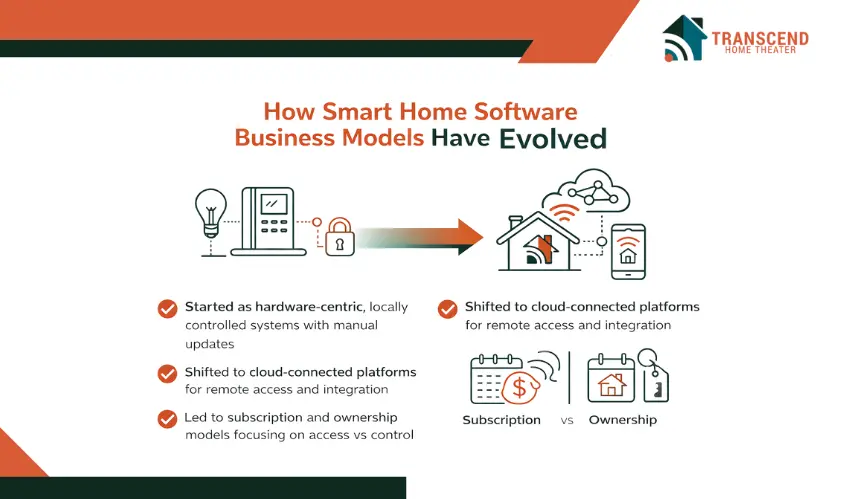
Smart home technology did not begin as a software-first experience. Early automation systems were built around fixed controllers and hardware-specific logic, where software played a supporting role rather than acting as the core value driver.
Understanding this evolution helps explain why subscription and ownership models exist today and why the conversation around them has become increasingly important.
From Hardware-Centric Systems to Software-Driven Control
Initial home automation platforms relied on locally installed controllers that managed lighting, climate, and security through preconfigured rules. These systems offered limited flexibility and required manual updates or professional intervention to change functionality.
Software was tightly bound to hardware, making expansion costly and often restrictive as new smart devices entered the market.
The Rise of Connected Ecosystems and Cloud-Based Platforms
As internet connectivity became standard, smart home software shifted toward cloud-supported architectures. Remote access, mobile apps, and cross-device integration turned software into the central layer connecting devices, users, and data.
This transition enabled continuous improvement, real-time monitoring, and integration with voice assistants and third-party services, laying the foundation for subscription-based access models.
Why Business Models Became a Strategic Decision Point
Once software became the core of the smart home experience, monetization models naturally evolved alongside it. Vendors needed sustainable ways to support updates, security, and expanding ecosystems, while users began evaluating long-term costs and control.
This shift set the stage for the current divide between subscription-based access and ownership-based licensing, framing how smart home platforms are designed, maintained, and scaled today.
Understanding Subscription-Based Smart Home Software Models
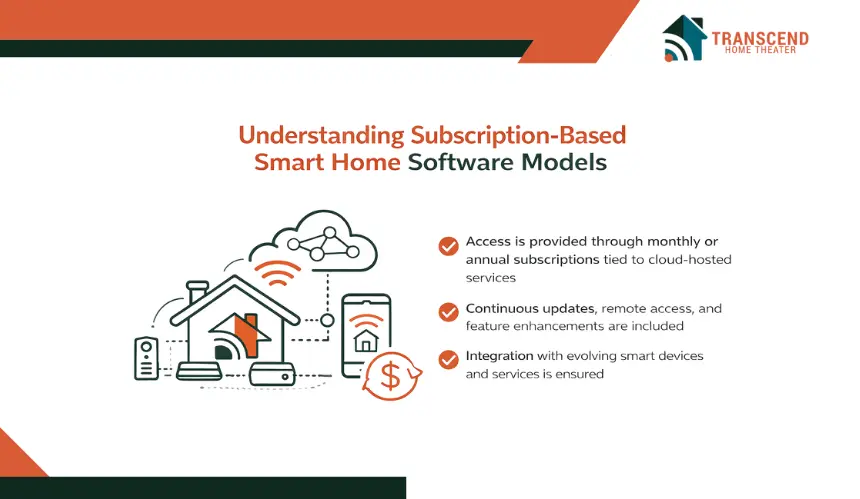
Subscription-based smart home software is built around continuous access rather than permanent ownership. Instead of purchasing a fixed version of a platform, users pay recurring fees to use software that evolves over time.
This model has become increasingly common as smart homes rely more on cloud connectivity, real-time data processing, and ongoing feature expansion.
What Defines a Subscription-Based Smart Home Platform
A subscription model provides access to smart home software through monthly or annual plans, often tied to cloud-hosted services. These platforms manage automation logic, device communication, and user interfaces through centralized servers rather than relying solely on local controllers.
Features are delivered as part of ongoing service access, not as a one-time software release, which allows the system to change as technology and user behavior evolve.
What Users Are Actually Paying for in Subscription Models
The cost of a subscription typically covers more than basic device control. Users gain access to remote management, software updates, expanded automation rules, and integrations with voice assistants and third-party services.
Security monitoring, data backups, and AI-driven automation improvements are also commonly bundled, making the software feel like a living system rather than a static tool.
Why Subscription Models Align With Modern Smart Home Ecosystems
Smart home environments are no longer isolated setups. They depend on frequent compatibility updates, evolving device standards, and security patches to remain reliable.
Subscription-based platforms allow vendors to maintain these systems continuously, ensuring that automation software stays aligned with new devices, updated protocols, and user expectations without requiring manual upgrades or system replacements.
Understanding Ownership-Based Smart Home Software Models
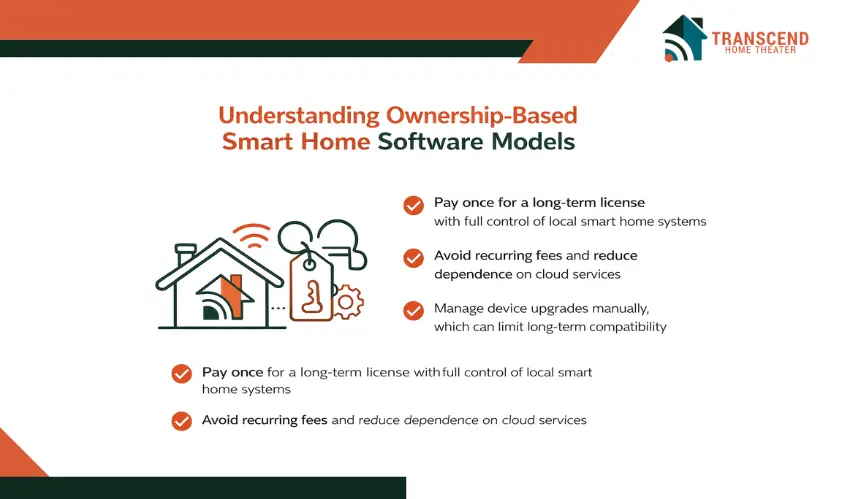
Ownership-based smart home software follows a fundamentally different access model, where users purchase a license that allows long-term or permanent use of the platform.
Instead of ongoing payments, the value is delivered upfront, appealing to users who prefer predictable costs and greater control over how their systems operate and evolve.
What Ownership Means in Smart Home Software Licensing
Ownership in smart home software typically refers to a perpetual or long-term license rather than full control over the underlying code. Users gain the right to run the software locally on approved hardware, often without relying on continuous cloud connectivity.
Core automation functions, device control, and rule execution are handled within the home environment, reducing dependency on external services.
Why Some Users Prefer Ownership-Based Models
Many users gravitate toward ownership models because they offer a sense of autonomy and stability. Locally hosted platforms reduce exposure to recurring fees and cloud outages, while giving homeowners greater confidence over data handling.
For technically inclined users, ownership also enables deeper customization and long-term system use without being tied to changing subscription terms.
Where Ownership Models Face Practical Limitations
While ownership-based software offers control, it often requires more hands-on management. Updates may be limited, delayed, or paid separately, and compatibility with newer devices can lag behind subscription platforms.
Over time, this can restrict system growth and make it harder to adapt to evolving smart home standards without manual upgrades or hardware replacements.
Subscription vs Ownership: Structural Differences That Matter
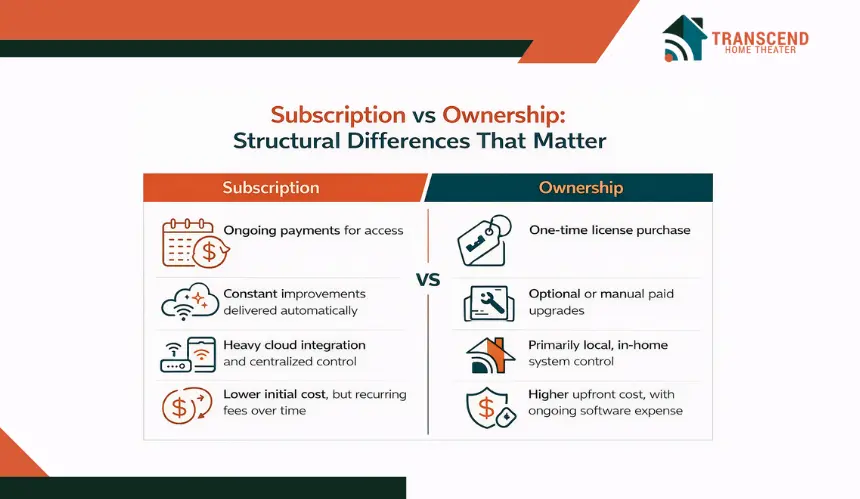
The differences between subscription-based and ownership-based smart home software become clearer when viewed side by side.
The table below highlights how each model differs in structure, control, cost behavior, and long-term adaptability, focusing only on the factors that directly influence user experience and system performance.
Comparison Factor | Subscription-Based Smart Home Software | Ownership-Based Smart Home Software |
Access Model | Ongoing access through monthly or annual payments tied to active service plans | One-time license purchase with long-term or permanent usage rights |
Software Updates | Continuous feature updates and improvements delivered automatically | Updates are limited, optional, or released as paid upgrades |
System Control | Heavily cloud-integrated with remote access and centralized management | Primarily locally hosted with on-site system control |
Device Compatibility | Rapid support for new devices and evolving smart home standards | Compatibility expands slowly and may depend on manual configuration |
Long-Term Cost Pattern | Lower upfront cost with cumulative expenses over time | Higher upfront cost with minimal ongoing software expenses |
Vendor Dependency | Higher reliance on vendor infrastructure and service continuity | Reduced dependency once software is installed and configured |
Scalability | Designed to scale easily as devices, rooms, and automations increase | Scaling may require hardware upgrades or additional licensing |
This comparison shows that the core difference lies in how flexibility, control, and long-term value are balanced, making the choice less about features and more about how homeowners want their smart home software to grow and operate over time.
Cost Dynamics Over Time: Short-Term Savings vs Long-Term Value
Cost differences between subscription and ownership models often look simple at first, but they unfold differently as a smart home matures.
Subscription-based software reduces upfront commitment and spreads expenses over time, making it easier to adopt advanced automation early.
Ownership-based software requires a higher initial investment but creates a more stable cost structure once the system is installed and operational.
Over the long term, the value equation shifts from entry price to sustained usability and maintenance responsibility. Subscription fees can accumulate as years pass, while ownership models tend to level off financially, with costs tied mainly to optional upgrades or hardware changes rather than mandatory payments.
- Lower upfront access with subscription plans can make advanced smart home features immediately available
- Recurring fees may exceed a one-time license cost in long-term, stable households
- Ownership models offer predictable costs after installation, with fewer ongoing software expenses
- Subscription platforms often bundle maintenance, security updates, and compatibility improvements
- Ownership-based systems may require separate spending for upgrades, expansions, or new device support
How to Choose the Right Smart Home Software Model for Your Needs
Choosing between subscription and ownership models becomes easier when the decision is tied directly to how a smart home is expected to function over time. The right choice depends on priorities such as flexibility, control, and how actively the system is expected to evolve.
A smart home automation company can help evaluate current needs, future expansion plans, and software compatibility before a long-term commitment is made.
Choose a subscription-based smart home software model if:
- Continuous software updates and feature improvements are important
- Remote access and cloud-based control are used frequently
- New smart devices and integrations are added regularly
- Built-in security updates and maintenance reduce hands-on management
- Long-term adaptability matters more than fixed ownership costs
Choose an ownership-based smart home software model if:
- Predictable, one-time software costs are preferred
- Local system control and reduced cloud dependency are priorities
- Data handling and privacy need to stay within the home network
- The smart home setup is stable and unlikely to expand rapidly
- Manual upgrades and system management are acceptable
Consider a hybrid smart home software approach if:
- Local control is essential but selective cloud features add value
- Flexibility is needed without full reliance on subscriptions
- Future expansion is possible but not guaranteed
Frequently Asked Questions
Can smart home software continue working if a subscription service is discontinued?
In many cases, core device control may continue at a limited level, but advanced features such as remote access, cloud automations, and AI-driven routines are often disabled.
The exact behavior depends on how tightly the platform is designed around cloud services and whether any local fallback functionality is supported.
Do smart home software models affect home resale value?
Yes, the software model can influence resale appeal. Homes running transferable ownership-based systems may attract buyers who want immediate functionality without recurring fees. Subscription-based platforms can still add value, but buyers may factor ongoing costs into their decision.
How do smart home software models impact internet outage reliability?
Ownership-based and locally hosted systems generally retain core functionality during internet outages. Subscription-dependent platforms may lose remote access and cloud automations temporarily, even though basic device control can sometimes remain available through local networks.
Is vendor shutdown a real risk with subscription-based smart home platforms?
Vendor continuity is a growing concern as the smart home market evolves. If a subscription-based provider shuts down or discontinues services, users may lose access to key features. Platforms with documented exit strategies or local fallback modes are considered more resilient in the long term.