
Voice Assistants & Multimodal Control: The Rise of Touchless Smart Homes
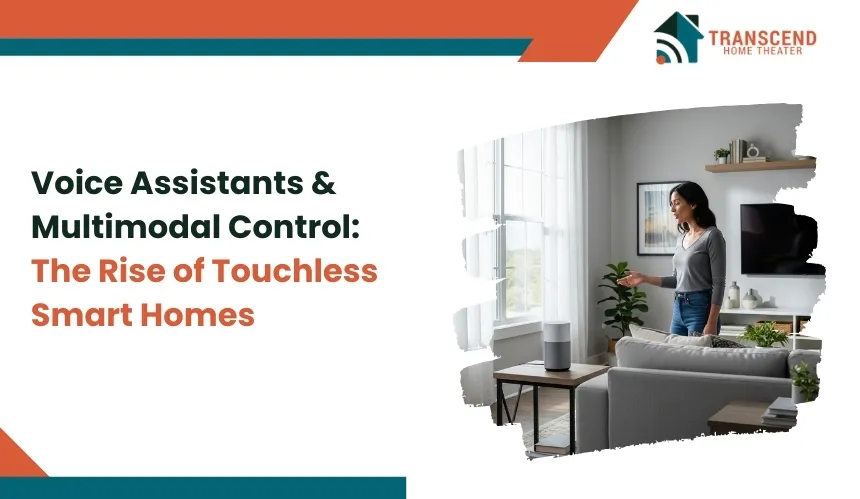
Life at home is full of small moments that can feel heavier than they should. Hands full of groceries while trying to turn on the lights. Cooking with messy fingers and wishing the oven would just listen. Waking up at night and reaching around in the dark for a switch you can’t find.
Touchless control is changing that experience. With voice assistants and intelligent sensors responding the moment you need them, the home begins to feel more supportive and intuitive.
Platforms like Alexa, Google Assistant, and Siri help create an environment that reacts to your presence, your mood, and your routines without needing constant physical effort.
Did you know? More than 8.4 billion voice assistants are estimated to be in use worldwide by 2024-25. This means that voice interaction has already surpassed the world’s population in sheer number of agents. |
This article explores how these touchless systems work, the technologies behind them, and why they are quickly becoming the new standard for people who want a home that feels effortless.
What Touchless and Multimodal Smart Home Control Really Means
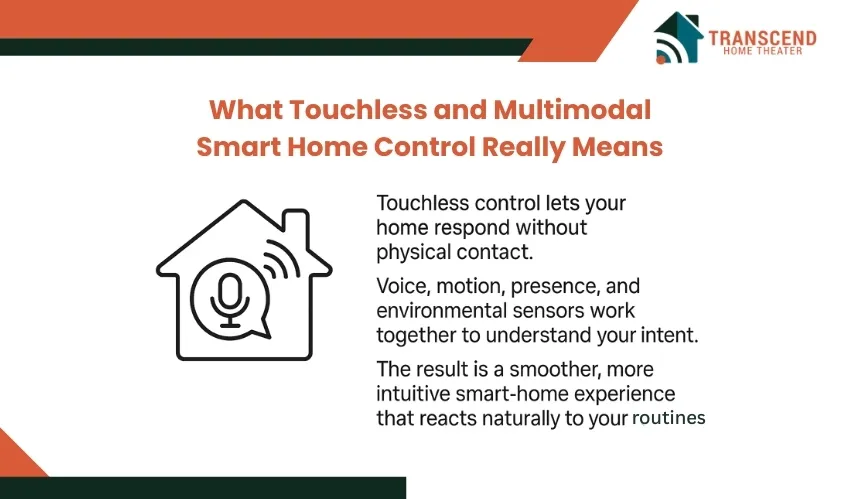
Many people hear about touchless or multimodal control and imagine it is simply about talking to a device. In reality, it is a far more advanced and intuitive experience. It brings together multiple forms of input so the home can understand what you want even when you are not speaking.
This section breaks down what this concept actually involves and why it is reshaping the way people interact with their living spaces.
What Is Touchless Smart Home Control and How Does It Work?
Touchless control refers to any home interaction that does not require physical contact. Instead of pressing switches or buttons, the home responds through voice commands, motion detection, presence sensing, facial recognition, and contextual automation.
Systems interpret these signals using technologies such as AI inference, far-field microphones, sensor fusion, natural language processing, and natural language understanding.
How Has Smart Home Control Evolved Into a Multimodal Experience?
Multimodal control means the home can interpret more than one type of input at the same time. A voice assistant may hear a command while motion sensors pick up movement, or environmental monitors detect changes in light or temperature. These layers of input help systems understand intent with greater accuracy and respond in ways that feel more natural.
Interesting information: Around 68% of smart-home interactions in 2025 are initiated via voice assistants. This means voice is now the primary trigger in most connected homes. |
Leading Voice Assistants and Multimodal Ecosystems
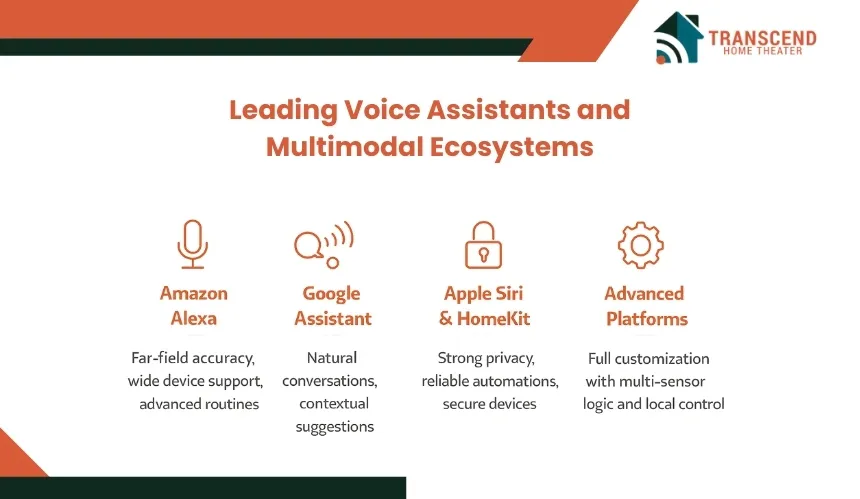
Choosing the right voice assistant often comes down to how naturally it fits into daily life. Each ecosystem brings its own style of intelligence, privacy standards, and device compatibility.
This section explains how the major platforms shape the touchless smart home experience so readers can understand their core differences without feeling overwhelmed.
1. Amazon Alexa Ecosystem
Amazon Alexa offers a wide range of compatible devices, which makes it a popular choice for homeowners who want flexibility. Its far-field microphones and strong voice recognition allow it to respond quickly from across the room.
Alexa supports advanced routines, sensor integrations, and Matter-enabled devices, which create a smooth and customizable home environment. Many users appreciate how easily it connects with lights, thermostats, cameras, and appliances.
2. Google Assistant Ecosystem
Google Assistant is known for its conversational accuracy and ability to understand natural language. It handles layered commands and follow-up requests with ease, making interactions feel more human.
Deep integration with Android, Chromecast, and Nest products supports responsive, context-driven automation. This ecosystem works well for people who want smarter suggestions and seamless syncing across multiple devices.
3. Apple Siri and HomeKit Environment
Siri and HomeKit appeal to homeowners who value privacy and tightly controlled device performance. HomeKit-certified products go through strict testing, which helps create reliable automations. On-device processing and encrypted communication keep user data protected.
The consistent experience between iPhone, Apple TV, and HomePod gives the ecosystem a stable and unified feel that many users trust.
4. Advanced Multimodal Platforms
Platforms such as Home Assistant, Control4, and SmartThings offer deeper customization for users who want more control. These systems support complex automation logic, local processing, multi-sensor integration, and personalized dashboards.
They work well for homeowners who want to build a tailored multimodal environment that uses voice, sensors, presence detection, and custom triggers in harmony.
Comparing Voice Assistants for Multimodal Control Needs
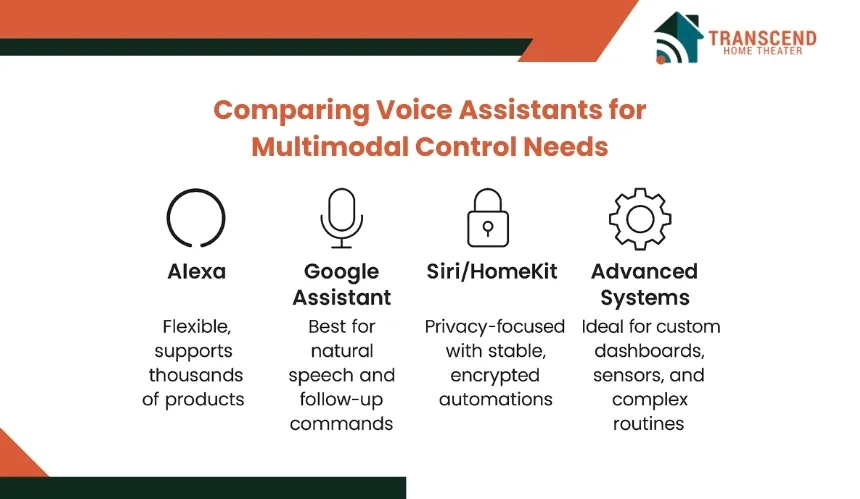
The table below gives a summarized oversight of strengths, limitations, and compatibility factors that influence touchless and multimodal smart home performance.
Feature / Criteria | Amazon Alexa | Google Assistant | Apple Siri & HomeKit | Advanced Platforms (Home Assistant, Control4, SmartThings) |
|---|---|---|---|---|
Natural Language Understanding | Strong recognition with far-field accuracy | Highly conversational and contextual | Accurate for simple commands; more structured | Depends on integrations and user configurations |
Device Compatibility | Very wide ecosystem; thousands of supported devices | Broad compatibility with Nest and many third-party products | Limited to HomeKit-certified devices | Extremely wide support with custom integrations |
Multimodal Capabilities | Voice, sensors, routines, compatible cameras | Voice, contextual suggestions, presence-based actions | Voice, presence detection, and limited gesture support | Fully multimodal with sensors, dashboards, presence, and custom triggers |
Privacy & Security | Cloud-based processing | Cloud-based with strong privacy controls | Strong privacy with encrypted, on-device automations | Varies; many offer local-only processing for stronger privacy |
Ease of Setup | Beginner friendly | Beginner-friendly with simple routines | Simple but requires certified devices | Requires more technical setup and configuration |
Best For | Users who want flexibility and large device support | Users who prefer conversational interactions | Users who value privacy and ecosystem consistency | Users who want deep customization and advanced automation logic |
How to Choose the Right Voice Assistant for Your Touchless Smart Home
Picking the right platform becomes much easier when you connect the system’s strengths to your daily habits. Consulting with a professional smart home automation company during this can help you match device capabilities to real lifestyle needs.
This section gives readers a clear path toward a confident decision by showing exactly who benefits most from each ecosystem.
Choose Amazon Alexa If You Want Maximum Flexibility
Alexa is the strongest match for people who enjoy experimenting with different brands, expanding their setup over time, or mixing devices from multiple manufacturers. Its huge compatibility range and advanced routines make it ideal for households that want versatility without strict ecosystem limits. If you want to build a large and varied smart home with plenty of choices, Alexa fits naturally.
Choose Google Assistant If You Prefer Conversational Control
Google Assistant works well for users who want smoother, more intuitive voice interactions. It understands follow-up commands, handles natural speech patterns, and offers contextual suggestions based on habits.
If you want the smart home to feel more like a thoughtful helper that understands how you speak, Google Assistant delivers that experience.
Choose Apple Siri and HomeKit If Privacy and Stability Matter Most
Siri and HomeKit are the best match for people who prioritize data protection, reliable automations, and a tightly unified ecosystem. HomeKit’s strict certification process gives users predictable performance and secure device behavior.
If you want a stable environment with strong encryption and clean integration across Apple devices, this is the right choice.
Choose Advanced Platforms If You Want Full Customization
Platforms such as Home Assistant, Control4, and SmartThings suit homeowners who want deeper control over automation logic. These systems support custom dashboards, multi-sensor triggers, local control, and highly specialized routines.
If you enjoy fine-tuning your smart home and want the freedom to create detailed multimodal interactions, these platforms give you the most control.
Real-World Use Cases of Multimodal Touchless Living
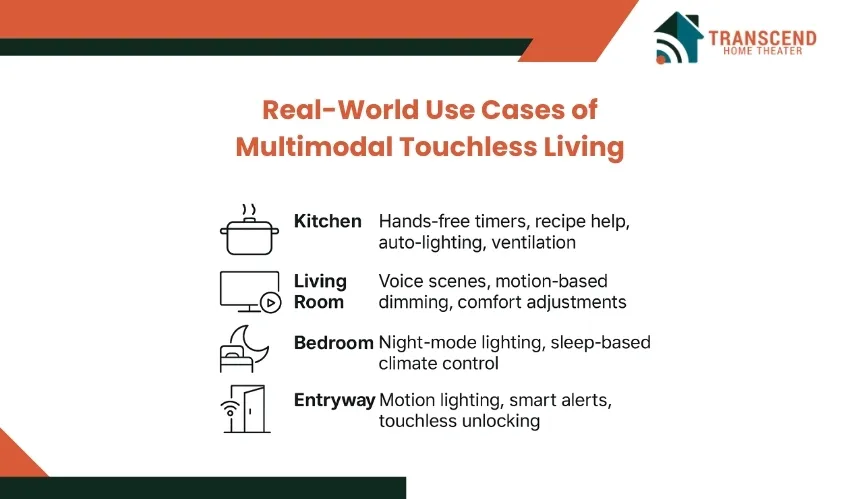
Touchless control becomes most meaningful when people see how it supports everyday life. These examples show how voice input, sensors, and environmental awareness come together to create a home that feels more supportive, calm, and intuitive in moments that matter.
1. Kitchens Become Easier to Manage With Hands-Free Convenience
Busy kitchens often leave people juggling tasks with messy or occupied hands. Voice-controlled timers, recipe instructions, and appliance commands help reduce stress during cooking. Presence sensors can brighten the room automatically and adjust ventilation when activity increases. The combination of voice input and environmental detection brings order and ease to the heart of the home.
2. Living Rooms Offer Multimodal Control for Entertainment and Comfort
Entertainment spaces become more enjoyable when multiple inputs work together. A simple voice request can adjust volume or switch scenes, while motion sensors dim the lights when someone settles in to watch a movie.
Environmental cues help maintain comfortable brightness or temperature without manual adjustments. This blending of triggers creates a relaxed and uninterrupted viewing experience.
3. Bedrooms Support Rest Through Adaptive and Gentle Automations
Bedrooms benefit from quiet, subtle automation that responds to personal rhythms. Presence detection can activate soft lighting for late-night movement, while voice commands manage music or night mode settings. Environmental sensors can adjust temperature based on sleep preferences. These small touches make the space feel safer, calmer, and more restful.
4. Entryways Become Smarter With Predictive and Touchless Security
Entry points to the home can react instantly based on movement, identity, or time of day. Motion sensors can activate pathway lighting, while smart cameras recognize visitors and send relevant alerts. Touchless unlocking options add convenience for people arriving with bags, children, or groceries. This blend of security and ease enhances both comfort and peace of mind.
Setting Up a Touchless, Multimodal Smart Home: Step-by-Step Guide
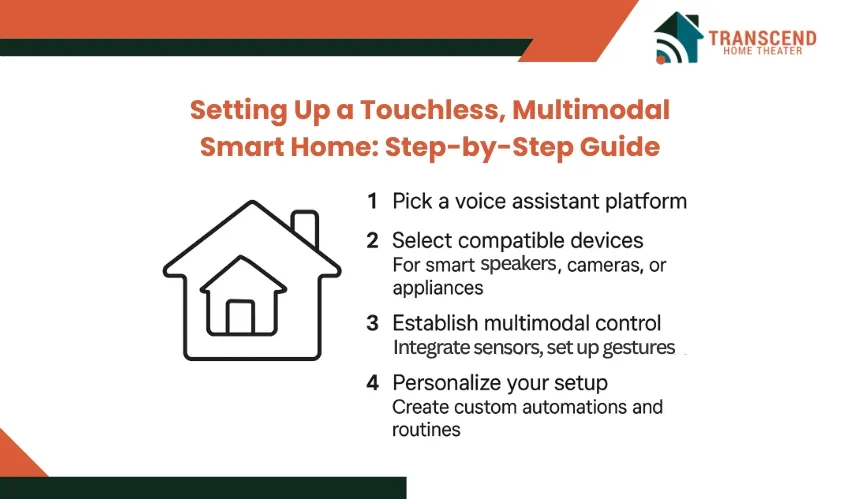
Getting started is easier when the process is clear and simple. The steps below give a direct path from idea to working touchless routines without unnecessary complexity.
Step 1: Define Your Daily Routines and Pain Points
List the moments where you wish the home could respond on its own, such as coming home at night, cooking, or going to bed. These situations will guide which automations matter most.
Step 2: Choose Your Main Ecosystem
Select the voice assistant or platform that fits your style, devices, and privacy needs. Decide whether you want a simple setup or a deeply customizable environment before buying hardware.
Step 3: Select Core Devices and Sensors
Start with essentials such as smart lights, plugs, a thermostat, and a few motion or presence sensors. Make sure each device is compatible with your chosen ecosystem.
Step 4: Create Simple Multimodal Automations First
Build basic routines that combine at least two inputs, such as voice plus motion, or presence plus time of day. Keep them focused on one clear outcome, like lighting a path or setting a scene.
Step 5: Test, Refine, and Expand Gradually
Use the setup for a few days, notice where it feels awkward or slow, and adjust triggers or timing. Once the first routines feel natural, extend them to more rooms and more detailed scenarios.
If you want a home that responds effortlessly to your voice, your routines, and your everyday comfort, the right setup makes all the difference. Reach out to Transcend Home Theater to explore customized home automation solutions that fit your lifestyle.
Frequently Asked Questions
Do touchless smart home systems work well for people with limited mobility?
Yes, touchless systems are especially helpful for individuals with mobility challenges. Voice commands, presence detection, and automated routines reduce the need for physical interaction, making daily tasks easier and more accessible.
Can touchless control work when multiple people are speaking or moving around the home?
Modern systems use advanced audio and sensor processing to separate voices, detect direction, and ignore background noise. This helps them respond accurately even in busy environments.
Will touchless automations still work during internet outages?
Many devices support local processing for essential routines. If the ecosystem or hub includes offline capabilities, core functions such as lighting control or presence-based triggers continue working without internet access.
Are there safety risks with motion or presence sensors in a smart home?
High-quality sensors are designed to detect activity without interfering with normal movement or home safety. They simply read environmental changes and trigger actions without creating hazards.
Can smart homes learn preferences for different people in the same household?
Yes, many platforms now recognize patterns for individual users. Through profiles, voice recognition, and behavior tracking, systems can adapt lighting, temperature, and media settings based on who is present.