
Virtual Reality Meets Home Theater: What’s Coming Next?
Key Takeaways
|
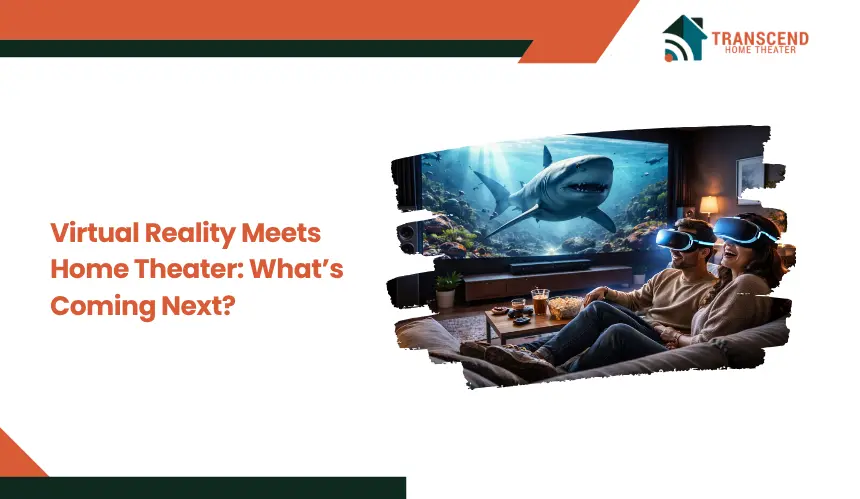
Home theater systems have reached a technical plateau where larger screens and better sound no longer translate into deeper immersion. Viewers are still confined to a fixed perspective, passive storytelling, and environments that cannot adapt in real time.
Virtual reality is introducing a different model, where content is not just watched but experienced within a responsive environment. This shift is redefining how visuals, audio, and user control operate together inside a home setup.
This blog explores how virtual reality is reshaping home theater systems, the technologies enabling it, and what users can realistically expect next.
Why Traditional Home Theater Setups Are Reaching Their Limits
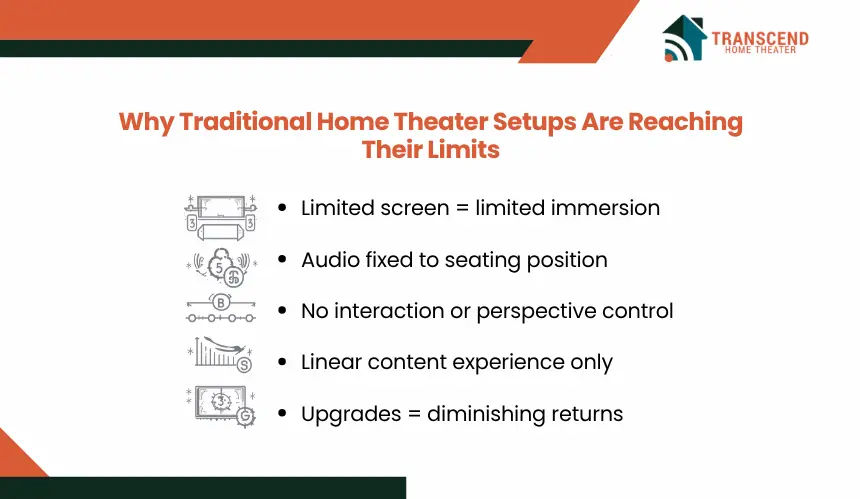
Current home theater systems deliver high resolution and powerful audio, but their architecture is still built around passive consumption. This creates structural limitations that modern immersive technologies are starting to expose.
The viewing experience remains constrained by a fixed display surface. Even with large-format TVs or projection systems, the field of view is limited to the physical dimensions of the screen. This restricts depth perception and prevents the viewer from experiencing true spatial immersion, especially in content designed for expansive environments.
Audio systems, including advanced configurations like object-based surround sound, simulate spatial positioning but cannot dynamically adapt to user movement. The soundstage is calibrated for a fixed seating position, which limits accuracy when the user shifts perspective or position within the room.
Content delivery also follows a linear structure, where scenes unfold from a single, predetermined viewpoint. This prevents any form of interaction or perspective control, which is increasingly expected in modern digital experiences influenced by gaming and interactive media.
As a result, incremental upgrades such as higher resolution displays or additional speakers are delivering diminishing returns. The limitation is no longer hardware performance but the fundamental design of the system itself, which cannot support real-time interaction, spatial awareness, or adaptive environments.
How Virtual Reality Is Redefining the Home Theater Experience
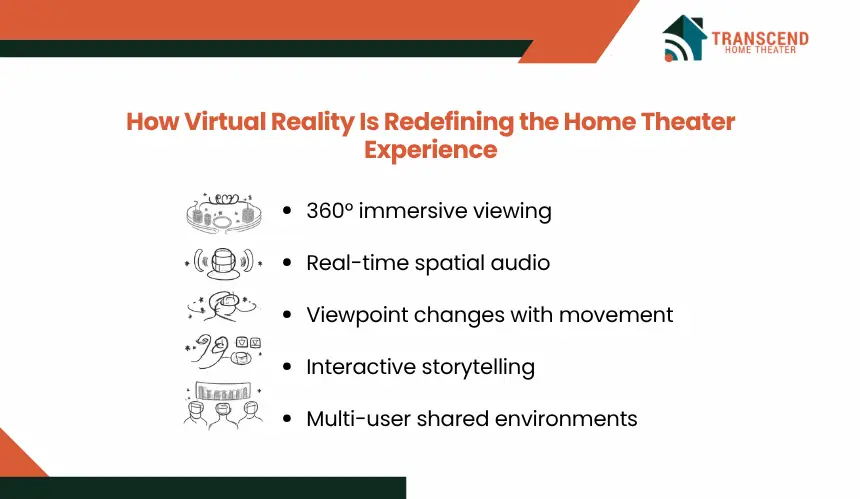
Virtual reality shifts home entertainment from a screen-centered system to an environment-centered system, where visuals, audio, and user interaction operate within a unified spatial framework.
360-Degree Visual Environments Replacing Fixed Screens
VR removes the dependency on a physical display by rendering content across a full 360-degree field of view. Instead of scaling screen size, the system expands the viewing environment itself, allowing users to exist inside the scene rather than observe it externally.
Modern headsets now support ultra-high pixel density per eye, enabling cinema-grade clarity without the constraints of projection distance or room size.
This also allows dynamic environment switching, where a user can move from a traditional theater layout to simulated locations such as open landscapes or enclosed cinematic spaces without changing physical hardware.
Spatial Audio and Real-Time Sound Positioning
Audio in VR environments is processed as a dynamic system rather than a fixed channel layout. Sound sources are mapped in three-dimensional space and adjust in real time based on head movement and orientation.
This creates accurate directional cues where dialogue, ambient noise, and effects maintain spatial consistency relative to the user’s position. Unlike traditional setups, where sound is anchored to speaker placement, VR audio recalculates positioning continuously, improving realism and reducing perceptual disconnect between visuals and sound.
Interactive and Multi-Perspective Viewing
VR introduces interaction at the system level, where user movement and gaze directly control how the environment is rendered. Instead of navigating through predefined camera angles, the system continuously recalculates the viewpoint based on head position and orientation.
This creates a real-time spatial viewing model where visibility, focus, and depth are dynamically adjusted. Multi-user environments extend this further by synchronizing spatial positioning across participants, allowing shared presence within the same virtual theater without altering the content structure itself.
Emerging Technologies Bridging VR and Physical Home Theater Systems
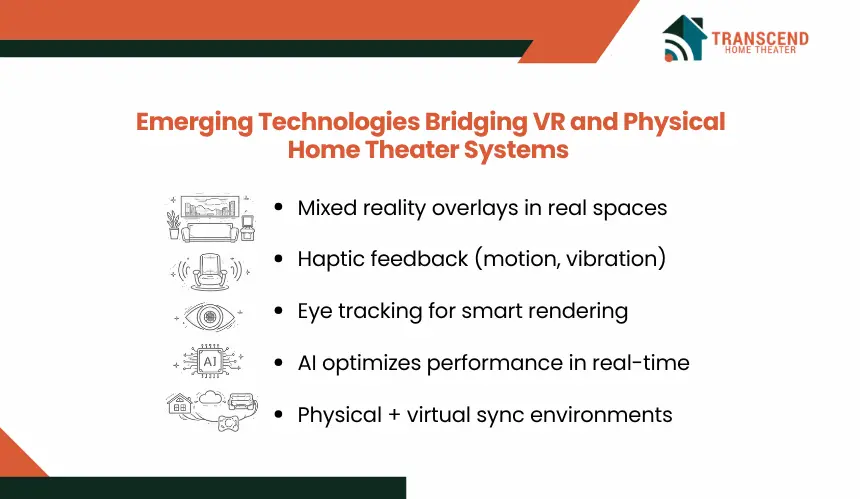
The transition to VR-driven home theaters is not replacing physical setups entirely. Instead, current innovation is focused on integrating virtual environments with real-world spaces to create hybrid systems that retain physical comfort while adding immersive layers.
Mixed Reality Overlays in Physical Living Spaces
Devices like Apple Vision Pro are enabling persistent virtual displays to be anchored within actual rooms. Instead of isolating users inside a fully virtual environment, mixed reality allows digital screens and interfaces to coexist with physical surroundings.
This enables large-scale virtual screens without requiring dedicated wall space, while maintaining awareness of the room layout.
Environmental lighting and reflections can also be synchronized with virtual content, creating visual continuity between digital elements and the physical space.
Shipping hardware is already validating this shift. Apple says Mac Virtual Display in Vision Pro can expand into an ultrawide workspace equivalent to two 5K monitors side by side, and its entertainment mode can present video on a screen that feels 100 feet wide with access to more than 150 3D titles. |
Haptic Feedback and Environmental Simulation
Visual and audio immersion alone do not fully replicate real-world experiences. Haptic systems are being introduced to simulate physical sensations aligned with on-screen events.
Advanced seating systems now integrate vibration patterns, motion feedback, and pressure shifts that correspond to scene intensity. In parallel, connected devices can trigger environmental effects such as airflow or subtle temperature changes, creating a multi-sensory response that aligns with the virtual environment.
Eye Tracking and AI-Driven Rendering Optimization
One of the primary technical constraints in VR is the computational load required to render high-resolution environments in real time. Eye tracking systems address this by enabling foveated rendering, where only the area the user is directly focusing on is rendered at maximum detail.
AI models continuously analyze gaze patterns and adjust rendering priorities, reducing GPU load while maintaining perceived visual quality. This not only improves performance but also lowers latency, which is critical for maintaining immersion and preventing motion-related discomfort.
NVIDIA researchers found that well-tuned foveated rendering can reduce shading work by up to 70 percent without introducing perceivable blur, which is why eye tracking is becoming one of the most commercially important upgrades in premium headsets. |
How Content Is Evolving for VR-Enabled Home Theater Systems
As hardware capabilities expand, the structure of content itself is being redesigned to leverage spatial computing, real-time interaction, and adaptive environments. The shift is not just technical but narrative and experiential.
VR-First Movies and Interactive Storytelling
Content production is shifting toward environment-based storytelling, where scenes are built as spatial volumes rather than edited sequences. Instead of directing attention through fixed shots, creators design narrative layers that exist simultaneously within the environment.
This requires new production workflows such as volumetric capture and real-time rendering engines, where storytelling is structured around spatial continuity rather than timeline progression. The result is content that is inherently designed for immersive systems rather than adapted from traditional formats.
Production pipelines are also evolving to use volumetric capture and real-time engines, reducing reliance on traditional post-production workflows.
Live Events in Virtual Theaters
Live content is being restructured to support immersive attendance rather than broadcast viewing. Sports events, concerts, and premieres are now captured using multi-angle volumetric setups, allowing users to position themselves anywhere within the venue.
This creates a persistent sense of presence where users can move between vantage points without interrupting the stream. Real-time synchronization ensures that all participants experience the event simultaneously, while virtual avatars enable interaction without disrupting the core content experience.
Apple’s 2025 immersive Metallica release used 14 immersive cameras and ultra-high-resolution 180-degree video with Spatial Audio, giving viewers vantage points that conventional concert broadcasts cannot produce. |
AI-Personalized Viewing Environments
Artificial intelligence is being integrated to dynamically adjust the viewing environment based on user behavior and preferences. Instead of static theater settings, the system modifies spatial layout, lighting intensity, and ambient effects in response to content type and user interaction patterns.
Recommendation systems are also evolving beyond content selection to include environment curation. For example, high-intensity scenes may trigger tighter spatial configurations and focused lighting, while slower narratives may expand the environment to reduce visual fatigue. This creates a continuously optimized experience tailored to both content and user engagement patterns.
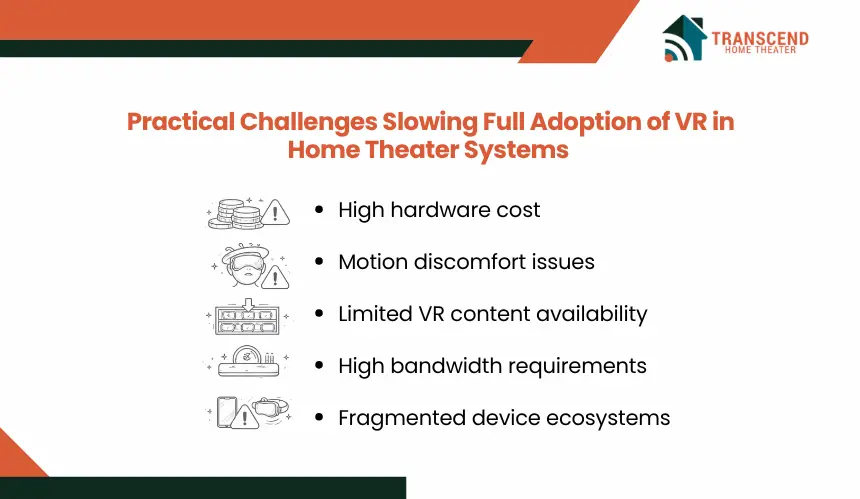
Practical Challenges Slowing Full Adoption of VR in Home Theater Systems
Despite rapid innovation, VR integration in home theater environments is constrained by technical, economic, and ecosystem-level barriers. These limitations directly impact usability, scalability, and long-term adoption.
- High hardware cost and upgrade friction: Advanced VR systems require high-resolution displays, low-latency tracking, and powerful GPUs. For users who already own premium TVs or projection systems, the additional investment creates hesitation rather than a clear upgrade path.
- User comfort and motion consistency issues: Even with improved refresh rates, mismatches between visual motion and physical stillness can cause discomfort during extended viewing. This limits VR’s practicality for full-length movies compared to traditional setups.
- Limited availability of VR-optimized content: Producing VR-first content involves volumetric capture, spatial audio engineering, and real-time rendering workflows. This increases production complexity, resulting in a smaller content library tailored for home theater use.
- High bandwidth and processing requirements: Immersive environments, especially live or multi-user experiences, demand stable high-speed internet and strong local processing. Performance drops directly affect immersion through latency, compression, or sync issues.
- Ecosystem fragmentation across devices and platforms: VR hardware, content platforms, and smart home systems often operate in closed ecosystems. This lack of interoperability increases setup complexity and reduces flexibility when building a unified home theater experience.
What the Next 3–5 Years Will Look Like for VR-Integrated Home Theater Systems
Near-term development is focused on making VR a practical extension of home theater setups rather than a standalone replacement. The direction is toward seamless integration, reduced hardware friction, and tighter alignment with existing home environments.
In regions like Northern Virginia, where high-speed fiber networks and tech-driven households are more common due to proximity to data centers and enterprise infrastructure, early adoption of VR-enabled systems and advanced home theater design and installation is likely to accelerate.
In contrast, Washington DC’s dense apartment layouts create a different use case, where mixed reality displays and compact VR setups become more practical than full-scale physical installations.
Suburban areas across Maryland, especially newer residential developments, are increasingly being built with integrated smart home systems, making them more compatible with synchronized VR environments.
Hybrid Setups Combining Screens and VR
Home theater systems are evolving into dual-mode environments where users can switch between traditional displays and immersive VR without changing the core setup.
This allows high-value use cases to remain on physical screens, such as casual viewing or group watching, while immersive content shifts into VR mode. The system architecture supports synchronized audio, shared content libraries, and unified control interfaces across both modes.
Lightweight, Everyday VR Hardware
Hardware design is moving toward reducing physical strain and improving long-session usability. The transition from bulky headsets to compact, glasses-like devices is a key focus area.
Improvements in battery efficiency, thermal management, and wireless data transmission are enabling longer usage cycles without performance degradation. This directly impacts adoption, as comfort becomes comparable to miwearing standard consumer electronics rather than specialized equipment.
Integration with Smart Home and IoT Systems
VR-enabled home theaters are increasingly being integrated with connected home infrastructure to create coordinated environments.
Lighting systems, climate controls, and ambient settings are being linked to content playback, allowing real-time adjustments that align with scene dynamics. Voice and gesture-based controls are also being integrated to reduce dependency on physical remotes, creating a more fluid interaction model within the home theater space.
Ready to move beyond traditional viewing and experience true immersion? Transcend Home Theater helps bring next-generation setups to life with tailored solutions that align with how you watch, listen, and interact. Explore what a future-ready home theater can look like for your space.
Frequently Asked Questions
Can a VR headset realistically replace a projector or OLED TV for home theater use?
For solo viewing, it increasingly can. Current headsets can create a very large private screen and strong cinematic isolation, which is why many users now consider VR a genuine home-cinema alternative. For shared family viewing, though, a traditional TV or projector still has the advantage because the experience remains headset-first and personal.
What audio setup works best for a serious VR home theater experience?
Low-latency headphones or headset-mounted spatial audio usually work better than trying to force a conventional surround receiver into a head-tracked VR workflow. In user discussions, power users often pair premium headphones with their headset because external speaker layouts do not automatically follow head orientation the way VR audio rendering does.
How long can someone comfortably watch movies in VR before fatigue becomes a problem?
Comfort varies, but shorter sessions are still the safest starting point. Apple’s guidance for Vision Pro recommends beginning with roughly 20 to 30 minutes and building up gradually, which matches the broader reality that facial pressure, heat, eye strain, and motion sensitivity remain practical limits for full-length movie sessions.
Can two people watch the same movie together in VR without it feeling isolating?
Shared viewing is becoming more viable, especially on platforms that support synchronized playback, spatial personas, and shared environments. The tradeoff is that it still depends heavily on both users owning compatible hardware and being inside the same ecosystem, so it is more practical than before but not yet as effortless as turning on a living-room TV.
Should someone with an existing home theater replace it with VR or build a hybrid setup?
A hybrid setup is the smarter near-term move. Traditional screens still handle group viewing, simple controls, and full-room audio better, while VR is stronger for private screenings, immersive 3D movies, and spatial experiences. Current user behavior and product design both point toward coexistence rather than full replacement in the next few years.