
Whole Home Audio vs Portable Speakers: Which Delivers Better Sound?
Key Takeaways:
|
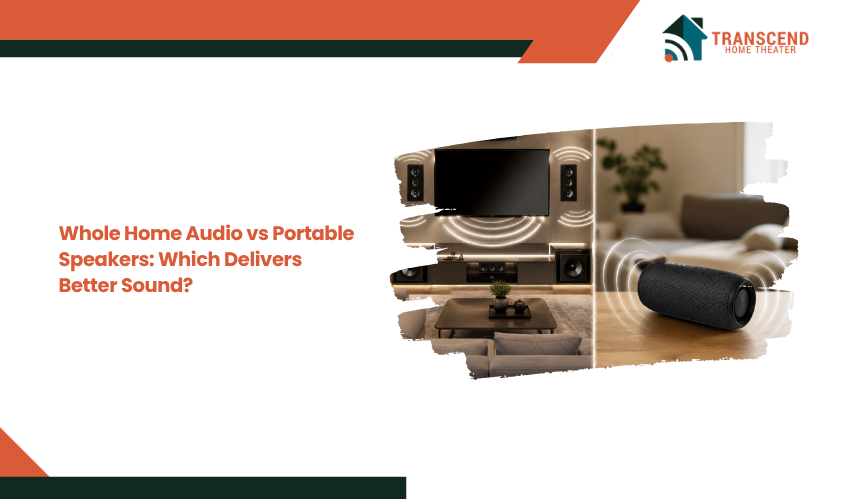
Choosing between a whole home audio system and portable speakers can be difficult because sound quality depends on more than volume alone. Factors such as room coverage, speaker placement, acoustic performance, and long-term usability all influence the listening experience.
While portable speakers offer convenience, dedicated multi-room audio systems are designed to deliver more consistent and immersive sound throughout a home. The right choice depends on listening habits, budget, and how audio is used on a daily basis.
This article compares both options to help determine which solution delivers better sound for different needs.
How Whole Home Audio and Portable Speakers Differ
Both audio solutions are designed to play music, podcasts, and streaming content, but they are built for different listening environments. Their design, power source, and intended use directly influence performance and user experience.
What Does a Whole Home Audio System Include?
A whole home audio system uses multiple speakers installed throughout different areas of a house and connects them through a centralized platform. Depending on the setup, the system may include in-wall speakers, ceiling speakers, amplifiers, receivers, audio matrices, and smart control applications.
Many systems divide the home into audio zones, allowing different rooms to play separate content or synchronize playback across the entire property. Streaming services, voice assistants, and home automation platforms can also integrate with the system for centralized control.
What Defines a Portable Speaker?
Portable speakers are self-contained audio devices designed for mobility and convenience. Most models rely on Bluetooth or Wi-Fi connectivity and include built-in amplification, rechargeable batteries, and onboard controls.
Because all components are housed within a single enclosure, portable speakers require minimal setup and can easily move between rooms, outdoor spaces, or travel locations. Their compact design prioritizes flexibility over permanent installation.
Typical Listening Scenarios for Each
Whole home audio systems are commonly used in larger residences where consistent sound coverage across multiple rooms is a priority. They are often chosen for entertaining, background music, and integrated smart home environments.
Portable speakers are typically used for individual listening, temporary setups, outdoor activities, and spaces where permanent speaker installation is not practical. Their portability allows users to bring audio wherever it is needed without modifying the home.
Which Option Produces Better Sound Quality: Whole Home Audio or Portable Speakers
Sound quality depends on how accurately a speaker reproduces audio and how effectively that sound fills the listening environment. Driver design, room acoustics, coverage area, and speaker placement all influence the overall experience.
Speaker Size and Acoustic Performance
Whole home audio systems generally use larger drivers, dedicated tweeters, and external amplification. These components allow the system to reproduce a wider frequency range with greater detail and higher output levels.
Portable speakers combine all components inside a compact enclosure. Although many premium models deliver impressive performance for their size, physical limitations restrict driver size and cabinet volume, which can affect overall dynamics and low-frequency response.
Room Coverage and Sound Consistency
A whole home audio system distributes sound through multiple speakers placed throughout the house. This approach creates balanced coverage and minimizes volume differences between rooms.
Portable speakers concentrate sound from a single location. As distance increases, sound intensity decreases, which often produces uneven listening experiences in larger spaces.
For example, many newer homes in Northern Virginia feature open-concept floor plans with connected kitchens, family rooms, and dining areas. In these layouts, a distributed audio system can maintain consistent sound across the entire space, while a single portable speaker may struggle to provide even coverage.
Bass Response, Clarity, and Stereo Imaging
Dedicated home audio systems typically produce stronger bass, better instrument separation, and a more defined stereo soundstage. Separate left and right channels create a wider listening image that improves music playback and movie soundtracks.
Portable speakers often rely on digital signal processing to enhance bass and simulate stereo effects. While these technologies improve performance, they cannot fully replicate the depth and spatial accuracy of multiple dedicated speakers.
How Does Speaker Placement Affect Sound Performance?
Speaker placement directly affects clarity, reflections, and sound balance. Whole home audio systems are usually planned around room dimensions and listening areas, which allows sound waves to disperse more evenly.
Portable speakers are frequently placed wherever space is available. Positioning near walls, corners, or furniture can alter bass levels and reduce overall clarity. Proper placement can improve performance, but the flexibility of portable devices often comes with acoustic compromises.
Convenience and Flexibility Comparison Between Whole Home Audio and Portable Speakers
Sound quality is only one part of the decision. Daily usability, control options, and installation requirements often determine which audio solution fits a household more effectively.
Mobility and Portability
Portable speakers are designed for movement. Their battery-powered operation allows users to take music to patios, backyards, garages, pools, and travel destinations without relying on fixed wiring.
Whole home audio systems remain permanently installed. Although they are not portable, they provide immediate access to music in multiple areas without carrying equipment from one room to another.
In many parts of Virginia, outdoor living spaces have become a common extension of the home. Properties in areas such as Fairfax, Loudoun County, and Virginia Beach frequently include covered patios, decks, and outdoor kitchens. Homeowners who regularly entertain outdoors often prefer integrated indoor and outdoor audio zones instead of relocating portable speakers for every gathering.
Multi-Room Control and Smart Features
Whole home audio systems are built around centralized control. Users can adjust volume, select streaming services, and manage different listening zones through a smartphone, touchscreen, or voice assistant.
Portable speakers also support modern features such as Bluetooth connectivity, Wi-Fi streaming, and app-based controls. However, managing several standalone speakers individually may become less convenient as the number of listening areas increases.
Installation Requirements and Setup Complexity
Portable speakers require minimal setup. Pairing a device and charging the battery are often the only steps necessary to begin playback.
Whole home audio systems involve more planning because speaker locations, wiring paths, network connectivity, and equipment placement must work together as a unified system. Professional installation often produces cleaner aesthetics and more reliable long-term performance.
Pro Tip: Network stability has a direct impact on modern audio systems. A strong mesh Wi-Fi network or professionally designed home network can reduce audio dropouts, synchronization delays, and streaming interruptions. This factor becomes increasingly important in larger Virginia homes where multiple smart devices compete for bandwidth simultaneously. |
Cost, Longevity, and Long-Term Value Comparison
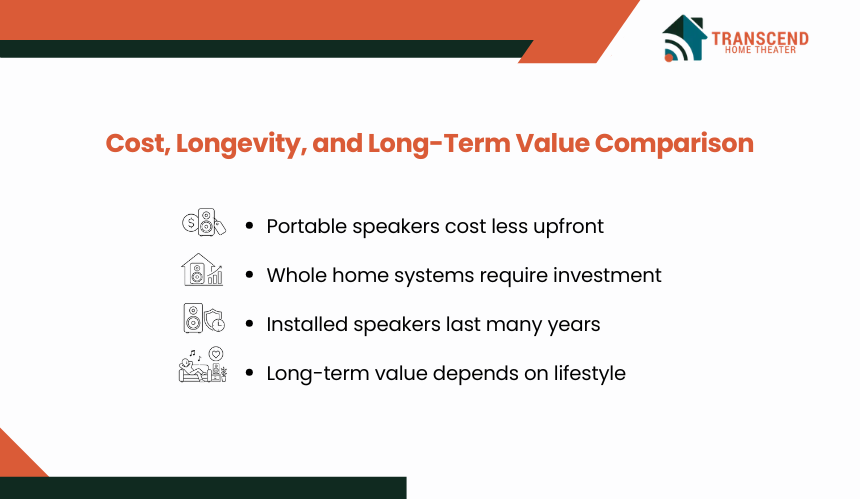
Purchase price alone does not determine overall value. The total ownership experience depends on upfront costs, upgrade potential, equipment lifespan, and how well the system continues to meet changing entertainment needs over time.
How Do Initial Investment Costs Compare?
Portable speakers generally have a lower entry cost because amplification, wireless connectivity, and controls are built into a single device. Entry-level Bluetooth speakers typically range from $50 to $150, while premium portable models from brands such as Sonos, Bose, or JBL commonly cost between $250 and $600 per speaker.
Whole home audio systems require a larger initial investment. A professionally installed two- to four-room system often starts around $2,500 to $5,000, while larger multi-zone systems with architectural speakers, amplifiers, and smart home integration can range from $8,000 to $20,000 or more, depending on the number of rooms and system complexity.
Expandability and Future Upgrades
Many portable speaker ecosystems support pairing and grouping, but expansion is often limited by brand compatibility and the capabilities of individual devices.
Whole home audio systems are designed with scalability in mind. Additional zones, outdoor speakers, subwoofers, streaming sources, and automation features can often be incorporated without replacing the entire system. This modular approach allows homeowners to expand gradually as needs evolve.
Durability and Expected Lifespan
Portable speakers rely heavily on rechargeable batteries. Over time, battery capacity declines, which can shorten playback duration and eventually require replacement or device upgrades. Most portable speakers remain in regular use for approximately 3 to 7 years, depending on battery health and usage conditions.
Whole home audio systems use fixed power sources and permanently mounted components, reducing physical stress on equipment. Quality speakers commonly last 15 to 25 years, and many amplifiers remain functional for more than a decade with proper maintenance.
In many cases, homeowners keep architectural speakers and wiring in place through several generations of technology upgrades. Streaming platforms and control hardware may change, but the core speaker infrastructure often remains usable for decades.
Which Option Delivers Better Long-Term Value?
Long-term value depends on listening habits and usage frequency. Portable speakers provide strong value for users who prioritize flexibility and occasional listening.
For households that regularly use audio across several rooms, a whole home system can deliver a lower cost per listening area over time. Because the infrastructure is intended for permanent use, homeowners often avoid repeatedly purchasing separate devices for different spaces.
Virginia homes often include finished basements, open living areas, screened porches, and outdoor entertainment spaces, which can make connected audio more useful across daily routines and gatherings. For this reason, many homeowners consider whole home audio installation in Virginia a long-term investment in convenience, future upgrades, and consistent sound throughout the property.
The better investment is not necessarily the least expensive option. It is the solution that continues to satisfy performance expectations and lifestyle requirements over many years.
Which Audio Solution Is Better for Different Users?
The better sound system depends on how audio fits into daily life. Listening habits, home layout, and entertainment priorities often determine which option delivers the most practical value.
When Does Whole Home Audio Make More Sense?
Whole home audio systems are often the better choice for homeowners who want a seamless listening experience across multiple spaces. They are commonly selected for primary residences where music, podcasts, television audio, and streaming services are used throughout the day.
A distributed audio system may be a strong fit for:
- Large homes with several living areas
- Households that frequently host guests
- Smart homes with integrated automation systems
- Homeowners planning long-term property upgrades
- Families that want synchronized indoor and outdoor audio
Because the system becomes part of the home’s infrastructure, it can support changing entertainment needs without relying on separate devices in every room.
When Are Portable Speakers the Better Fit?
Portable speakers are often more suitable for users who prioritize simplicity and mobility. They provide an accessible solution without requiring installation, wiring, or dedicated equipment locations.
Portable speakers may be ideal for:
- Apartments and rental properties
- Occasional listeners
- Students and frequent travelers
- Outdoor activities and temporary gatherings
- Buyers working with limited budgets
Their flexibility allows users to enjoy audio in different locations without making permanent modifications to the property.
What Questions Should Be Asked Before Choosing?
Before selecting either option, homeowners should evaluate how the system will actually be used. A clear understanding of daily habits often leads to a better investment decision than focusing on specifications alone.
Consider these questions:
- How many rooms require audio coverage?
- Is portability more valuable than permanent convenience?
- Will the system support music only, or television and home automation as well?
- Is future expansion a priority?
- How often is the audio system used each week?
In many cases, households seeking maximum sound quality, consistent coverage, and long-term usability gravitate toward whole home audio systems. Users who value flexibility and lower upfront costs often find portable speakers to be the more practical choice.
Looking to create a more connected entertainment experience? Transcend Home Theater provides professional home automation and whole home audio solutions designed around the way each household lives and listens. Serving homeowners across Virginia, Maryland, and Northwest DC, the team delivers customized systems that bring music, technology, and smart home control together with seamless integration.
Frequently Asked Questions
Can whole home audio be added to an existing house without major remodeling?
Whole home audio can often be added to an existing house without major remodeling, especially when wireless control systems, attic access, crawl spaces, or unfinished basements are available. Professional installers can route low-voltage speaker wiring discreetly or use hybrid systems that combine wired speakers with wireless streaming components.
Is Wi-Fi audio better than Bluetooth for home listening?
Wi-Fi audio is usually better for home listening because it supports higher bandwidth, longer range, multi-room playback, and stronger connection stability. Bluetooth works well for short-range portable use, but Wi-Fi streaming is more suitable for synchronized speakers, lossless audio formats, and smart home audio integration.
What happens to a whole home audio system if the internet goes down?
A whole home audio system may lose access to cloud-based streaming services when the internet goes down, but local sources can still work if the system is configured properly. Stored music, television audio, receivers, and wired inputs may continue operating through the home network or direct audio connections.
Are outdoor speakers better than using a portable speaker on the patio?
Outdoor speakers are usually better for patios, decks, and pool areas because they are designed for weather resistance, wider sound dispersion, and permanent placement. A portable speaker can work for casual use, but it may struggle with open-air coverage, battery limits, and consistent volume across larger outdoor spaces.
Can whole home audio connect with TVs and home theater systems?
Whole home audio can connect with televisions, media rooms, and home theater systems when the design includes compatible receivers, amplifiers, audio zones, or control processors. This allows homeowners to route TV sound, music, and streaming content through selected rooms instead of relying only on built-in television speakers.
Does a whole home audio system need regular maintenance?
Whole home audio systems require limited maintenance, but periodic checks can protect performance. Homeowners may need firmware updates, network reviews, app updates, amplifier inspections, and speaker testing. Maintenance becomes more useful when the system includes outdoor speakers, smart home controls, streaming devices, or multiple audio zones.