
Wired vs. Wireless Smart Homes: Pros, Cons & Hybrid Solutions for New Builds
A Quick Answer: Wired smart homes rely on physical cabling that delivers stable connectivity, low latency, and consistent device performance. Wireless smart homes depend on Wi-Fi and mesh networks that offer easier installation, flexible device placement, and quicker expansion. The core difference lies in how each system handles reliability, speed, range, and long-term scalability. Many new builds benefit from a hybrid approach because it combines the strength of a wired backbone with the adaptability of wireless devices. |
Homeowners planning new construction want systems that feel dependable, responsive, and ready for future upgrades. Understanding how each infrastructure supports automation protocols, connected devices, and network stability helps readers make confident decisions early in the design process.
This blog will cover how wired, wireless, and hybrid smart homes compare, when each option works best, and how to plan the right setup for a new build.
What Defines a Smart Home Network Today?
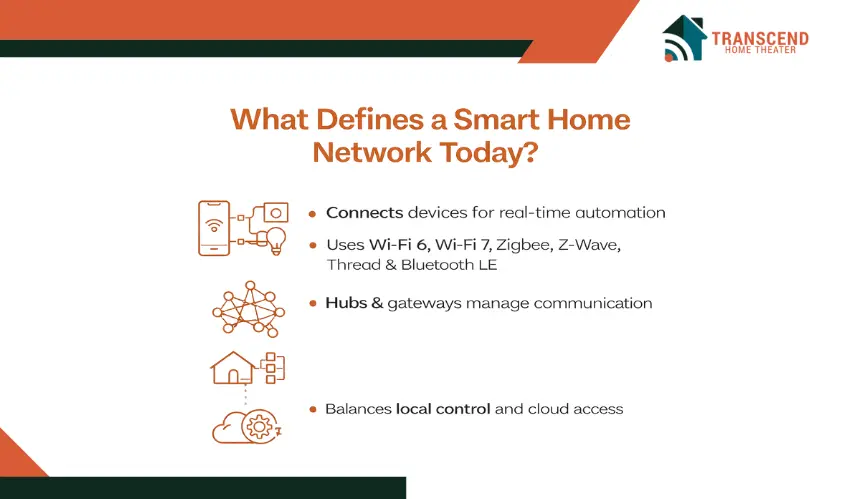
A modern smart home network is the system that allows connected devices to communicate, automate tasks, and respond to user commands in real time. It includes components such as sensors, smart switches, lighting controls, thermostats, cameras, and voice assistants that interact through coordinated communication paths.
Current smart homes operate through a mix of connectivity standards that shape performance and reliability. Wi-Fi 6, Wi-Fi 7, Zigbee, Z-Wave, Bluetooth Low Energy, and Thread all support different levels of range, bandwidth, and energy use.
Together, these protocols create the communication layer that determines how quickly devices respond, how far signals travel, and how seamlessly platforms integrate with one another.
Control hubs, bridges, and gateways bring these elements together by managing device pairing, local processing, automation logic, and remote access. Some systems rely more on cloud connectivity, while others prioritize local control for faster response time and added stability.
Wired Smart Home Systems Explained
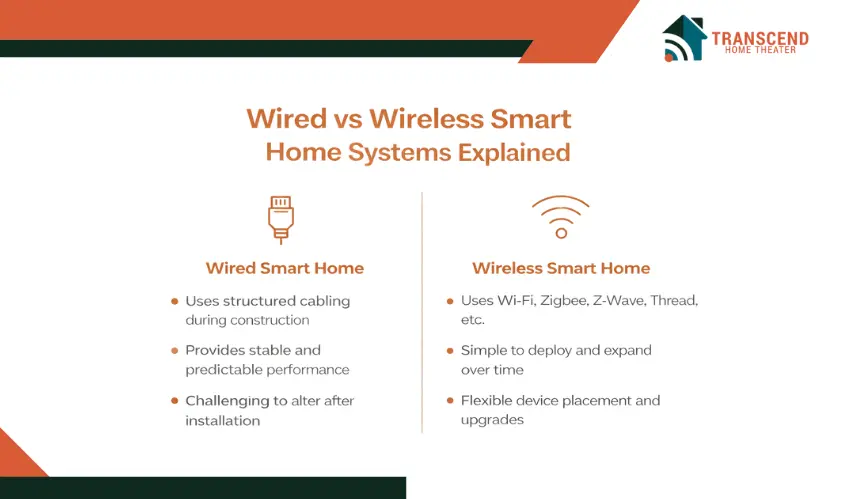
Wired smart home systems form the physical foundation of many high-performance automation setups. They use structured cabling, hardwired controllers, and dedicated pathways that allow devices to communicate with precision and stability. This type of infrastructure is often chosen during new construction because it offers predictable performance and long-term scalability.
How Do Wired Smart Home Systems Work?
Wired systems operate through low-voltage cabling such as Cat6 or Cat7 that connects switches, sensors, security cameras, audiovisual equipment, and automation processors.
These cables create direct communication routes that avoid congestion and signal loss. By sending data through physical wiring instead of radio frequencies, the network maintains consistent speed and supports real-time control across the home.
What Are the Advantages of Using a Wired Smart Home Setup?
A wired layout provides stronger reliability, faster device response, and higher bandwidth for data-heavy tasks. It reduces interference from appliances, walls, and neighboring networks, which helps automation remain stable even in large or multi-level homes.
Hardwiring is especially valuable for whole-home audio systems, lighting control panels, distributed video, and professional-grade security equipment.
Are There Any Limitations to Wired Smart Home Systems?
Wired systems require planning during construction because cable routes, distribution panels, and access points must be installed before walls are closed. This increases installation time and labor cost. They are also more challenging to modify after the build is complete, which limits flexibility for future layout changes. Despite these considerations, many homeowners accept these trade-offs to gain stronger long-term reliability.
When Are Wired Systems the Best Choice for a Home?
Wired setups work best in new builds, large properties, and homes that depend on advanced automation or heavy audiovisual distribution. They support systems that require continuous uptime and precise performance, such as surveillance networks, integrated lighting, media rooms, and access control. For homeowners prioritizing stability and low-latency control, a wired foundation delivers dependable results.
Wireless Smart Home Systems Explained
Wireless smart home systems rely on radio-based communication to connect devices throughout the home. They use Wi-Fi networks, mesh protocols, and low-power communication standards, making them attractive for homeowners who want easy setup, flexible device placement, and room to expand without major construction work.
How Do Wireless Smart Home Systems Operate?
Wireless systems use communication protocols such as Wi-Fi, Zigbee, Z-Wave, Bluetooth Low Energy, and Thread to transmit data between devices and automation platforms.
These signals travel through access points or mesh nodes that extend coverage across rooms and floors. Because no physical cabling is required, devices can be moved or replaced without altering the home’s structure.
What Are the Advantages of Using a Wireless Smart Home Setup?
Wireless networks make it simple to add new sensors, switches, or smart appliances. Homeowners can upgrade device types or change automation routines with minimal technical effort.
This flexibility makes wireless systems ideal for smaller homes, rental properties, and users who prefer a gradual adoption of smart technology. Quick installation and budget-friendly expansion options add to their appeal.
What Limitations Should Homeowners Consider With Wireless Smart Home Systems?
Wireless performance can be influenced by distance, building materials, and household interference. Devices that rely heavily on Wi-Fi may experience slower response times if the network becomes congested.
Wireless standards also vary in range and stability, which can affect communication between rooms or floors. These limitations can be reduced with stronger routers, mesh nodes, or upgraded protocols, but careful network planning is still required.
When Are Wireless Smart Home Systems the Best Choice?
Wireless systems work well for small to mid-sized homes, apartments, and spaces where running cable is impractical. They are also ideal for homeowners who want immediate convenience without construction planning.
Their scalability allows users to start with a few essential devices and expand as needs evolve. This makes wireless automation a practical entry point into smart home technology.
Hybrid Smart Homes: Combining the Best of Both Worlds
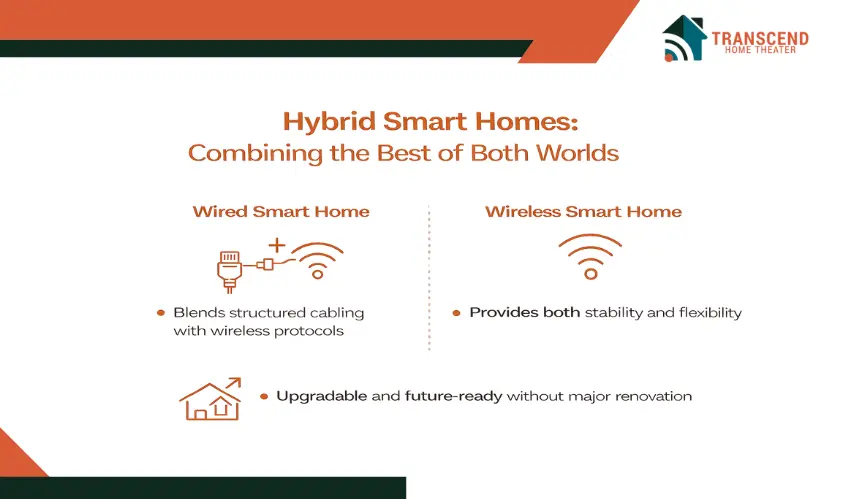
Hybrid smart home systems merge the reliability of wired infrastructure with the flexibility of wireless devices. This approach allows builders and homeowners to create a balanced environment that supports high-performance automation while maintaining room for updates.
It is increasingly favored in new construction because it offers long-term adaptability without sacrificing stability.
What Makes a Hybrid Smart Home System Unique?
A hybrid setup blends structured cabling for critical systems with wireless protocols for devices that benefit from mobility. Hardwired connections support components such as lighting panels, security cameras, network backbones, and audiovisual distribution.
Wireless devices, including sensors, smart locks, and thermostats, are layered on top of the wired foundation to allow easy upgrades and placement changes.
Why Do Builders Prefer Hybrid Smart Home Systems in New Construction?
Hybrid layouts are widely recommended because they combine the dependable performance of wired pathways with the adaptability of wireless devices. Smart home installers value this balance since hardwired connections support components that need consistent speed and stability, while wireless elements make it easier to expand the system, reposition devices, or integrate new technologies.
This approach helps keep the home’s automation infrastructure future-ready and compatible with emerging platforms and standards.
Which Devices Work Best in a Hybrid Smart Home Setup?
Devices that require constant uptime or high throughput benefit from wired installation. This includes surveillance cameras, lighting control modules, media distribution systems, and central automation processors.
Wireless devices are more suitable for components that may need repositioning or frequent upgrading, such as contact sensors, smart locks, environmental monitors, and portable controls.
Wired vs. Wireless vs. Hybrid: Key Differences at a Glance
The table below outlines the core functional differences between wired, wireless, and hybrid systems, focusing on reliability, installation requirements, scalability, security considerations, device support, and ideal use cases.
Feature / Factor | Wired Smart Home System | Wireless Smart Home System | Hybrid Smart Home System |
Performance Stability | Very high stability with consistent speed | Varies depending on signal strength and network congestion | High stability due to a wired backbone with wireless flexibility |
Latency and Response Time | Fast response due to physical cabling | Slower response when signals are obstructed or overloaded | Optimized response time by balancing both layers |
Security Level | Strong security through closed physical connections | Dependent on encryption, authentication, and router security | Enhanced security with wired critical devices and encrypted wireless accessories |
Installation Requirements | Requires structured wiring during construction | Simple installation with no cables required | Wiring added where needed while keeping the rest wireless |
Scalability | High but depends on pre-planned wiring routes | Very flexible with easy device additions | Strong scalability that supports both stable wiring and wireless expansion |
Best Uses | Large homes, high-performance automation, AV distribution, surveillance | Small to mid-size homes, rentals, gradual smart home adoption | New builds seeking long-term reliability and flexible upgrades |
Estimated Cost Level | Higher upfront cost due to cabling and labor | Lower initial cost, higher over time if upgrades are needed | Moderate cost with long-term value and reduced future rewiring |
Device Compatibility | Works best with high-demand or hardwired devices | Ideal for sensors, smart locks, and portable devices | Suitable for a wide mix of wired and wireless categories |
Planning a Smart Home for New Construction
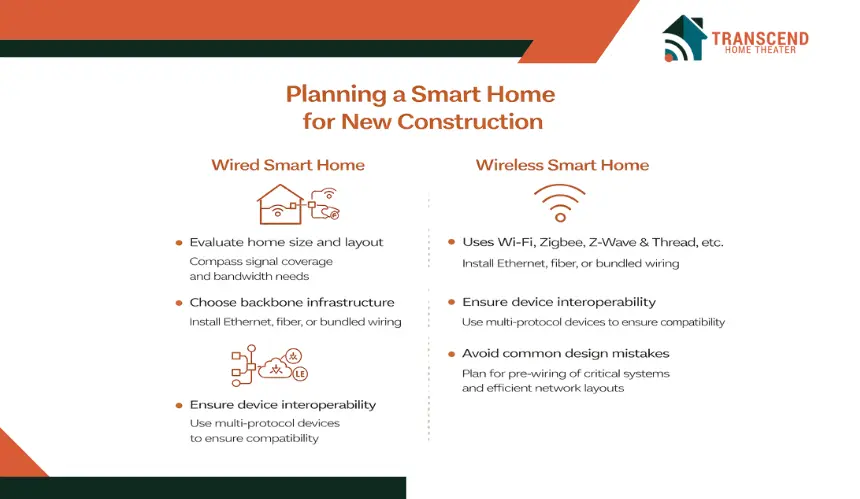
Designing a smart home during the construction phase gives homeowners the chance to create a strong, expandable foundation that supports future devices and evolving automation standards.
How Should Home Size, Layout, and Network Needs Be Evaluated for Smart Home Construction?
Evaluating the home’s size and layout is essential because it influences how signals travel, where wiring routes should be placed, and how reliably devices communicate across rooms.
Industry assessments show that wireless signals can when passing through dense construction materials such as concrete or brick, which makes early layout analysis important for planning access point placement and structured wiring.
Larger homes often require multiple wiring drops or mesh nodes, since properties over 2,500 square feet frequently need two or more access points to maintain even coverage.
Floor count, room function, and entertainment zones also affect network planning. High-demand areas such as media rooms, offices, or gaming spaces can consume significantly more bandwidth than standard rooms, and these spaces often benefit from dedicated wiring to maintain stable performance.
Which Backbone Infrastructure Is Best for a New Build Smart Home?
The backbone of a smart home can be built using several types of structured wiring that support fast and reliable communication. Ethernet cabling such as Cat6 or Cat7 is the most common option because it provides strong throughput for automation controllers, access points, and media systems.
Fiber cabling offers even higher bandwidth for homes that expect heavy data use or long-term scalability. Some installations use structured wiring bundles that combine Ethernet, coaxial, and audio cabling in one sleeve to simplify routing during construction.
The best choice depends on bandwidth needs, the number of connected devices, and the homeowner’s long-term upgrade plans. Placing a structured wiring cabinet or distribution panel in a central location keeps all routes organized and makes it easier to expand the system later.
How Can Homeowners Ensure Device Interoperability in Smart Homes From the Start?
Selecting devices and platforms that support multi-protocol communication helps avoid compatibility issues. Systems built around Matter, Thread, Zigbee, or Z-Wave provide flexibility when adding sensors, lighting, or control hubs later. Planning interoperability early prevents lock-in to a single brand and keeps the system adaptable as new devices become available.
What Design Mistakes Should Be Avoided During Smart Home Construction?
Thoughtful planning prevents performance issues that often appear once a smart home is fully occupied and running multiple systems at the same time.
Identifying common mistakes early helps ensure the infrastructure supports stable connectivity, smooth automation, and long-term upgrade options.
1. Relying Solely on Wi-Fi for Critical Systems
Many homeowners underestimate how many devices will connect over time. When Wi-Fi becomes overloaded, response times slow down and automation scenes become unreliable.
Homes with thick walls or long distances between rooms experience more dead zones, which creates inconsistent performance.
2. Failing to Pre-Wire Essential Locations
Skipping wiring for fixed systems such as security cameras, media rooms, or lighting control panels often leads to performance issues later. These devices benefit from stable, hardwired connections, and adding wiring after construction becomes costly and invasive.
3. Placing Access Points in Inefficient Areas
Access points positioned too close to walls, corners, or appliances reduce coverage and cause signal loss. Smart home installers recommend locating them in open, central spots where signals can spread evenly across floors and rooms.
4. Ignoring Ventilation for Network Hardware
Routers, hubs, and distribution panels generate heat during operation. When they are installed in cramped or poorly ventilated spaces, overheating can lead to lag, intermittent connectivity, and shortened equipment lifespan.
5. Overlooking Potential Network Bottlenecks
Homes that group too many high-demand devices onto a single path often experience slowdowns. Distributing workload, separating networks when needed, and allocating dedicated wiring to bandwidth-heavy components helps maintain smooth operation.
Ready to build a smart home that feels seamless in every room? Transcend Home Theater can help you design a system that fits your space, supports your goals, and stays effortless to use as your needs evolve. Our team brings clarity to wiring choices, network planning, and device integration so your home is built for performance from day one.
Frequently Asked Questions
How do smart home systems stay compatible as new devices and standards are released?
Modern smart home ecosystems stay compatible through multi-protocol hubs, firmware updates, and platforms that support emerging standards such as Matter and Thread. These updates allow older devices to communicate with newer ones, and they help ensure that automations continue working even as technology evolves.
Can artificial intelligence improve smart home automation in new builds?
Artificial intelligence enhances smart homes by learning user habits, predicting preferred settings, and adjusting routines based on environmental changes. AI-driven suggestions can optimize lighting, energy usage, heating, and security, making the home more responsive without requiring manual adjustments.
What role do energy-efficient devices play in a long-term smart home plan?
Energy-efficient devices reduce ongoing operating costs and help homeowners track electricity consumption more accurately. Smart thermostats, low-power sensors, and energy-monitoring plugs give users real-time insights and support greener home management strategies.
Is it possible to integrate wellness-focused technology into a smart home?
Wellness technology can be integrated through systems that monitor air quality, manage circadian lighting, track indoor humidity, or automate purification equipment. These tools help maintain a healthier living environment and personalize comfort based on daily routines.
How do smart home systems support aging-in-place or accessibility needs?
Smart homes support accessibility through voice control, automated lighting paths, fall-detection sensors, remote monitoring tools, and adaptive routines that simplify daily tasks. These features help individuals maintain independence while providing families with added peace of mind.
Can smart homes reduce maintenance issues for homeowners?
Yes. Smart leak detectors, appliance monitoring tools, HVAC diagnostics, and predictive maintenance alerts help homeowners address small issues before they become costly repairs. These early warnings extend equipment lifespan and reduce unexpected breakdowns.